Monday, January 17, 2011

Review: The Quiet Gentleman by Georgette Heyer


The Quiet Gentleman
By: Georgette Heyer
Publisher: Harlequin
ISBN: 0373836848

About the book:

An unwelcome return…

When Gervase Frant returns home unscathed from the wars to claim his title as the new Earl of Stanyon, he senses his stepmother’s resentment and his half brother’s open disdain. Now he must establish himself as the new head of the house…and ignore his family’s rising hostility.

Then Gervase’s eye is caught by a lovely young woman – the same woman already much in favor with his half brother. Now the brothers are rivals as they bid for the lady’s affections. But as Gervase struggles to maintain a gentlemanly balance, he begins to find himself the victim of repeatedly cruel accidents. Soon it becomes increasingly clear that someone wants the new Earl of Stanyon dead…

Review:

Georgette Heyer novels should be printed with a warning. I have to be careful when reading her novels in public. This is because they inevitably cause a goofy smile to be pasted on my face, and I’ll start giggling loudly at random times for no apparent reason to the poor, unsuspecting public around me. The Quiet Gentleman is no exception to this rule. Absolutely nothing beats a Heyer Regency romance for the sheer enjoyment factor and witty, intelligent humor. She truly is the closest thing to reading Jane Austen – and is generally more hilarious. The Quiet Gentleman is the perfect combination of mystery and romance. The whodunit aspect of the novel is so carefully plotted that the revelation of the guilty party is an eyebrow-raising surprise. And with the romance, Heyer once again succeeds in bringing together two seemingly irreconcilable individuals who turn out to be, of course, perfect for each other. To all you fellow Austen lovers out there – if you’ve never read a Heyer, and my enthusiasm still hasn’t convinced you to pick one up, read The Quiet Gentleman for the pure novelty factor that the hero can be named Gervase Frant and still be incredibly hot. Unbelievable, but trust me, it’s true. *wink*

***

I originally reviewed The Quiet Gentleman back in September 2006 on my old blog. Since this review has never made it to my new blogging home, I thought it was high time I re-posted it here, especially since I am participating in the Georgette Heyer Reading Challenge this year. I did not re-read this novel for the challenge, it's simply the only Heyer novel I've formally reviewed to date (shockingly unforgivable, I know!).

If you're friends with me on Goodreads you may have noticed that I'm currently about halfway through my first selection for the Heyer Reading Challenge - The Reluctant Widow - and it is every bit as delightful and hilarious as every other Heyer Regency that I've ever read. The woman was a genius! Review coming soon!

My mass market edition of The Quiet Gentleman is sadly out of print, but Sourcebooks is re-releasing the novel later this year with a gorgeous new cover (just in case you're interested!). :)

Saturday, January 15, 2011

Primeval 4.2


So, I realize this review is horribly late since episode three airs tonight, but what can I say? I was seriously distracted by Downton Abbey blogging this week. :) Episode two of this season of Primeval opens with a flashback to five years ago, when a random woman found a creepy lizard-like creature ransacking her living room and flushed it down the toilet. If you can ignore the logisitics of that actually working (that lizard was HUGE - seriously what are toilets like in the UK? LOL), it is nice to see the show address what happened to creatures who came through anomalies before the creation of the ARC. Flash-forward to the present, and we find Connor (Andrew Lee Potts) and Abby (Hannah Spearitt) being debriefed by Matt (Ciarán McMenamin) following their return after a year-long absence through an anomaly. The standout performances in this episode easily belong to Connor and Lester (Ben Miller). The ever-prickly Lester continually goes to bat for Connor and Abby - of course, he only compliments them when they aren't around. One has to maintain one's imagine, no? *wink* Besides revealing that yes, he does indeed have a heart, it's fun to watch Lester cope with Philip Burton (Alexander Siddig), the billionaire investor who funds 50% of the ARC's operations. Philip doesn't seem to really have a point, other than to undermine and annoy Lester. Hopefully the showrunners have a master plan for his character, otherwise I fear he is destined to simply clutter up the team.

This episode was a great venue for showcasing Connor's personal journey since the show began. Dismissed from the team thanks to the new "army experience" rule, and with no immediate prospects in sight, Connor decides to do a little creature sleuthing on his own. He runs across an old friend from his college days - Duncan, played by James Bradshaw. Duncan was part of Connor's gang of college friends - all conspiracy loving geeks. The group was torn apart when Connor joined the ARC team, and one of their number was killed by poisonous dodos (seriously, it was creepier than it sounds) in episode four of Series One. Duncan has really regressed, I guess you could say, while Connor has managed to mature (most of the time, haha)thanks to the faith Professor Cutter placed in him early in the show. This episode was a reminder that it easily could have gone the other way for Connor. Duncan and Connor's scenes were also a lot of fun, especially at the end of the episode when Duncan congratulates Connor on "making it" by dating Abby - Connor's geeked-out response, and then his quick reversal when he returns to join Abby in the car is hilarious to watch, and very well played by Potts.

I was only annoyed by Jess (Ruth Kearney) approximately 50% of the time she was on-screen this time around. She seems to be a genuinely nice person, in spite of the slightly creepy way she keeps talking about "knowing" everyone since she's read their files (over and over and over again in the case of Becker, methinks!). What I would like to know is what the heck is the pay scale at the ARC? Because Jess's apartment is RIDICULOUSLY nice. Not to mention ridiculously furinished - you couldn't help but notice that she has four rotary phones, lined up to spell out her name. Is that some stupid trend I'm not aware of? LOL! However, her crushing on Becker (Ben Mansfield) is still painfully awkward. But I LOVE the fact that he's not giving an inch - and the scene at the end where he remembers to bring her chocolate was kinda cute.

I was pretty pleased with the creature/chase portion of the show. As far as the world of the show goes, having the Kaprosuchus terrorizing a homeless community living near its lair felt like a pretty believable set-up. However, Jess's insessant online stalking of Matt when he leaves the ARC to follow Connor and Abby to the creature site really annoyed me after about sixty seconds. I just feel like there has to be a better way to prove her worth to the team than her penchant for nosiness...but maybe that's the route the showrunners are taking, so who knows?! *sigh* Which brings me to Matt...what kind of team leading idiot goes into the field with no weapon? I really want to like Matt's character, since I do like McMenamin, but he's so stiff on-screen it's hard to really get a feel for the character. I will be shocked if Matt doesn't get eaten by a creature before the end of this season - with his continued meetings with Gideon (Anton Lesser), and hazy motivations, I'm guessing he's doomed.

I really liked the chase through the container yard at the docks. That was a nicely creepy, tense set up, since with the containers stacked high, and everything looking the same, it would be quite frightening to be tracking down a rogue dinosaur in such a constricted area. It was also fantastic to see Connor prove himself in the field. We all knew they *had* to let him back on the team, but nonetheless it was fun to see him prove his mettle. And the final scene, where he confronts Lester demanding his job back, not knowing things have already been decided in his favor - that, my friends, was one of my favorite moments in the entire series. Lester's deadpan delivery of "well, you're back on the team" and Connor taking full credit for it and high-fiving Becker was absolutely HILARIOUS. Andrew Lee Potts had me laughing so hard, so many times in this episode - he really is the heart of the show now, and deservedly so in my opinion.

Looking forward to tonight's episode, which promised the arrival of humans through an anomaly (I doubt it's Helen reincarnated, but you never know with this show). Here's hoping that the show finds a point for Philip and Gideon soon, and that maybe, maybe Matt loosens up a bit.

Thursday, January 13, 2011

Review: The Silent Governess by Julie Klassen


*2010 INSPY Award Nominee for Historical Fiction*

By: Julie Klassen
Publisher: Bethany House
ISBN: 978-0-7642-0707-5

About the book:

Olivia Keene is fleeing her own secret. She never intended to overhear his.

But now that she has, what is Lord Bradley to do with her? He cannot let her go, for were the truth to get out, he would lose everything - his reputation, his inheritance, his very home.

He gives Miss Keene little choice but to accept a post at Brightwell Court, were he can make certain she does not spread what she has heard. Keeping an eye on the young woman as she cares for the children, he finds himself drawn to her, even as he struggles against the growing attraction. The clever Miss Keene is definitely hiding something.

Moving, mysterious, and romantic, The Silent Governess takes readers inside the life of a nineteenth-century governess in an English manor house where all is not as it appears.

Review:

Aspiring schoolmistress Olivia Keene’s quiet life is cruelly disrupted when she saves her mother from a vicious attack and in the aftermath is forced to flee, believing herself guilty of a heinous crime. Alone and frightened, with only the vague hope of securing a position thanks to her mother’s recommendation, Olivia stumbles onto Brightwell Court. An unfortunate misunderstanding and a brutal attack leave Olivia at the mercy of the heir of the manor, Lord Bradley. For Olivia has overheard a desperate family secret, and in order to secure his future Edward sees no other option than to keep the beautiful stranger who holds his future in her hands a virtual prisoner in his home. Though her “prison” is a gilded one, Olivia longs for her freedom, even while the desperate circumstances that forced her flight from home weigh heavy on her heart. But the residents of Brightwell Court begin to wend their way into Olivia’s heart – Edward’s young cousins, starved for a mother’s love, provide Olivia with the opportunity to step into the role of governess. And Edward’s pride and fear, which had made Olivia an unwilling resident of Brightwell, prove to mask the kind heart of a gentleman. But secrets cannot remain hidden forever, and Olivia’s reticence to admit her past and Edward’s desperate attempts to hide the secret of his birth threaten to destroy any hope of happiness for the unlikely pair. Seemingly thrown together by chance, Olivia and Edward must each discover that only grace can cover the secrets they are so desperate to keep unspoken, or they may lose their chance at a future brighter than they’d ever dreamed.

I found the exploration of a governess’s lot in life to be absolutely fascinating. Each chapter opens with a quote that eloquently speaks to the theme found within the subsequent pages, many of them newspaper clippings or snippets from 19th century texts describing the duties and perception of governesses by their employers. Olivia’s position as governess at Brightwell Court is a heart-rending example of the cost and sacrifice devoting one’s life to the children of others. Outside the family yet intimately connected with it through the children, and forbidden from socializing with household servants, the lot of women like Olivia was a lonely one, wholly dependent upon the whims of their employers. While Olivia struggles with the enforced solitude, her status in the household gives her the unique position to observe the secrets and relationship dynamics at work in Edward’s home, and her intelligence and empathy make her an asset to the family and an enemy to be eliminated to their foes. In addition to Olivia, Klassen peoples her world with a host of well-drawn characters, from the Edward’s father, Lord Brightwell, who has an unexpected tie to Olivia’s mother that could chang her her future forever, to the crotchety gamekeeper Croome, whose gruff manner hides secrets capable of rocking the carefully ordered world of Brightwell Court to the core. With The Silent Governess, Julie Klassen has created a world for the reader to lose oneself in, filled to the brim with well-drawn, beautifully flawed characters who are so real, so authentic they leap from her descriptive prose fully formed in the mind's eye.

Klassen’s third novel was like a love letter to my Regency-loving heart. The Silent Governess possesses the intricacy of Austen mixed with the passionate romance and secrets of Jane Eyre, a potent combination that results in an unforgettable novel. The story is saturated with an atmosphere of historical authenticity and compelling secrets that will keep you turning pages well into the night. The touch of mystery and the beautifully restrained romance that Klassen develops between Olivia and Edward will steal your breath away. The simmering combination of secrets and passions that lie buried within The Silent Governess result in a compelling, lushly romantic historical that I’d happily name as a worthy heir to the novels that inspired it, such as Jane Eyre. The faith element is deftly woven throughout the novel, never overpowering the story, and feels completely authentic to the time period. I loved Klassen’s exploration of the cost of secrets, and the freedom found in relinquishing one’s fears and plans to the God capable of redeeming all one’s regrets. Though this was my first Klassen novel it most certainly will not be my last. With its heady combination of mystery and romance amid the vibrantly recreated world of 19th-century England, The Silent Governess is a story to savor, romantic escapism at its finest.

Downton Abbey continues Sunday!

Well I'm sure it's no surprise that I can't WAIT for Part Two of Downton Abbey to air on Masterpiece Classic this Sunday! Here's a brief teaser about what we have to look forward to in this series' second installment:
The hit series Downton Abbey continues Sunday, January 16, 2011 on MASTERPIECE CLASSIC. Mary entertains three suitors, including a bold Turkish diplomat. Meanwhile, the former life of Carson, the butler, is revealed, and Bates risks his health to remain valet.
Hmm, Mary is headed for trouble, I just know it. And I don't know how I'm going to take more of Bates's heartache! Those scenes just tore me up in Part One. If you need a refresher, or you haven't decided whether or not to watch Downton, check out my reviews of Part One:

Tuesday, January 11, 2011

Downton Abbey, Part One (The Servants)

Downton Abbey is so broad and epic in scope that I just couldn't squeeze a review of all of the characters and plot lines found in Part One into one blog post. (There are worse problems I could have, I know. LOL!) My first review of Part One focused on the Crawleys, the wealthy family who calls Downton Abbey their home, and the succession crisis they face when the heir is lost when the Titanic sinks. As a refresher, here is the portion of the Part One summary that focuses on the plot points specific to the servants who keep Downton running:
As the drama unfolds among the aristocrats of Downton Abbey, changes are happening amidst the servants as well. John Bates has arrived as a new valet for Robert, but he has a pronounced limp, potentially making him unfit to perform his duties. Also, Bates seems to have some previous link to Robert, and a murky past. And, someone else in the servant's quarters is darkly entangled with the fortunes of the family he serves.

Bates
Thus far my favorite "downstairs" character is John Bates, played by the wonderful, marvelous actor Brendan Coyle. Coyle really excels at playing middle class characters (for lack of a better term) who are hard-working, good men, full of heart and nobility. One of Coyle's most famous roles is probably as mill worker Nicholas Higgins in North and South (Oh those scenes with Richard Armitage! I loved their unlikely friendship!). He's also appeared in Lark Rise to Candleford and the Masterpiece Mystery series Jericho (sadly playing a villain in the latter!). Bates is going to be a fascinating character. He suffered a debilitating injury in the Boer War, and thanks to the Earl's willingness to take him on as a valet he is fiercely loyal and heart-breakingly long-suffering. Because of his preferential status with the Earl, despite the fact that his war wound limits some of the duties he can perform, Bates's presence causes instant division below stairs. 

Anna
Bates has one ally in the form of Anna, the head housemaid played by Joanne Froggatt. Longtime blog readers may remember my rants against Froggatt when she appeared in the final season of Robin Hood, but I'm happy to report that so far I love Froggatt's character in Downton Abbey. Not only does Anna have the good sense to develop feelings for Bates, but Froggatt portrays her character with a real warmth and appealing vulnerability. I hope, I do so hope that whatever secrets lie hidden in Bates's past don't prevent a romance with Anna from developing below stairs, because Coyle and Froggatt have the makings of an adorable on-screen couple.

Mr. Carson

Mrs. Hughes
It would be easy to assume that Downton Abbey's servants would care little for the social machinations of the aristocrats they serve. But during this time period, servants often felt a fierce loyalty towards the families they served - often for their entire adult lives - and there was as much competition for primacy of place among the servants as among their upper-class counterparts. This quality is perhaps best embodied by Mr. Carson (Jim Carter), the butler, and Mrs. Hughes (Phyllis Logan), the housekeeper. Carson has been in service at Downton since his youth, longs for the way things were prior to the entailment issue, and he places a high emphasis on order and tradition. The Crawleys, though they would never recognize it, are his family, a sacrifice he has determined is worth an price to his personal life. Carter should be quite familiar to Masterpiece fans - he played Captain Brown in both series of Cranford. Mrs. Hughes embodies everything I'd imagine a housekeeper of the period to be - she's highly competent, moral, and seems fair. She and Carson share a fascinating exchange when she essentially asks him if he believes a life in service is "worth it." Though she would most likely never admit to possessing doubts, it's a telling moment that hints at the resolve and sacrifice necessary to rise through the ranks in service at a great estate like Downton.

Daisy
O'Brien
Among the serving members of Downton's household, there's bound to be "troublemakers" - servants who are either bitter and dissatisfied with their lot, power-hungry, or outright mean. Chief among the latter is Lady Cora's maid O'Brien, played by Siobhan Finneran. O'Brien is, I suppose, the equivalent of an Edwardian "career woman." She sacrified all to rise through the ranks and achieve the coveted post of ladies' maid to a countess. She'll flatter her mistresses as needed in order to get her way, and drop poisonous barbs disguised as concerns into the ears of any and all who will listen. There were moments in Part One when I thought Finneran was quite chilling her performance was so convincing. O'Brien is fast becoming one of those filmic villains you love to hate. *wink*

Thomas
Gwen
Her main ally is Thomas, the first footman played by Rob James-Collier. Thomas's chief faults appear to be pride and self-importance, and he's bitterly resentful of losing the valet position to Bates, a lame war veteran. Thomas and O'Briens schemes to cast Bates as an incompetent had my blood boiling at various points throughout Part One, proving the world below stairs is every bit as cutthroat and intrigue-filled as the world above. Thomas's naked ambition masks the fact that he is a closet homosexual, who had a brief fling with a duke. Whether this fling involved genuine emotional attachment on his part or was a calculated power grab is not specified, but the crushing emotion Thomas exhibits in the scene when the duke rejects him hints at the forces that have molded Thomas into the cold, hard servant he is today. Personally I could've done without "the scene" between the duke and Thomas, and I do hope the series doesn't get more explicit than what was shown in Part One. I do think Thomas's character and the secrets he keeps may perhaps turn into one of Downton Abbey's strongest examples of the price of secrecy and lies - of course only time will tell if I'm correct. :)

Mrs. Patmore

William
The balance of Downton's staff is peopled with other characters who, while they may not have the main plot lines in Part One, are every bit as colorful and fascinating as their fellow servants. Mrs. Patmore, the cook, is played by Lesley Nichol. She is an absolute delight - outgoing and high strung, the woman appears to be a veritable whirlwind of activity. Nichol's face wasn't familiar to me, but when I looked her up on the IMDB I was delighted to discover that she played Mrs. Beaver in the old 1988 production of The Lion, the Witch, and the Wardrobe that I grew up watching on TV. The brunt of Mrs. Patmore's *ahem* stress is directed towards Daisy the scullery maid, played by Sophie McShera. Poor Daisy is well-meaning but quite the scatterbrain, a humorous but sympathetic character. I feel so bad for her because she's naively developing a crush on Thomas, and after the scene with the duke it's abundantly clear that crush is gong to go nowhere. So far she's completely blind to the fact that William, the second footman, has a crush on her. William is a bit of a goofball, but he seems like a sweet guy - he just seems a little too willing to be a doormat for the likes of Thomas. William is played by actor Thomas Howes, and this is poised to be a breakout role for him. I'm anxious to see where his character goes throughout this series. Finally, Gwen the housemaid, played by Rose Leslie is introduced. Her character gets relatively little screentime in Part One, but it's clear she's ambitious and has secrets that I look forward to discovering in the subsequent installments of Downton.

Once again I have to stress that the editing and writing for this series is brilliantly done (bravo, Julian Fellowes!). The way script and scenes cut back and forth between the Crawleys and their servants is seamlessly, resulting in a fast-paced, thoroughly engaging viewing experience. It drives home like no other movie I can think of at the moment the intricate balance and connection between wealthy families and the servants who make their lifestyle possible. The entailment issue that throws the Crawley family into turmoil does not exist in some sort of aristocratic vacuum. Anything that impacts the Crawleys matters deeply, to some degree or another, to each member of their household - and the servants are not shy about taking sides or forming their own alliances. The result is riveting television. I cannot WAIT for Part Two this weekend!

Downton Abbey, Part One (The Crawleys)

The premiere of Downton Abbey on Masterpiece Classic this past Sunday was an absolute joy to watch from start to finish. The show, with its sprawling cast and attention to historical detail, is completely enthralling. It is drama at its finest, the kind that makes my period film loving heart sing with joy. Here is the summary of episode one from the Masterpiece website:

It's 1912, and life in the Edwardian country house of Downton Abbey is idyllic and bustling for the Crawley family, aided by their cadre of servants. Robert, Earl of Grantham, his American heiress wife Cora, and their three daughters, along with Robert's mother Violet, have lived largely uncomplicated lives. But the sinking of the Titanic hits home in an unexpected and dramatic way — Lord Grantham's heir, James Crawley, and his son Patrick have perished. It's personally agonizing (momentarily) for daughter Mary who was supposed to marry Patrick. On a grander scale, suddenly all the predictable succession plans have gone terribly awry, and unheard of questions now loom large — Who will be the new heir to the earldom? And what will happen to this distinguished estate, now in jeopardy? Mary's grief is short lived as she sets her sights on another suitor, the Duke of Crowborough.

As the drama unfolds among the aristocrats of Downton Abbey, changes are happening amidst the servants as well. John Bates has arrived as a new valet for Robert, but he has a pronounced limp, potentially making him unfit to perform his duties. Also, Bates seems to have some previous link to Robert, and a murky past. And, someone else in the servant's quarters is darkly entangled with the fortunes of the family he serves.

Despite much angling and consternation, the course of action emerges — a new heir presumptive will soon arrive at Downton. As Matthew Crawley, the heir presumptive, and his mother Isobel arrive, the emotions of the onlookers range from anxiety to outright antagonism. But in crisis there may be opportunity, and Matthew is considered as a suitor for Mary. Yet, nothing is quite as it seems in the changing landscape and shifting fortunes of Downton Abbey.
Robert Crawley
I have never seen the original Upstairs Downstairs, but that remains one of my mother’s favorite shows. And her description of that classic drama is the closest thing I can think to liken Downton to – with the Upstairs Downstairs reboot coming in April, comparisons will be unavoidable in the coming months, I’m sure. With the sharp class distinctions between Downton’s aristocrats and the resident servants, I feel like this type of show almost delivers two films in one. The differing perspectives and lifestyles represented in the two classes that call Downton home are absolutely fascinating, there’s no other word for it.

The show opens with the arrival of the news of the Titanic’s sinking, and with the “death” of that great ship the Earl of Grantham, Robert Crawley (Hugh Bonneville) sees his hopes of smooth succession plans for Downton Abbey destroyed as well. Since the estate is entailed, and the Earl has only three daughters, Downton must go to the nearest male relative. Prior to the Titanic tragedy, the heir presumptive was the Earl’s cousin, whose son Patrick was slated to wed the Earl’s eldest daughter Mary (Michelle Dockery). Two choices remain for the family – attempt to break the entail and declare Mary the heiress, something the Earl is loathe to do and could likely fail, or accept the new heir, a distant third cousin, and through him attempt to salvage Downton’s future.

Cora Crawley
The Crawley family patriarch is played by a long-time favorite of mine – Hugh Bonneville, a Masterpiece veteran. He’s appeared in everything from an Inspector in Miss Marple to a villainous aristocrat in Daniel Deronda to a kindly Mr. Bennet in Lost in Austen. Bonneville brings a real kindness to his turn as the Earl of Grantham, principally evident in his character’s relationship with his new valet and former army comrade, John Bates (Brendan Coyle). Every inch the aristocrat, Robert bears the burden of responsibility for Downton and its history heavily following the death of his close heir. It would be easy to view the Earl as a perfect, Edwardian “ideal,” but the script and Bonneville’s wonderfully nuanced performance turns Robert into an unforgettable, sympathetic character who has allowed not only the circumstances of his birth but also his regrets to refine his character. One of the most touching aspects of Robert’s personality is his relationship with his wife, Cora, played by Elizabeth McGovern. McGovern became one of my favorite actresses following her performance as Lady Marguerite Blakeney in the three part The Scarlet Pimpernel miniseries. She just screams “class” in my mind, and since she’s American she’s the perfect choice to play Cora, daughter of an American millionaire whose dowry saved Downton from financial ruin. Robert openly admits to marrying Cora for her money, and didn’t fall in love with his wife until after their marriage. I just loved witnessing the mutual warmth and affection in their relationship in spite of their different perspectives on societal position and the entail (and for the record, if I was Cora I would be ticked that all of my money would go to a virtual stranger instead of my own children!).

Lady Mary
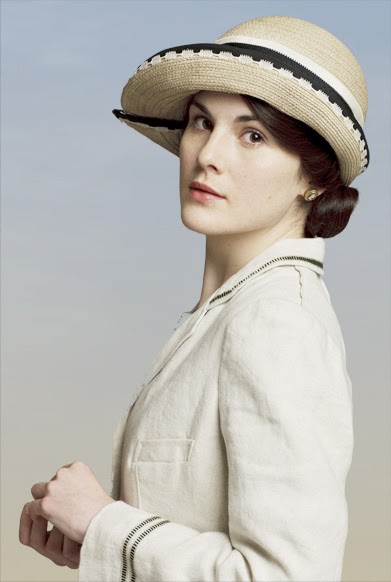
The Crawley daughters are Mary (Michelle Dockery), the eldest, Edith (Laura Carmichael), and Sybil (Jessica Brown-Findlay). As the eldest and the heiress, should the entail be broken, Mary gets the bulk of screentime and character development in this episode. Dockery appeared in Return to Cranford on Masterpiece last year, as Erminia, cousin of William, the series’ romantic lead. I'm afraid I took an almost instant dislike to Mary - from the moment her father breaks the news to her that her presumptive fiance is dead, her lack of feeling was almost chilling. But as the episode progresses, it becomes gradually clearer that Mary is much more than a "snooty" aristocrat - as a woman during this time she was privileged and blessed, certainly, but she was still a pawn to be bartered on the marriage market for the benefit of family and estate. The weight of bearing the burden that one's choices in the end are not entirely your own must be crushing, and Mary's public demeanor is clearly in part a defense mechanism designed to protect and keep her hopes in check. With the exception of Edith, whose frustration with the deference given to her older sister is abundantly clear, the character and motivations of the younger Crawley daughters remain to be revealed.

Violet, Dowager Countess
The dowager countess, Violet, is played by the inimitable Maggie Smith, and her character is an absolute delight. Violet would have been a fearsome woman to cross. She has a formidable will and a passionate devotion to Downton Abbey and the illustrious legacy she fears is in jeopardy following the Titanic sinking. I found Smith's scenes opposite on-screen daughter-in-law McGovern to be absolutely priceless. When it comes to saving Downton, she's clear that her untitled daughter-in-law isn't her "friend," but an ally out of necessity. Violet has clear ideas about the way things should be done - it's basically her way or the highway, as the saying goes. When she first meets the new heir Matthew (Dan Stevens) and his mother (Penelope Wilton), their rather middle class sensibilities - especially Matthew's, since he's a lawyer - rock her carefully ordered world. That her beloved Downton should be inherited by a man who speaks of things like "jobs" and "weekends" is utterly insupportable! *wink* As always Maggie Smith's performance is a scene-stealer, and I look forward to Violet's future appearances in the balance of this series.

Matthew Crawley
The new heir, Matthew, should be a familiar face to fans of Masterpiece Classic. Dan Stevens's break-out role was as Edward Ferrars in the 2008 version of Sense and Sensibility. Matthew is a character whose personality and values are in many respects completely alien to his aristocratic relations. He is determined to continue practicing law, and has little patience or understanding for the traditions that govern Downton Abbey. I think Dan Stevens is going to be the perfect actor to play Matthew with his fierce independent streak, determined not to allow his new status as heir to change him. I think it will be interesting, though, to possibly see Matthew grow in understanding and empathy towards the Crawleys and the people who make serving that family their pride and livelihood. Resented as an interloper, Matthew's world is going to be rocked when Cora and Violet unite in their efforts to make the best of an untenable situation by determining that the best course of action for Downton's future is to secure a marriage between Matthew and Mary - and a more unlikely pair you're never likely to see.

Isobel Crawley
Matthew's mother, Isobel, is played by the wonderful Penelope Wilton. Wilton is another familiar face to fans of British drama. She's appeared in Wives and Daughters, the 2005 version of Pride and Prejudice, and Doctor Who, to just name a few of the film credits in her illustrious career. The push-and-pull between Isobel, her son Matthew, and the Crawleys is fascinating to witness. The daughter and widow of doctors, she is highly intelligent and possesses a worldview that is perhaps best described as broader in scope than that of her female counterparts resident at the Abbey. She's also quite proud of Matthew, and while I think it's apparent he inherited his independent streak from her, she also knows how to play the game better than her son. A once in a lifetime opportunity has been set before him, and she would not see it squandered out of foolish pride. I look forward to seeing more social sparring between Isobel and Violet in future episodes.

Now, I'm going to do something I've never done with a Masterpiece production - I'm dividing my review of Part One of Downton Abbey in two. Not only is this post probably long enough (LOL), but intricacies and machinations that occur below stairs in Downton are every bit as worthy of their own post and examination as that of the servants' upper-class counterparts.

I realize we still have three weeks of Downton Abbey episodes to look forward to on Masterpiece Classic, but I'm going to go ahead and go out on a limb here and state that at this pace, Downton is likely to be my favorite Masterpiece production since Bleak House. With the sprawl and scope of Dickens and the intimate understanding of social mores found in Austen, Downton Abbey is an absolute jewel of television drama. And while I would be among the first to argue for the benefits of adapting classic novels to the screen, I love the fact that Downton Abbey is a original - there's no book to compare it to. Created and scripted by Julian Fellowes (who may begin to rival Andrew Davies as my favorite screenwriter), Downton delivers drama in spades. Fellowes is responsible for scripting several movies I love, including The Young Victoria and most recently The Tourist, as well as Gosford Park (and with the benefit of hindsight, one must consider Gosford a dry run for Downton).

The costumes and sets for this miniseries are absolutely scrumptious! When watching Downton, I couldn't help but liken the Crawleys to the Vanderbilts - and my desire to visit the Biltmore Estate again has grown tenfold. The direction and editing of this miniseries is superb, the cuts between the drama of the Crawleys and that of their servants seamlessly done. I also adored the score, supplied by John Lunn. Lunn worked on Little Dorrit and Bleak House, so while the music here had a vaguely familiar "sound," it was completely and utterly captivating in its own right.

Look for my post on the servants of Downton Abbey soon! But in the meantime, please chime in with your thoughts on Part One and the Crawleys. There's little I like better than discussing British drama. :)

Sunday, January 9, 2011

Review: Jane and the Unpleasantness at Scargrave Manor by Stephanie Barron


Jane and the Unpleasantness at Scargrave Manor (Jane Austen Mysteries #1)
By: Stephanie Barron
Publisher: Bantam
ISBN: 0-553-57593-7

About the book:

On a visit to the estate of her friend, the young and beautiful Isobel Payne, Countess of Scargrave, Jane bears witness to a tragedy. Isobel's husband - a gentleman of mature years - is felled by a mysterious and agonizing ailment. The Earl's death seems a cruel blow of fate for the newly married Isobel. Yet the bereaved widow soon finds that it's only the beginning of her misfortune...as she receives a sinister missive accusing her and the Earl's nephew of adultery - and murder. Desperately afraid that the letter will expose her to the worst sort of scandal, Isobel begs Jane for help. And Jane finds herself embroiled in a perilous investigation that will soon have her following a trail of clues that leads all the way to Newgate Prison and the House of Lords - a trail that may well place Jane's own person in the gravest jeopardy.

Review:

The Unpleasantness at Scargrave Manor is the first in a series of novels that purports to be based on "long lost" Austen journals -- journals where, shockingly enough, Jane is revealed to have an aptitude for solving crimes. Perhaps even more shocking is how well the concept works in Barron's execution of the story. Through novels like Pride and Prejudice and Emma, Austen revealed herself possess a masterful understanding of human nature and all its foibles, and this skill lends itself well to casting Austen as an unconventional investigator with a flair for understanding the criminal mind.

Since relatively little is known of Austen's life, there's plenty of opportunity for an Barron's imagination to fill in the gaps. She grounds her stories in what little is known of Austen's life. In the case of Scargrave Manor, the fact that Austen had once received and refused a proposal from a Harris Bigg-Wither serves as the impetus that allows Barron to send Jane to the home of a beloved -- but entirely fictitious -- friend in order to recover. Soon after her arrival, Jane finds herself embroiled in not one, but two cases of murder most foul, with her beloved friend Isobel standing accused of murdering her husband. Isobel begs Jane to employ her acute powers of observation in order to discover the truth of the matter, and so the chase is on for Jane to discover the truth before Isobel is brought to trial before the House of Lords.

Barron's first novel featuring Jane Austen in the role of sleuth succeeds on all fronts -- it's an incredibly engaging, fast-paced read, rich with historical detail (supplemented by select footnotes which aid in giving credence to the assertion that the story is an edited "journal"). Most enjoyable of all is the experience of seeing inside Jane Austen's head, albeit a fictitious Austen. The story's prose is rich with the language and customs of the early nineteenth century, and it's an enjoyable escape to read a novel that pretends to flesh out the character of one of the most beloved, but mysterious, novelists of all time. All in all it's a thoroughly enjoyable and absorbing read.
 
***
 
This review was written back in 2007 on my old blog - that is how long I've been "meaning" to officially review all of Stephanie Barron's delightful Jane Austen mysteries (sad, I know, but such is the state of my TBR pile). This is the fourth or fifth time (honestly I've lost count) I've read Jane and the Unpleasantness as Scargrave Manor, and revisiting Jane's first case for the Being a Jane Austen Mystery Challenge and and the Historical Fiction Reading Challenge has proven to be just as delightful and absorbing an experience as the first time I delved into the novel's pages, completely unaware of the treat that awaited me there. That, my friends, is the mark of an enduringly good read. :)
 
Click to visit author Stephanie Barron's blog and read her thoughts on Scargrave Manor. And if you haven't read the book for yourself, well, what are you waiting for?!
 
P.S.: I'd forgotten (shocking!) how much I adore Lord Harold Trowbridge. Yowzers.

Saturday, January 8, 2011

Well this is a dream come true...


Well this is a dream come true that I didn't even know I had. David Tennant and Catherine Tate in my favorite Shakespeare play, Much Ado About Nothing?! Oh. My. WORD. This is going to be brilliant. And someone needs to film this for posterity's sake. Tennant's Hamlet made it to DVD, why not a brilliant Shakespearan comedy as well?

David Tennant as Benedick? DAVID TENNANT AS BENEDICK?! I am so happy right now. :)