Showing posts with label Benedict Cumberbatch. Show all posts

Thursday, July 9, 2015

Sherlock Special - First Look!

Sherlock (Benedict Cumberbatch) and Watson (Martin Freeman) back in their original Victorian setting? This may be the most beautiful thing I've ever seen...well, this week at any rate. ;-) I hate the wait between new Sherlock episodes, but this clip makes me realize anew how much this show makes it worth the wait.

Friday, January 17, 2014

Sherlock: The Reichenbach Fall


PEOPLE. The things I find in the drafts folder of this blog...like half-forgotten musings on The Reichenbach Fall from TWO YEARS AGO.

This Sherlock post isn't going to be nearly as in-depth as past blog entries (i.e., The Hounds of Baskerville or A Scandal in Belgravia), but as Sherlock is finally returning to Masterpiece with Series III THIS SUNDAY, I feel compelled to post something about this installment of the show (and in case you're wondering, yes, I have managed to avoid spoilers as to how Sherlock survives that fall!).

This episode is positively riddled with wonderful character moments and nods to the canon, but at its heart is, of course, the relationship between Sherlock and John, and a showcase for the chemistry between Benedict Cumberbatch and Martin Freeman. Before touching on a few of those moments, here are the paragraphs I wrote TWO FRIGGIN' YEARS AGO and then, apparently, promptly lost in my drafts folder:

I have a feeling the answer is hidden in plain sight, but because we have all been watching the characters and action unfold on-screen we're missing some subtle clue(s). I'm convinced Molly has something to do with helping Sherlock pull it off. I read an interesting theory that possibly John was drugged by the substance used in the Baskerville episode...which is fascinating to me because going on what we see, we see Sherlock with his head bashed in -- but that is from John's point of view...and shock/drugs/getting hit by that bike...all contributing factors to his rattled state.

I sort of feel like Sherlock's tears might have -- at least in part -- been a genuine emotional reaction to the moment. Because I think whatever he planned, however he pulled it off, he KNEW what it was going to do to his best friend, he KNEW he had no choice but to willingly crush him emotionally. Very interesting how Moffat and Gatiss are overseeing the growth of Sherlock's character. He is very much the Sherlock of the canon but there are moments of powerful growth that they insert in the series, that I think mean a great deal because we know Sherlock isn't "wired" to connect/be emotionally vulnerable. He's not becoming someone he isn't, or was never meant to be...they are just testing him in some really interesting ways. At least I think so. :)

I think it is possible Sherlock and Mycroft are in on the whole thing -- during the "dead" time between "Fall" and "Empty House," Mycroft financially supports Sherlock in hiding...will be interesting to see if that is brought into the next series! I love how this series explores this testy, emotionally frought relationship between the brothers...just because Mycroft is more "socially adept" than Sherlock doesn't mean he is any less messed up. :P There's a bigger game afoot, at least that's how I saw it.

***

Was that worth waiting two years to click "publish"? Nevermind, don't answer that. *wink*

The episode opens with John visiting his psychiatrist for the first time in over a year, heartbroken over his best friend's death. I KNEW that was coming, and still, after all this time, that opening gives me chills. Flashback three months, and we see Sherlock riding on high on a string of fabulously publicized successes, his crowning jewel the recovery of a J.M.W. Turner painting of Reichenbach Falls (I LOVED that, immediately reminded me of the atmosphere of the original stories as well as my beloved Jeremy Brett series).

Meanwhile Moriarty (Andrew Scott) pays a visit to the Tower of London, breaking into the case containing the Crown Jewels (after writing "Get Sherlock" on the glass), while simultaneously unleashing codes from his phone that open the vault at the Bank of England and unlock all of the cells at Pentonville Prison.. This is a brilliantly filmed sequence to the soundtrack of Rossini's "La gazza ladra" ("The Thieving Magpie"), a wonderfully appropriate metaphor for the Moriarty of this series, here highly suggestive to my mind of the manner in which he picks away at the threads of Sherlock's reputation in this installment.

Moriarty is arrested and Sherlock is called to testify, sure of the outcome, never dreaming, perhaps, that it was Moriarty's plan all along to participate in a highly publicized trial only to be acquitted. This highly public black mark against Sherlock in the public eye is but the first step in the madman's plan to see his rival utterly destroyed, to see the "angel" the public has embraced shredded, utterly destroyed.

The primary canon source for this episode is obviously Doyle's "The Final Problem." I've always thought it was rather interesting that Doyle scripted Sherlock's death here, tired of writing for his most famous creation, determined to have him exit in a spectacular fashion -- little counting on the public pressure that would insist on Holmes's resurrection ten years later in "The Adventure of the Empty House." Doyle's rather fraught relationship with the cult of celebrity that erupted around Sherlock is, I think, mirrored after a fashion in this episode -- public adoration made Sherlock here, and can just as easily destroy him as Moriarty so methodically intends to prove.

Through the ensuing storm of accusations and doubt, John (of course) remains faithful to his friend -- what breaks my heart here is seeing the impact of Sherlock's very public fall from grace on Lestrade (Rupert Graves). THAT killed me (just ONE of the times something came very near that in this episode) -- closely followed by the revelation that Mycroft (Mark Gatiss) was responsible for the leak of personal information regarding HIS BROTHER during earlier interrogations of Moriarty. That fatalistic acceptance of that -- well, is there any other word for it than betrayal, however unintentional? -- is brilliantly played. The Holmes brotherly relationship in this series is so fraught with tension, so utterly heartbreaking.

This series' crowning moment is Sherlock and Moriarty's final face-off on the roof of St. Bartholomew's Hospital, where Moriarty reveals the true depth of his obsession with destroying his rival -- he commits suicide, leaving Sherlock to pay the price of his friends' lives -- John, Mrs. Hudson, Lestrade -- with his own. Only with his death will they be spared an assassin's bullet. And so he makes a final call, determinedly attempting to destroy John's childlike faith in him by admitting that he's a fake, that everything they've experienced together, the entire basis of their friendship, is a lie.

But of course John knows his friend. And the final scene of this episode leaves me every bit as gutted as Martin Freeman is on-screen. The utter devastation with which he imbues John's final words over Sherlock's grave -- while Sherlock looks on from the shadows -- is gut-wrenching, an unforgettable image of loss and steadfast faith that has been the defining image of this incarnation of the classic friendship for far too long.

Sherlock returns this Sunday on Masterpiece. I am looking forward to seeing how he survived the fall, of course, but the mechanics are at this juncture just that -- mechanics. What I really can't wait to revel in is the return of Sherlock and Watson to my television screen and the unforgettable dynamic brought to their unorthodox friendship by Cumberbatch and Freeman's performances. Everything else is just icing on the cake. :)

*Image copyright BBC/Masterpiece. No copyright infringement intended.

Thursday, July 18, 2013

Sherlock at Comic-Con

Click through to see the taped messages from Martin Freeman and Benedict Cumberbatch that aired at the Sherlock Comic-Con panel. Benedict is in especially fine form. *wink*

Tuesday, May 21, 2013

Star Trek Into Darkness


People, where do I begin? How can I possibly articulate in a semi-coherent manner how much I ADORED Star Trek Into Darkness?!

If you're worried about spoilers, this is NOT the place to be. Consider yourself warned. 

I mean it. :)


Okay, here we go. :) Prior to Abrams' spectacularly entertaining re-boot of the Trek franchise in 2009, I wasn't a Trek fan in any way, shape, or form. I knew who Kirk and Spock were and that was about it. Any effort to engage with the film's source material previously had ended in apathy. But that film -- what Abrams and his cast and crew did for me then was introduce me to a vibrant cast of characters with a chemistry and an energy that reminded me of my personal science fiction favorite -- Star Wars. So the four year "drought" waiting for a follow-up has been absolute torture -- and to be quite frank, I was beginning to wonder if this movie would ever happen. And when it WOULD finally appear, could it possibly succeed in recapturing everything about the first film that I loved so much? COULD IT POSSIBLY LIVE UP TO THE HYPE??

Amazingly my answer to that question is YES. Yes, yes, and THEN SOME. Star Trek Into Darkness (do you have ANY IDEA how desperately I want to but a colon between "Trek" and "Into"?!) is a thoroughly entertaining, engaging sequel that continues to reinvent the tropes of this world while letting these new cast members, this perfect "Abrams-caught-lightning-in-a-bottle" ensemble make these characters their own.


Prior to this film's release I'd been reading rumors of the identity of villain, and the storyline's relation to what is (apparently?) considered one of the best classic Trek films -- The Wrath of Khan. So the night before I was due to meet friends to see Into Darkness I decided it was time to not just read about Khan online, but to watch the film -- and goodness am I ever glad I did, as I thought it thoroughly enriched my viewing experience and appreciation of everything Into Darkness works to accomplish on-screen.

So much of the success of Star Trek (both new and old) rests on the strength of the ensemble, and in particular New Trek is a positive gold mine of pitch-perfect, once-in-a-lifetime casting decisions and amazing group chemistry. But the relationships between various members of the crew (and I love them all) pales in comparison to the importance of the Spock/Kirk friendship, and here Abrams delves deeply into what friendship between two people who, on the surface at least, should have nothing in common to bind them together in friendship.


Now I can't speak in any great depth to how the classic Kirk and Spock friendship compares to the incarnation Abrams has given us in his re-boot, except to say that I feel New Trek is not only intent on examining how a human/Vulcan friendship works, but is perhaps more interested in how that friendship changes both men irrevocably. And for my money you could not ask for two better actors Chris Pine and Zachary Quinto to bring this legendary duo to life on-screen.

Pine's Kirk is cut very much from the Han Solo-hero mold -- good-looking, brash, and cocky, his Kirk would much rather act than reflect, sieze the day than think through the consequences. And his brash confidence has paid off in spades, bringing him success and command of the Enterprise -- but his success, his willingness to disregard the rules time and again has earned him not only the ire of Starfleet Command, but has arguably instilled in him a false sense of security in life and his ability to lead others.


Quinto's Spock absolutely fascinates me. Not only do we have Spock in a romantic relationship (more on that later), but Spock seems shaded with a touch more transparency, more hints of inner conflict rippling just below the logical Vulcan surface of his persona. And that conflict between his Vulcan and human halves, between the logical, unemotional side of his heritage and the part of him that genuinely wants to understand why he drives Kirk and Uhura insane just plays out brilliantly on-screen (when Kirk finds himself caught in the middle of what passes for a Spock/Uhura "fight" is one of the film's most hilarious scenes). When Kirk flouts convention and returns to save Spock from a volcano explosion at the beginning of the film, he genuinely does not understand why Kirk would be compelled to act so illogically or the potential consequences of his truthful reporting of the incident (which sees Kirk demoted). That gut reaction vs. a measured, intellectual response is the trigger that sets Spock on this inward journey to understand and relate to those around him throughout the film which culminates in a spectacular -- and very un-Vulcanlike -- emotional finale.


For his part, Kirk's character arc through the film not only neatly fits within the beats of Joseph Campbell's definition of the heroic journey, but the hothead must also learn the value of what someone of Spock's experience and perspective can bring to his life. Speaking to the heroic journey -- if the first film covered step one, the separation, than this second installment is Kirk's initiation and trial by fire. Disappointing his mentor, Admiral Pike (Bruce Greenwood -- okay let me just say, I get why this had to happen, but losing Pike was dang near as traumatic for me as the whole Coulson dying thing in The Avengers), and then seeing that surrogate father figure murdered sets Kirk on a path to revenge. This hearkens back to Kirk beating the Kobayashi Maru test in the 2009 film (also referenced in The Wrath of Khan) -- if the purpose of that test is facing a no-win scenario, of seeing how one would act in the face of sure death, having never accepted that as a possibility, Pike's death and the events that follow force Kirk to confront his fallibility. And in doing that, in recognizing that "how we deal with death is at least as important as how we deal with life" is a critical step in Kirk's heroic journey and maturation as a man and a leader.

In my rather random and sporadic watching of anything Classic Trek, while I always got the sense that Kirk and Spock were close friends what I LOVED about their relationship in this film is the glimpse we get into the DEPTH of that friendship. It is no stretch in my mind to say that the events of Into Darkness are a crucible through which the bond of friendship between them is solidified and strengthened. And we really see that played out in a powerful manner in how they push each other, how they change each other, and how through their friendship, through how they each take on the other's best qualities, each man is changed, arguably, for the better.


I understand that among some Trek purists Spock's relationship with Uhura (Zoe Saldana) is the subject of some controversy. Personally I think it is one of the best aspects of the new films, and I promise that isn't because I am a total romantic sap. *wink* I don't feel that Uhura fundamentally changes the logical, intellectual, supremely rational being that Spock is; rather she stretches and changes and challenges him in a way that is pure and simple an utter delight to watch on-screen. Quinto and Saldana play this atypical couple with more class and maturity than most film romances today in my opinion. Yes, Uhura gets frustrated with Spock -- but witness the looks she gives him before he's lowered into the volcano on Nibiru and after they survive the incursion into Klingon territory. It's love and acceptance pure and simple, and her ability to be so passionate about their relationship and ultimately so accepting of who he is (even though certain qualities occasionally drive her mad) just BAFFLES him. (And when he tells her that when he thought he was going to die he couldn't think about her because he feels TOO MUCH?! -- I DIE!) And watching Spock puzzle through the nuances of the relationships in his life, that will never get old, especially with an actor as fantastically expressive as Quinto in the role.


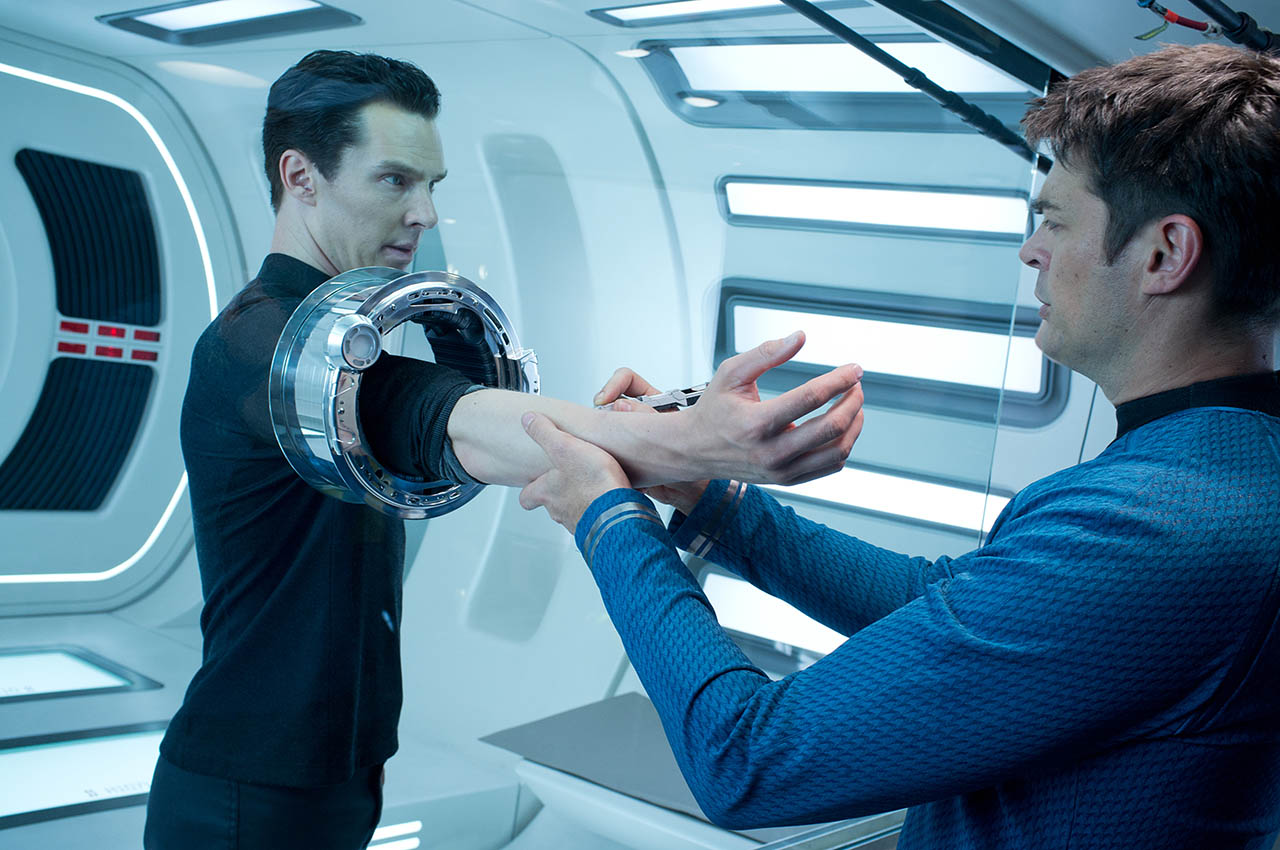
We all know I love Benedict Cumberbatch, right? :) Benedict did me proud here, and it was an absolute thrill to see him figure so prominently -- and so well -- in such a big-screen spectacle. In my experience following his career I've never seen him play such a villain. And being the superlative actor that he is, and stepping into a franchise that has grounded itself in the relationships between core characters, it's a testament to his considerable ability as an actor and the material that he was given to work with that his Khan is such a memorable, three-dimensional, terrifying villain. For while his actions -- blackmailing the Starfleet officer (hello Mickey from Doctor Who) into blowing up the archive, attacking Starfleet HQ -- are reprehensible, Cumberbatch never lets us forget that he is driven by a genuine love and fear for the safety of his crew, his family. There was a moment there when Kirk and Khan prepare to board the Reliant that I thought maybe, just maybe, "new" Khan was going to end more heroically -- Cumberbatch did a fantastic job playing painting Khan not in black and white, but shades of grey. And much like he will do anything to achieve his aim, so Kirk must also embrace what it means to be a true leader of his own crew, and come to terms with what he's willing to sacrifice for his family, the perhaps never-considered reciprocity of what he expects of them as their commander. While both men are driven by the same impulse, it's the choices each makes that ultimately defines who they are, for good or ill.


(Side note: Did Benedict perform in the fight scenes? Because that moment in Klingon territory when he saves Kirk, Spock, and Uhura is PURE DEADLY POETRY in motion.)


Where Kirk and Spock and Uhura and BENEDICT would be more than enough, Into Darkness goes above and beyond giving viewers a tremendous array of well-realized supporting characters that steal the show more often than not. *wink* I don't even think I can pick favorites, people, seriously -- I love them all. :) Off-hand I'd say Sulu's (John Cho) wins for most improved over his appearance in the 2009 film, as short but critical scenes give him the chance to test his own leadership potential when Kirk grants him the captain's chair. Please, can we have MORE of his character in the third film? Cho is a badass. ;-)


I absolutely LOVE Chekov (Anton Yelchin), and it was such a treat to see him get stressed out over assuming Scotty's position as chief engineer, when the latter resigns in protest over the presence of sketchy photon torpedoes on the Enterprise. I was seriously concerned about his safety when Kirk ordered him to don a red shirt, but thankfully that temporary transfer didn't blow up in his face (literally). And when he saves Kirk and Scotty I could barely contain my glee. :)


And Scotty! Could anyone else but Simon Pegg be so perfect for the role? I think not. I loved his professional outrage over the whole torpedo debacle, his insistence that he'd never help Kirk with anything EVER AGAIN, and then his own personal entering the Death Star moment when he discovers Admiral Marcus's secret warship Reliant (not to mention his solo heroics in the bowels of the oddly deserted ship). But more than all that, his indignant OUTRAGE at returning to the Enterprise after an absence of like a DAY only to discover she's falling apart around his ears. :)


I like Karl Urban a lot, and I like him as Bones...but maybe this is just a part of the original character that I don't get, but he seemed to spend an awful lot of time telling Kirk or Spock or whoever that he couldn't believe they were doing whatever it is they were going to do, instead of, you know, doing something. And while there's a lot of humor and warmth in his interactions with Kirk in particular, and he gets a moment with a TRIBBLE (!!), and those thirty seconds where he thinks he's going to get blown up by a torpedo, I am always left wanting. Like I just feel like there's more he should be doing than throwing around "dammit Jim's" and being hilariously neurotic. I LIKE it all, don't get me wrong, I just feel like he could play a bigger role vis-a-vis Kirk and Spock...I think that's what I'm getting at is I want more Bones being incredible. :)

While I don't know that I'd call Into Darkness a remake of The Wrath of Khan, exactly, it does borrow and adapt substantially from that film to fit certain story beats into the New Trek world -- and I love that. If the 2009 film established the two separate but similar timelines, this film takes that further by exploring how these new incarnations of the classic characters can take canonical story beats and experiences and make them their own. I think there must always be certain parallels, no? I find that it really enriches my appreciation of the Abrams films as I learn more about the source material.


That said, I LOVE LOVE LOVE how this film takes Spock's sacrifice in Wrath and turns it on its head. In this timeline, Kirk needed to come to the point where he was willing to sacrifice for a cause, for his family. And Spock -- with the insight offered from his counterpart Spock Prime (Leonard Nimoy) on New Vulcan, I truly believe he thought that defeating Khan would require him to make the ultimate sacrifice. So when his friend Kirk sacrifices his life to save the Enterprise he's absolutely gutted. Only then does he understand Kirk's drive to save him earlier in the film and how deep the bonds of friendship run between them, and how when evil threatens something near and dear to one's heart the gut response -- not the logical one -- oft-times demands action. (On a lesser level -- much less, since I didn't find Alice Eve as Carol terribly interesting -- I am looking forward to where the franchise goes with the canonical Kirk/Carol relationship given the characters' history in the show. I DO hope that the scripts up Carol's smarts in subsequent outings, as Eve was barely given enough to work with to raise her above my least favorite female scientist on film of all time, Denise Richards in The World is Not Enough -- that is NOT a mark you want to aspire to.)

So, wrapping things up, I basically think this film is pretty much pitch-perfect (just in case you couldn't tell). It's a fast-paced, energetic, engaging, and slickly-produced piece of summer entertainment with heart, thanks to memorable, well-drawn characters. Not only do you have the characters and special effects, but the film is just plain GORGEOUS. From the pops of vibrant yellows and reds on Nibiru to Abrams's apparent love of light halos illuminating the bridge of the Enterprise in space, every frame of this movie is a feast for the eyes. Finally, composer Michael Giacchino returned to score the film, and I think he outdid himself. From the action cues to gorgeous piano solos to his adaptation of the Classic Trek theme, every note of music complements the on-screen action perfectly. Very well done.

If you've seen the film I would (obviously) love to discuss! :) I can't wait to see where this crew takes us next, and I can only hope that the five year mission the Enterprise sets out on at the film's conclusion isn't some sort of sign that it is going to actually take FIVE YEARS for a sequel. Please, for the love Abrams, don't make me wait that long.

*Images copyright Paramount.

Thursday, January 10, 2013

Cabin Pressure Series 4.1: "Timbuktu"


Cabin Pressure fans rejoice! The first episode of the BBC radio comedy's fourth series is available to listen to online via the BBC Radio 4 Player for the next six days, absolutely free! No word yet as to when the series will be available for purchase -- I assume sometime after the entire fourth run airs, the sooner the better as far as I'm concerned. :)

If you're not familiar with Cabin Pressure, here's a short blurb about the program -- each and every episode is absolutely HILARIOUS (and conveniently available for purchase through iTunes...just sayin'!). *wink*
Cabin Pressure is a sitcom about the wing and a prayer world of a tiny, one plane, charter airline; staffed by two pilots: one on his way down, and one who was never up to start with. Whether they're flying squaddies to Hamburg, metal sheets to Mozambique, or an oil exec's cat to Abu Dhabi, no job is too small, but many, many jobs are too difficult...

Thursday, December 6, 2012

Star Trek Into Darkness teaser trailer!

The first look at the long (and I mean LONG) awaited sequel to 2009's Star Trek has debuted:


Love seeing (and hearing) Benedict Cumberbatch! :) There's also the Japanese version of this teaser, which features a few additional seconds of footage:


May 2013 come quickly. :)

Wednesday, May 30, 2012

Sherlock: The Hounds of Baskerville

The middle installment of this all-too-short second series of Sherlock on Masterpiece Mystery saw the twenty-first century incarnation of the world's foremost consulting detective tackle a reimagining of arguably his most famous case -- The Hound of the Baskervilles. Originally published in serial form from 1901-1902, Doyle's original tale is a dark and twisty story of family secrets and murder, the latter inspired by a local legend of a fearsome, other-worldly hound roaming the moors. I must admit I was quite curious as to how Sherlock would adapt this fantastical tale to its 21st-century setting and audience. Anchored by a strong script from the pen of the show's Mycroft, a.k.a. Mark Gatiss, I was not disappointed -- as only this series can, Gattiss' script manages to retain the essence of the original story while at the same time transforming it into a unique and fresh spin for this series' purposes.

To begin our analysis of this episode, here's the summary from the PBS website:

Boredom has set in at 221 Baker Street, with Sherlock (Benedict Cumberbatch, The Last Enemy, War Horse, The Hobbit) jonesing for a meaty case and — in its absence — a cigarette. Only the arrival of Henry Knight (Russell Tovey, Little Dorrit), terrorized and desperately clinging to sanity, piques the consulting detective's interest. A gigantic hound — part tourist attraction, part conspiracy theory, part demonic moor stalker — is legend around Baskerville, a top-secret military compound where, it's rumored, chemical and biological weapons experiments are conducted on genetically engineered animals. And Henry Knight has just seen the hound's footprints in the very location where it killed his father decades before. Sherlock gleefully sets off to track the demonic hound with John (Martin Freeman, The Office UK, The Hobbit) at his side and Mycroft's access-granting government ID on hand to enter the high-security corridors of Baskerville. But he may have opened doors to a realm where deduction and reason have no place. Written by Sherlock series co-creator Mark Gatiss (Doctor Who), The Hounds of Baskerville offers thrills, chills, laughs, and an unsettling, unprecedented facet of our hero's clinically controlled mind. (One episode; 90 minutes, TV-PG)


The episode opens with images of a terrified young boy crashing through the woods, desperately trying to escape the something (or someone?) viciously attacking his father on the moors. Now a young man, Henry Knight has returned to the scene of his worst nightmare twenty years later at the urging of this therapist, hoping to put his demons to rest -- only to discover he's standing on ground covered with giant, hound-like footprints. Henry is played by Russell Tovey, who I first fell in love with as the lovelorn John Chivery in the 2008 miniseries adaptation of Little Dorrit. Look at his ears, isn't he adorable? *wink* Also, how deliciously ironic is it that Tovey makes his Sherlock debut in an episode centered on a legendary, fearsome hound, when he played a werewolf in Being Human? At any rate, Tovey's character Henry retains the same first name and status as sole male heir of his family, only with significantly more baggage than his counterpart in Doyle's novel. I thought it was an extremely nice touch to change Henry's last name from Baskerville to Knight, a nod to the original character's status as a peer.

At 221B Baker St., Sherlock (Benedict Cumberbatch) is in desperate need of a challenging case or, barring the appearance of the former, a nicotine fix. I ADORED Sherlock's entry, blood-covered and brandishing a harpoon (a nod to the short story "The Adventure of Black Peter"), completely clueless as to how crazy he must've appeared to everyone he encountered. :) This sequence between Sherlock and John (Martin Freeman) puts the focus squarely on the heart of the series -- the wonderfully odd and unexpected friendship that has developed between Sherlock and John. Freeman is just brilliant here, so matter-of-fact because by this point he knows better than to be surprised by anything Sherlock does. And it reminds viewers of Sherlock's penchant for falling back into drug usage (in this case, cigarettes) when no suitable case presents itself with which he can exercise his incredible intellect. Sherlock's manic desire for cigarettes, even going so far as to suggest something "seven percent stronger" when offered tea (a nod to the canonical Holmes' cocaine habit, mentioned in The Sign of Four), is vintage Holmes -- manic, energetic, self-absorbed by the desire for something, anything, "worthy" of his time. The banter between John and Sherlock in this scene is a prime example of just how perfectly suited each actor is to his respective role -- and to a lesser extent I must include Mrs. Hudson (Una Stubbs), as her never-failing cheeriness in the face of Sherlock's "eccentricities" is a mark of just how much these three oddly-matched individuals have become a family of sorts.

Thankfully for John's patience (ha!), Henry arrives at Baker St. seeking Sherlock's help for explaining what happened to his father all those years earlier, and what, exactly, haunts the moors and his dreams to this day. Tovey is just brilliant as Henry -- edgy, haunted, his every word and action is weighted with survivor's guilt and torment. Sherlock's initial interview with Henry is in every respect a vintage "client scene," one of those moments that occur so frequently in the canon where Sherlock makes a series of amazing and spot-on deductions simply by looking at someone. We've been given this to some extent in previous episodes of the series via the text-message style pop-ups that appear on-screen when Sherlock first meets someone -- however, this time Gatiss gives viewers the joy of watching a maniacally intense Sherlock wow one of the lesser mortals he so frequently has the burden of dealing with, as he lays out, piece-by-piece, Henry's journey to Baker St. (Also, how funny was it watching Sherlock insist that Henry smoke, just so he could get all up in his personal space and inhale second-hand?)

Much to Henry's chagrin, Sherlock is at first uninterested in the case until he is struck by Henry's repeated use of the old-fashioned word "hound" to describe the monstrous beast he saw on the moors. No longer the ancestral home of the novel, Baskerville is now a top-secret military testing facility. Henry's father had been one of the "conspiracy theorists" sure the base was involved in animal testing and the like, developing super-beasts which would of course explain his childhood memories surrounding his father's death. Sufficiently hooked, Sherlock at first promises to only send John to Dartmoor -- a nod to the original novel wherein Sherlock is mostly absent for the first half, Watson sending reports to him, unaware that his friend is observing all, hidden away in an isolated house on the moors. Thankfully for Sherlock, Gatiss and Moffat opted to make Sherlock and John more equal partners in this investigation, giving the ultimate rationalist a chance to confront the seemingly impossible.


I loved the scenes of Sherlock and John driving across the moors -- the bleak beauty of the scenery is the perfect moody, atmospheric setting for a tale of an impossible monster. When they arrive at the nearby village inn (a vegan establishment, significance forth-coming), they discover the the legend of the hound has created something of a cottage industry with tours to areas where there have been alleged sightings. One of the innkeepers is a cheery Little John -- I mean some guy named Gary played by Gordon Kennedy, a.k.a. Little John, which just got me to thinking why oh why did Robin Hood have to end the way it did? *sigh* Despite the claims of a local tour guide, Sherlock remains unconvinced that the local legend is real, and after John swipes a suspicious receipt for a large meat delivery from the vegan pub, the two proceed to the Baskerville testing facility.

In one of the episode's most brilliant comic touches, Sherlock impersonates his brother Mycroft (Mark Gatiss), using a stolen ID card to gain access for John and himself to the top-secret facility -- buying them an estimated twenty minutes, give or take, before the ruse is discovered. I love how John voices a token objection before going along with the plan (of course), even going so far as to "pull rank" when questioned by the officer who greets them, freaking out over the unheard of "surprise inspection." It's a nice reminder of John's military days, a past that seems to have been more frequently mentioned in the stories than it's been given play in this set of films. During their highly illegal tour they meet Dr. Frankland (Clive Mantle), who is WAY too nice for his own good, and Dr. Stapleton (Amelia Bullmore), a highly secretive woman who seems to relish her animal experiements. Now, I was probably biased here, but Bullmore's appearance immediately set me on alert -- not only does her character share the name of the novel's villain, but Bullmore had the distinction of appearing in one of my favorite Inspector Lewis episodes from last season -- the deliciously twisty Wild Justice. Incidentally, I loved how Stapleton's work reminded Sherlock of a query he received through his website -- where a child wrote wanting to know how her pet rabbit disappeared from its locked cage. It's a nice touch that reminds one there's rarely a throwaway reference in these scripts, so tightly do Moffat and Gatiss strive to present their incarnation of Sherlock and his powers.

As predicted, the facility quickly realizes they've experienced a major security breach -- and Mycroft's reaction in London is appropriately, hilariously, droll. The commander of Baskerville, Major Barrymore (Simon Paisley Day), is enraged until Dr. Frankland unexpectedly steps in and vouches for Sherlock and John's story -- allegedly because he's a fan and as a friend of Henry's father, is eager to help the son. Barrymore is a throwback to the novel, as that was the name of the butler -- and as such it is a nice touch to see Baskerville's modern "gatekeeper" share the name of its literary counterpart.

Meanwhile, following an intense session with his therapist Louise Mortimer (Sasha Behar), Henry has remembered two words -- "Liberty" and "In," though he has no idea how they are connected to his father's death. Dr. Mortimer is a nice connection between the novel and this adaptation, as in the novel Mortimer is the family practitioner responsible for bringing the Baskerville family to Holmes's attention, and a sort of self-appointed guardian to the family heir. (Side note: how hilarious is John's reaction to Henry's apparent wealth -- and why can't I live in that house?!) That evening the the three of them make their way to Dewar's Hollow, the site of Knight Sr. death. John gets separated from Sherlock and Henry, and while on his own he notices a series of flashing lights, apparently Morse code, but the letters being transmitted make no sense. (I LOVE how Sherlock has "inspired" John to observe and consider everything as a potential clue!) This "code" is later revealed to be shaking car lights from couples hooking up at a popular romantic spot -- it is a hilarious and cheeky twist on the situation John discovers regarding Barrymore's brother-in-law in the novel, where signal lights are used to get the escaped prisoner supplies. When he hears an unearthly howl he immediately runs toward Sherlock and Henry, just missing the fact that they've seen it, the monster of Henry's dreams, and a sight that has left the unflappable Sherlock shaken to the core.

This is a fascinating deviation from the canon, in that Moffat and Gatiss have chosen to place Sherlock right in the midst of arguably supernatural occurances, forcing him to confront the seemingly impossible with his oh-so-rational mind. This leads to an extraordinarily painful (but brilliantly played) scene between John and Sherlock at the pub. Sherlock is so rattled, so uncharacteristically upset, he rages at John's every attempt to calm him and dismiss what he saw (though he cannot, because being Sherlock he must explain it). It was a well-constructed moment in which to play one of Sherlock's most famous quotes -- "Once you've ruled out the impossible, whatever remains, however improbable, must be true" (a variation of which appears in several stories, including The Sign of Four). Watson's rejoinder to this bit of philosophizing to is to call Sherlock "Spock," which is just brilliant since Cumberbatch has a role in the upcoming Star Trek film. But I digress. In response to John's concern Sherlock then lets rip the killer line that he has no friends -- and wounded (enraged?) John leaves Sherlock to stew.

This is such a pivotal scene in the development of the Sherlock/John friendship over the course of this series. Does John put up with Sherlock in order to avoid dealing with his own issues? Perhaps, to some degree. But I keep coming back to the moment at the end of "A Study in Pink," when Mycroft muses that knowing John could be the "making" of his younger brother. And this is why I think Freeman's portrayal of John is so achingly brilliant. He's every bit the steadfast friend Watson is in the canon, willing -- happy, even (most of the time, ha!) -- to stay in the shadows while Sherlock hogs the spotlight with his brilliant deductions and his quick wit. But he feels deeply about this friendship in a way that Doyle, I think, only touched on in the stories. No matter how Sherlock may (most of the time, unintentionally) wound him, John seems to know he doesn't mean it, or rather can't help it -- and to realize that while he may never say it, Sherlock needs him as much as he needs Sherlock. These two wounded, messed-up people really are the making of each other -- and the way they complement each other, the depth of that friendship is the heart and soul of the show -- at least for me. :)


The following morning Sherlock is on a roll thanks to the revelation that "hound" is not necessarily a thing but perhaps an acronym. I loved watching him try to apologize to John for his rudeness the night before, because just saying "sorry" would be way too easy (he even makes COFFEE!). His admission that he doesn't have friends, he just has one -- oh, that was brilliant and Cumberbatch's delivery just broke my heart into a thousand pieces. This was of course followed by unbridled hilarity when Sherlock shoots himself in the foot going on about John being a "conductor of light," not a genius but inspiring genius in those like himself. *wink* Oh, Sherlock. The breach temporarily repaired they discover the arrival of Lestrade (Rupert Graves), sent down by Mycroft to keep an eye on Sherlock, but really just ridiculously happy to be there. I love Rupert. :) And the whole thing about Sherlock not knowing Lestrade's first name was Greg? HILARIOUS. The three of them really have this sort of deliciously dysfunctional "three musketeers" vibe going on. John takes advantage of Lestrade's presence to clear up the matter of the vegan pub's meat order. In another nod to the novel, the pub owners had been keeping a dog which they loosed on the moors to feed the legend, similar to how Stapleton in the novel used his own monster of a dog to feed the legend and frighten Sir Henry's predecessor to death. The pub owners claim to have put the dog to sleep for its out-of-control behavior, but Sherlock doesn't buy their explanation, because he definitely saw something, something that can be explained loose on the moors.

After convincing Mycroft he needs access to Baskerville's facility, Sherlock and John return, and John strikes out on his own to investigate labs for signs of animal testing while Sherlock (allegedly) meets with Major Barrymore. John finds himself locked in an abandoned lab, where he hears a growling and gradually becomes increasingly terrified (loved how valiantly John fought the fear impulse, one has to credit his military discipline), to the point that he locks himself in an empty cage until Sherlock arrives to free him. He tells Sherlock he's seen the hound, but Sherlock attempts to calm him by assuring him that they've all been drugged with something that mainifest their fears, i.e. what they've been conditioned to see/expect. It's a nice role-reversal from earlier. And oh, while my rational side "knew" Sherlock "had" to use John as a test subject, given their recent fight, oh how I hated it -- but at least Sherlock gives us the sense during the reveal at the end of the episode that he realized most people would take being made secret test subjects emotionally.


Sherlock then bans all from his presence so he can "go to his mind palace," a mental-mapping memory technique that allows him to sift through everything he knows regarding Henry's key words "Liberty" and "In." Cumberbatch was just brilliant in this sequence. It not only showcases his masterful grasp of the character, but it is a wonderful visual showcase for the series' colorful and visual filming techniques used to bring Sherlock's thought processes to life. This scene results in Sherlock realizing that Henry's key words refer not to things, but to a place -- Liberty, Indiana. He then utilizes Dr. Stapleton's computer access to research the location -- failing that, they go to a higher clearance level -- Barrymore's -- after Sherlock deduces the Major's password. Liberty, IN was the location of the H.O.U.N.D. project, a CIA chemical weapons experiment with a goal of developing an aerosol that would defeat the enemy by disorienting the fear stimulus center of one's brain, triggering violent, over-powering hallucinations. The project was shuttered after the test subjects were driven mad -- but clearly one of the founding scientific minds behind the technology hasn't given up on it -- as identified by Stapleton, the over-eager Dr. Frankland, with his penchant for Americanisms like "cell" instead of "mobile" is the culprit. (Interesting that a female Stapleton is once again key to solving the crime!)

The hound-through-hallucinogenic-gas is just a brilliant method, I think, of updating the original storyline. It retains so much of the story beats and flavor of the original while at the same time becoming something wholly unique to this series' incarnation and vision of Sherlock & Watson. The Holmes of the canon encountered the effects of hallucinogenic gas in the story "The Adventure of the Devil's Foot," which became to my mind one of the creepiest and most memorable episodes of the classic Jeremy Brett television series.

The episode reaches its climax when Dr. Mortimer calls John, frantic over nearly being shot by an out-of-control Henry. He, Sherlock, and Lestrade arrive at the hollow just in time to prevent a hysterical Henry from committing suicide. Now -- I love this conclusion, I adore how it plays out -- but given the limitations of the ninety-minute format, it feels just a tick too convenient, too rushed to be quite perfect. But all told that's a small qualm when one considers the overall quality of the episode. :) Sherlock manages to talk Henry out of suicide, explaining that Dr. Frankland was responsible for his father's death and strove to discredit Henry by driving him slowly insane with the hallucinogenic gas (dosing him up via the pressure-release pads in the hollow every time he visited). Just as Henry seems to calm down, a fearsome hound appears -- a wonderful moment for fans of the original novel. With the gas dosing everyone in the area, the dog looks every bit the monster Doyle created. The dog's appearance is followed by Frankland in a gas mask -- and I loved the touch of Sherlock ripping off the mask, only to reveal the face of Moriarty, not Frankland -- a telling moment for what keeps the great detective up at night, no?

Once Lestrade shoots the dog, it is revealed as completely ordinary -- and Henry is given the mental reprieve to process Frankland's betrayal. It's a painful but rewarding payoff for Henry, as his faith in his father is rewarded -- brilliantly and heart-rendingly played by Tovey. I thought it was an extremely nice touch to have Frankland run off onto the moors, stumbling into the Baskerville minefield -- and meeting his end in much the same way his novel counterpart did (though slightly more *ahem* explosively).

So all's well that end's well outside of Baskerville -- and while I treasure those little moments between Sherlock and John, I really feel the episode could've used a post-reveal scene with Henry, something to assure us that he's getting healthy and moving forward with his life, you know? Instead we cut to a prison, where Mycroft is overseeing the release of Moriarty (Andrew Scott) for a cell where he's covered the walls with graffiti of one word -- Sherlock. It's an ominous promise leading into the final Reichenbach-themed episode of this series.


"The Hounds of Baskerville" is really a brilliant episode, putting a unique update on the classic story, allowing us to see the ultimate rationalist confront and overcome fear -- which for Sherlock I think perhaps stems from a complete loss of control, the fear that logic would fail him. This is hands-down the eeriest, most atmospheric episode of the series to date (the moors never fail in that regard) -- in fact, if it was filmed in black and white I'd think it was  prime example of classic film noir thanks to its brilliant use of light and shadow to foster suspense. It's a fitting bridge looking towards Sherlock's next confrontation with Moriarty, the man this episode reveals to be Sherlock's greatest fear -- perhaps because Moriarity is his complete antithesis, chaos to Sherlock's order.

Wednesday, May 9, 2012

Sherlock: A Scandal in Belgravia


Masterpiece Mystery finally saw the long-awaited premiere of Sherlock’s second season this week, and oh was it worth the wait. This second slate of three episodes sees Sherlock tackle three of his most famous cases -- The Woman, The Hound, and The Fall. Show-runners Moffat and Gatiss begin the series with a Moffat-penned take on “A Scandal in Bohemia,” rechristened “A Scandal in Belgravia” for 21st-century set Sherlock’s purposes. While I loved this episode (in all seriousness, I think I'm pre-wired to love anything to do with this show), I say that with some reservations -- namely, the show's characterization of "The Woman."

To begin with, for context I thought I’d relate a bit of my history with Sherlock and the only woman who ever proved his mental match – the adventuress Irene Adler. When “Belgravia” aired in the UK, I was seeing much made in the blogosphere and news reviews of the show’s modernization of one of mystery literature’s most iconic characters. Moffat envisions a modern Adler as a dominatrix with an -- and this is critical in my view -- eager penchant for blackmail. While I can see some of the reasoning behind this decision – after all, a dominatrix would have unparalleled access and opportunity to collect the secrets of the rich and powerful – I’m not entirely pleased with the blatant sexualization of a character I’ve had very definite views about ever since I was first introduced to her. Moffat's job choice for Adler and her -- apparently amoral attitude towards blackmail plots -- adds an element of crassness to the character that is not only unfortunate in my view but potentially diminishes the extraordinary scenes Irene and Sherlock share, particularly in the second half of this episode.


If “adventuress” is Victorian code for “courtesan,” I suppose one could argue that dominatrix is a natural update of Adler’s profession – but for me when reading Doyle’s story Adler always epitomized grace and class. I’m sorry but Irene as a modern dominatrix = class? Not so much. There is also the issue of Irene’s motivations for acting as a blackmailer – in the short story, there is no indication that Adler made a widespread practice of dabbling in blackmail practices. The only case we’re presented with, involving the King of Bohemia, is for the Adler of the canon a matter of self-preservation, of security so she can marry her new husband without fear of reprisals. As such she would never associate with the likes of Moriarty, and it is highly troubling to me that in this latest presentation she apparently does so willingly. Moffat’s Adler seems to relish collecting incriminating material from her “clients,” and thinks nothing of attempting to topple governments or the innocents who would be harmed in the process, a radical departure from her origins.

While the issues that trouble me about Moffat’s re-imagination of Adler’s character are no small thing to overcome, there is much that “A Scandal in Belgravia” gets right – oft-times brilliantly so. And thanks to Lara Pulver’s finely-nuanced performance, particularly in the last half of the film, this Adler is unforgettable, in many respects the intellectual match I’ve long imagined Sherlock would require. Without further ado, let's dive into the episode, beginning with the episode summary from PBS:

How Sherlock (Benedict Cumberbatch, The Last Enemy, War Horse, The Hobbit) manages to survive snipers, explosives, and a poolside face-off with his insane arch-nemesis Moriarty — or end up in Buckingham Palace's inner chambers, clad only in a sheet — are just the initial tantalizing questions answered when Sherlock returns with its gripping second season opener, A Scandal in Belgravia. The central enigma concerns Irene Adler (Lara Pulver, True Blood), a beautiful entrepreneur whose special relationship with the rich, powerful and royal has allowed her to amass coveted information powerful enough to topple the government. A worthy match for the aloof detective, Adler masterfully maneuvers her many assets in a game that Sherlock is ill-prepared to fight: love. Two brilliant minds lock together, producing a heat that brings a blush to John's cheek and a potential change to a celibate, cerebral detective. But who will come out on top? Award-winning series co-creators and producers of Doctor Who Steven Moffat and Mark Gatiss reunite favorites Dr. John Watson (Martin Freeman, The Office UK, The Hobbit) and Mrs. Hudson (Una Stubbs) in an all-new adventure. (One episode; 90 minutes, TV-PG)  

This episode picks up right where The Great Game left off (also known as one of the best and cruelest television cliffhangers of all time) -- with Sherlock (Benedict Cumberbatch) and John (Martin Freeman) in a poolside confrontation with Moriarty (Andrew Scott). Just when it seems as though Sherlock will have no choice but to shoot the discarded, explosives-laden vest, killing them all, Moriarty's phone rings to the tune of the BeeGee's "Staying Alive." Moriarty's attention is immediately wholly absorbed by the mysterious caller, one who apparently has something he wants so badly that he's willing to save his confrontation with Sherlock for another day. Waiting a year and a half for the cliffhanger to end because of a BeeGees song absolutely made me cheer -- the sheer, wonderful absurdity of it all is a distinctly Moffat touch.

Over the subsequent weeks several cases come Sherlock and Watson's way in quick succession, moments that allow the show to make several nods to the canon while showing us how the residents of 221B Baker St. have settled into their friendship and routine. Per Sherlock's norm, he only takes a case if it engages him intellectually -- my favorite is the case of the three geeks and their comics who are christened "The Geek Interpreter" ("The Greek Interpreter" in the original stories). Watson's blog, initially started as a stress outlet per his therapist's instructions, once languished for material -- but since becoming friends with Sherlock, he has no lack of material, much to his roommate's chagrin. John's chronicles of Sherlock's cases -- never failing to include his many, MANY quirks -- has given the pair celebrity status. I loved how Cumberbatch played Sherlock's seeming disdain for "John's scribblings," with always a glint in his eye, a posture that clues us in to the fact that he's invested in how he's portrayed and not above being the teeniest bit flattered by the attention. I love it. :) The filmmakers use this broad investigative montage to give those who love the original stories a sweetly satisfying moment, when in an attempt to elude the press Sherlock dons a deerstalker cap, a lovely nod to the Sidney Paget illustrations. Yes, I squealed. Loudly. :) And how much fun is it having Watson's blog counter stuck at 1895? (You can read the Vincent Starrett poem here.)


While investigating the case of a harried car driver and a mysterious (and very dead) hitchhiker, Sherlock is unceremoniously hauled off to Buckingham Palace wearing only a bedsheet, leaving John temporarily stranded "in the field" courtesy of an introduction from the indefatigable Lestrade (Rupert Graves). (Side note: How much fun was it to see Sherlock draw his conclusions via webcam?!) Sherlock's long-suffering brother Mycroft (Mark Gatiss) is, no surprise, responsible for the summons to the Palace. Gatiss's portrayal of Mycroft is, as ever, pitch-perfect and his interactions with on-screen brother Benedict are quite simply a joy to watch. Those moments where they needle each other -- oh it had me in stitches! A palace official explains (a nod to the short story "The Illustrious Client") to Sherlock and John that Irene Adler (Lara Pulver), a dominatrix who is known professionally as "The Woman," possesses incriminating photographs of a female member of the royal family. Sherlock isn't interested in the case until he learns that Irene isn't interested in money -- this is a power play, pure and simple.

The "endangered royalty" aspect of this episode is a nod to the original story, but the photographs in question end up having little bearing on the end game of this episode. The opportunity to blackmail a member of the royal family was merely a convenient means for Irene to ensure a meet with Sherlock. The set-up for this meeting is chock-full of nods to Doyle's original tale -- from the hilarious moment when Sherlock asks John to hit him ("I used to kill people for a living!" "You're a doctor!" "I had bad days!") in order to fake a beating, to the moment he impersonates a wounded clergyman (oh the irony!) to gain entry to Irene's house (with John serving as a concerned passerby). Irene, fully aware of the impending visit, opts to greet Sherlock wearing nothing but a pair of heels. While this does stymie Sherlock to some degree, since his default is collecting information about people by observing wear and tear on their clothing, for my part it is unnecessarily crass and exploitative. I'm sorry but I've always thought Irene was better than that.

The scenes at Irene's Belgravia residence provide an excellent showcase for this series' stylish and unique brand of filmmaking. I love how we see text messages or Sherlock's bullet point observations about someone's appearance pop up on-screen. And in a further attempt to immerse viewers into the workings of Sherlock's mind, we see the pair imaginatively "enter" the scene of the dead hitchhiker -- trippy camera work but I loved it, highly effective. But back to Sherlock's purpose in Irene's apartment -- while she claims she'll never give up her camera phone packed with incriminating evidence, Sherlock quickly deduces the location of her hiding place while John sets a fake "fire" alarm in an attempt to force Adler's hand -- both plot points nice nods to the original story. Unfortunately for Sherlock and John, their plan is interrupted by the arrival of American CIA agents, also after Adler's phone, who threaten to kill Watson if Sherlock doesn't crack her safe code. The interjection of American spies into the storyline plays into the Moffat-crafted secondary storyline regarding Irene's involvement with Moriarty -- I can only think Americans were thrown in the episode as a possible nod to Adler's original New Jersey antecedents? (Another nod to the canon is Sherlock's "Vatican cameos!" exclaimation as a warning when he opens Irene's safe and the rigged pistol inside fires, mentioned in the The Hound of the Baskervilles-- an interesting reference considering Hound is modernized in episode two of this series!)

First of all, how fantastic is the moment when Sherlock realizes his best friend is in mortal danger? Well played, Cumberbatch. Immediately moving out of canonical territory, Adler bests Sherlock by drugging him (an aid she most certainly did not require in the original story) and disappearing with her phone, a.k.a. her "life." Sherlock is understandably a bit rattled by the experience, in his drugged stupor witnessing Adler return his coat (which she'd borrowed earlier) and his phone, which she programs with her own personalized ringtone of a woman's erotic sigh. Mrs. Hudson's and John's responses to Sherlock's most -- *ahem* -- unusual text alert are HILARIOUS, as is Sherlock's ability to act as if the sound is completely normal and fitting with his personality. :P

Months pass and it is now Christmas at 221B, and can I just tell how badly I want to be invited to Sherlock and John's Christmas party? I was a bit bummed to discover that Sarah (Zoe Telford) didn't return as John's girlfriend. But given coroner Molly Hooper's (Loo Brealey) almost painful-to-watch crush on Sherlock, I decided I'm holding out hope that she and John will become an item at some point during the series. Speaking of Molly, I wanted to reach through the screen and smack Sherlock when he (once again) gets carried away with his observational prowess and humiliates her, only to discover that the gift that prompted his spiel was in fact for him. But Sherlock has made some extraordinary progress as evidenced by his apology (including a kiss on the cheek! EEPP!!!) -- a sweet moment that I have to credit as proof that his friendship with John has not been without impact.

During the party Sherlock receives a text from Irene, notifying him of a gift she's left him -- her precious phone. Sherlock immediately calls Mycroft (the latter's comment about "Christmas phone calls" cracked me up) to inform him that Irene will soon be found dead, since she's given up all of her precious leverage with the phone. I love how deeply this idea troubles Sherlock -- Cumberbatch's finely nuanced acting reveals a man wholly unaccustomed feeling this level of concern? -- regret? -- however one defines it, it's an extraordinarily poignant moment, compounded by the identification of Adler's mutilated corpse a short time later. This sends Sherlock into what I think can only be described as a depression where he seeks solace in his violin -- oh how I loved those scenes! Kudos to David Arnold and Michael Price for composing a gorgeous theme for Sherlock to play in Irene's memory.


In short order Watson receives a summons to a meet with who he assumes is Mycroft, but in reality turns out to be Irene, revealing she faked her own death and desperately needs her phone and leverage returned to her. This scene is a beautiful example of the depth of John and Sherlock's friendship. I was immediately reminded of Mycroft's obersvation at the end of "A Study in Pink," that he thought Watson could be the making of Sherlock -- and here we see the converse, just how much the maddening Sherlock has come to mean to John. He's seen just how devasted Sherlock's been over Irene's apparent death, begs her to let Sherlock know he's alive -- and the scene transforms into a delicate dance where two people who care very deeply about someone who has always seemed -- claimed? -- to be emotionally unavailable reveal just how much the enigmatic, frustrating Sherlock matters to them -- and in John's case, the lengths to which he'll go to protect his friend. I love that -- a fantastic scene capped by the glorious reveal that Sherlock has been listening to them the whole time.

What follows when Sherlock returns to his flat is one of my favorite scenes in the entire series to date -- when he discovers that Mrs. Hudson (Una Stubbs) has been taken hostage by the Americans after Adler's phone. I wasn't entirely sure about Mrs. Hudson's portrayal in series one -- I felt her importance to Sherlock and Watson was a bit minimized. But this episode changed everything. Sherlock's barely suppresed anger when he sees how Mrs. Hudons has been roughed up was so brilliantly played it left me giddy. Also, how awesome was it when he calls Lestrade, asking for his least irritating officer to be sent over (which of course turns out to be Lestrade), and then Sherlock promptly tosses the interloper out his window? And when Watson suggests that Mrs. Hudson convalesce with her sister, but Sherlock won't have Baker St. without her (we all know he wants to keep an eye on her himself, right?), and then she reveals that she had Adler's phone hidden the whole time??? AWESOME. This Mrs. Hudson has more game than I'd ever given her credit for and I love that.

Now that she's been "outed," if you will, Adler shows up at Baker St. determined to reclaim her phone, dropping the tantalizing clue that a document she photographed from a Ministry of Defense "client" contains extremely dangerous -- but coded -- intel (again, stealing just for kicks? urgh...). Sherlock quickly cracks the code, which turns out to be seat assignments on an upcoming flight. To  make a long story short, this flight (flight #007 -- loved the Bond reference) was a joint British/American operation to foil a terrorist plot by allowing it to happen to a plane full of corpses (a fake-out inspired by allegations regarding the WWII Coventry blitz). Irene "charmed" Sherlock into cracking the code, she alerted Moriarty, the government's plan was foiled, which leads to Irene presenting Mycroft with a laundry list of demands that must be met or she'll topple the government with the contents of her phone -- making all of this somehow Sherlock's fault for getting "involved" with "The Woman."


It's not that I mind an original story woven into Sherlock's modernization of classic tales -- but the execution of this plot point felt a bit messy to me. Perhaps this is an extension of shoe-horning an Adler/Moriarty working relationship into the script? Perhaps it is my bias against this shading of Adler as a villain by her association with Moriarty -- but whatever the case, upon initial viewing this aspect of the episode didn't work for me quite as well as I would've liked. I'll be very curious to see if any scenes were trimmed in the DVD release.

That said, I thought the moments where Irene is almost desperately taunting Sherlock over his lack of romantic and sexual experience was extraordinarily painful to watch but oh-so-well-played. There was the sense, to my mind at any rate, that the exchange was the pair's method of coping, of masking how each has been affected by knowing the other. They shouldn't have connected, perhaps, but they did, and how they fought the acknowledgement of that in front of Mycroft was a brilliant, wrenching bit of cinema. Any time, particularly in the second half of this episode, where Irene and Sherlock engaged intellectually, the sparks that flew during their sparring matches indeed brought to life the whole "brainy is the new sexy" quip. Sherlock's final victory -- revealing that he's fully aware of how he impacted Irene, cracking her phone's passcode ("I am SHERlocked") was a wonderfully powerful, painful moment, because it felt as though Sherlock was shutting down again, that the ways in which his friendship with Watson have revealed little glimpses of his humanity are in danger of vanishing.


But that is the brilliance of how this episode plays the Sherlock/Irene relationship -- they try, and are capable, of deeply wounding each other which is a by-product of just how much they actually mean to each other -- make sense? Some months later, Mycroft approaches John and asks him to lie about Irene's fate, telling Sherlock she entered the Witness Protection Program in the US when she was actually killed by terrorists in Karachi. I love the pair's moment of shared concern over Sherlock's emotional state, though goodness knows I prefer John's methods to Mycroft's. :P The moment when Sherlock asks John "please," so that he can keep Adler's phone broke my heart. But the final scene, where Sherlock re-reads her texts -- is it too much to say he treasures them? -- and then reminsces about how he in fact saved her -- oh that moment.

Anyone who has read this blog for any length of time must know that I am an unabashed romantic. And while much as been made of Sherlock's extreme intellect, and corresponding lack of a need for emotional connection, I love how this show has slowly revealed how Sherlock's friendship with John has helped change how he views others, the world, and his cases -- humanizing him by slight degrees. And I might as well confess -- I've always harbored the secret dream that if anyone could have a possible romantic connection with Sherlock, it would be a women of Irene Adler's mental faculties. While I'm not fully sold on Moffat's incarnation of Irene as the perfect modernization, by the end of the episode, thanks to Pulver's finely nuance performance, I confess she comes oh-so-close. She's a fierce, smart, yet vulnerable match for Sherlock, and the two succeed in making  a connection so powerful, so electric that perhaps it would be fair to say it freaks both of them out a bit. *wink*

So I think that's why the episode's ending works so well for me. Sherlock had to save Irene (the music, the moment -- oh what a romanticized rescue! ha!), but he also had to let her go (I would posit that is in at least some part due to her willing association with villainous types). I feel as though the episode ends with a sense of love and loss and ultimate contentment within Sherlock regarding where he's at -- because the moments the pair did connect, that's something he will always treasure. Brilliantly played, Benedict, very, very well-done.

I'm not entirely positive, but I think this is the longest blog post of all time (around these parts, at any rate). If you made it this far congratulations and my deepest thanks! :) I would love to hear your thoughts on Sherlock's return!

Saturday, December 31, 2011

War Horse


War Horse was one of my most anticipated films of the holiday season. Much like the noble animal from which the film takes its name, this movie has a flawless and impressive pedigree -- based on the beloved novel by Michael Morpurgo, directed by Steven Spielberg, packed with well known British acting talent, this story of a boy and his horse set against the backdrop of a world at war is guaranteed to tug at the heartstrings. And for the most part, it works. The one glaring factor working against this film is its length. Clocking in at two-and-a-half hours, the film is at least a half hour too long. Told in a mostly episodic style, the length, combined with the narrative "chapters," results in a meandering movie that misfires when it strays too far from the core conceit of the story -- the extraordinary bond between Joey the horse and his boy, Albert (Jeremy Irvine -- after seeing Irvine in this film, I'm really looking forward to his turn as Pip in Mike Newell's big-screen adaptation of Great Expectations). That's not to say the movie is a wash -- far from it. But Spielberg's reluctance to tighten the on-screen storytelling does the movie no favors.

But let's talk about what works. At a livestock auction Ted Narracott (Peter Mullan), a poor, hard-drinking Devonshire farmer with a gimpy leg -- a souvenir of his service in the Boer War -- sinks his family's precious savings into the purchase of a thoroughbred colt, all in order to pique his landlord Lyons (David Thewlis). Unknown to Ted, his son Albert had been eyeing the horse from afar and is thrilled with his father's purchase, promising to train the animal himself and christening him Joey. And so the groundwork is laid for an extraordinary friendship -- these two become everything to each other, and that faith and trust in each other is what enables the pair to conquer mountains (or, as is the case in the film, plow a rock-strewn field). But when the crop fails, the only way to save the family farm is to sell Joey to the army, now preparing to head across the channel to Europe thanks to the recent declaration of war.

Before I touch on Joey's wartime experiences, I have to say that I think what interests me most about this film, and what works best, is the relationship between Ted and Albert. THIS is something that I wish had been explored in greater depth. It's obvious that Albert is devoted to his family, but Irvine shades his performance with jus the right touch of youthful frustration and shame. Frustrated with his father's drinking, with his constant struggles to provide for his family, Albert like so many of us at one point or another just doesn't get his father, sure he can do better. It isn't until his mother Rose (Emily Watson) reveals the cost of Ted's war service that we get an inkling of what made the dreamer the drinker he is today. Ted, for his part, wants to do better, wants to be more, but he's spent so long repressing his Boer experiences he doesn't know how, I think, to come out of that protective shell. Mullan's performance is really quite powerful in its restraint.

Through Joey's wartime experiences we witness the best and worst of humanity, all the more starkly drawn because our guide, the constant throughout each vignette, is an innocent animal. In my opinion the best aspect of this "second act" of the film are the war scenes the bookend Joey's experiences -- the beginning, when he's trained as a cavalry horse, one of a noble company full of honor and ideas about how this war will be fought, little realizing the crushing blow to come that will strip away those ideals and along with them, so very many lives. And the end of the war, full-blow trench warfare when Joey, and the men around him fighting are thrust, quite literally, into the middle of hell on earth. I am sure some will disagree with me, but I could've done without Joey's brief respite at the French Grandfather's (Niels Arestrup) farm with the horse-loving granddaughter Emilie (Celine Buckens). The forward-moving narrative slowed to a crawl during this scene, and the grandfather's later appearance, solely in order to throw a convenient wrench into Albert's attempts to buy back Joey, felt a little too contrived and unnecessary.


The advent of the war brings several familiar faces to the screen, namely Benedict Cumberbatch as the ill-fated Major Jamie Stewart and Tom Hiddleston as Joey's first soldier-owner, Captain Nicholls. While I love Cumberbatch (thank you for Sherlock), this sequence was all about Hiddleston (my appreciation for him has been well documented on this blog). He is ADORABLE. I loved how seriously Nicholls took his promise to Albert to watch over Joey, and it broke my heart when he was killed in the group's first charge. The concluding scenes of the war also featured several familiar faces, from Liam Cunningham as the Army doctor who treats Joey's wounded leg, to Pip Torrens as Major Tompkins, in charge of overseeing transport back to England after the Armistice, to Eddie Marsan as the hard-nosed Sgt. Fry, whose bluster hides a heart of gold.

As is the usual with Spielberg's period films, the attention to period detail is astounding. Every frame of film is a miniature work of art, from the sun-drenched, idyllic Devon countryside to horrifically realized trench scenes. There's a great deal of restraint in the war scenes -- this is not on an R-rated Saving Private Ryan level -- but nevertheless those sequences chilled me. I couldn't help but think of my father's stories about one of his uncles, who was a machine gunner during World War II, and who, much like Albert's father, could never talk about his wartime experiences. This was a war that changed everything, how the world fought and viewed combat, and was in many respects a great equalizer between the aristocratic officers and the "commoners" they commanded. I loved how the latter is realized in the understanding Albert reaches with David Lyons (Robert Emms), the previously insufferable son of his family's landlord, after saving his life in the trenches -- it was an extraordinarily well-done moment.

As the film ended, I found I wasn't focusing on Joey specifically as much as what Albert's homecoming would mean to his parents. Joey, Ted Narracott's one-time folly, the horse he purchased in a fit of pique -- that folly brings his son home -- and that may have been the film's most powerful moment for me. Because while so much had remained unspoken between those two characters, Albert's survival signals the possibility of a healing and a deeper understanding and appreciation between father and son. Whether or not the novel suggests that, whether or not that was intended I don't know -- but that to me is one of War Horse's most powerful moments. A father's folly brings his son home -- "In his heart a man plans his course, but the LORD determines his steps" (Proverbs 16:9). Though overly long, War Horse is a beautifully rendered film with many powerful moments -- definitely a worthwhile big-screen experience. (And film score fans -- John Williams has delivered yet another stunner with his work on this film -- that man is amazing.)