Wednesday, May 4, 2011

Something Borrowed


Monday night I had the opportunity to attend a free preview screening of the new chick flick Something Borrowed, which goes into wide release this Friday. The movie trailer made this look like a romantic comedy in the vein of The Wedding Planner (which is a favorite of mine), and when free passes are thrown into the equation I was more than happy to check it out. I really wish I had read or investigated the Emily Giffin novel upon which this film is based prior to seeing the movie, because I think if my expectations had been adjusted I wouldn’t be quite so conflicted about it. This is not a movie that has improved in my thoughts as time goes by – so you get this post. Be ye warned. :)
Basically, Something Borrowed is a messy story about messy people messing up each other’s lives. The crux of the story involves the complicated intricacies (and potentially toxic nature) of female friendships, particularly when the “balance of power” is heavily tilted in favor of one person in the equation over the other. Rachel (Ginnifer Goodwin) and Darcy (Kate Hudson) are life-long best friends. Rachel is bookish and serious and grounded, while Darcy is flighty and fun and self-absorbed (or the Hollywood stereotypes of brunette vs. blonde). Rachel has always given way to the force of Darcy’s overwhelming personality, to the point where she gave up her best friend from law school, Dex (the delicious Colin Egglesfield), with nary a word because she was too afraid of confessing her feelings for him. Thus an open door for Darcy, who promptly snatches him up, and six years later with a wedding in the offing it looks as though Rachel has lost her shot at true love and must settle into life as Darcy’s “yes woman” best friend.
But the status quo gets a MAJOR shake-up after Rachel’s “surprise” 30th birthday party, where she gets some one-on-one time with Dex and the two end up sleeping together. MAJOR guilt trip ensues, but beyond the thought of betraying her best friend is the exhilaration of finally acting on her feelings, and tantalizing glimpses that Dex is just as rattled and intrigued by the encounter as her.
So from here the film progresses into a series of scenes dealing with will-they-or-won’t-they confess, how can they keep Darcy from learning the truth, and how can they make this relationship work without fracturing their friendships. I know, I KNOW I’m probably oversimplifying things here. But it really grated on me when Rachel and Dex kept seeing each other, and it got worse when Rachel was forced to continually put up with Dex playing both sides of the fence, so to speak, and refusing to CHOOSE - and she kept allowing this continue – that got old FAST.
It’s not that I am entirely opposed to stories where a couple, clearly ill-suited to each other but a couple nonetheless, break up with each other because one or both parties involved meet new people. That’s why, I suppose, The Wedding Planner works for me. I would MUCH rather a couple break up BEFORE they “tie the knot,” as they do in TWP, than repeatedly cheat on their significant other all in the name of “making up their minds.” At least in TWP, Mary (Jennifer Lopez) and Steve (Matthew McConaughey) TRY to do the right thing and act honorably, and manage to refrain from acting on their attraction to each other until Steve breaks it off with his fiancée for good. If nothing else Something Borrowed made me really appreciate the restraint in a film like The Wedding Planner.
The characters in Something Borrowed don’t even try to act honorably for most of the film. Rachel and Dex move far past the “mistake” of sleeping with each other once and spend a holiday weekend together – while he’s still engaged – to see if this “thing” between the two of them has a future. Yes, isn't that the time to test the waters of a new relationship, while one party is still engaged? *sigh* And I won’t even get started on how Darcy is far, FAR from an innocent victim in all of this. Too many selfish people acting like jerks in the name of love kill any potential this story had for me to meaningfully – or even interestingly – look at the complexities of Darcy and Rachel’s friendship and its ramification on their lives. And the potential was THERE!
That said, believe it or not I didn’t hate absolutely everything about this movie. ;) Ginnifer Goodwin, apparently best known for her role in the HBO series Big Love (which I’ve never seen BTW) has an engaging, relatable screen presence that makes me desperately wish she’d had a better story to work with. While I had problems with almost all of the characters in this film, I – and I think many women – will find a lot to relate to in Rachel and her emotional turmoil, and Goodwin is achingly relatable on that front. Colin Egglesfield is an absolute DREAM, and I can only hope that the next time he gets the chance to appear in a romantic comedy someday in the future where his character has more backbone and moral fortitude. And Kate Hudson was excellent as Darcy. In fact, it’s a bit disturbing how well she brought the selfish twit to life. ;)
The biggest surprise of the movie for me was John Krasinski’s character and one of Rachel’s closest friends, Ethan. He was HILARIOUS. In fact, there was a moment where I thought the film was going to see his role take prominence on-screen, only to end up disappointed – because Ethan, while certainly not perfect, is a shining example in this movie of selflessness and friendship that was like water in a wasteland. Really I just wanted a movie with Ethan as the main character - Krasinski stole every scene he appeared in.
Real life is messy, I get that. I also confess to a general bias in favor of happily-ever-after, everyone gets some measure of resolution when it comes to chick flicks. Something Borrowed had the potential to, I think, meaningfully explore the intricacies of heartfelt but imbalanced friendships, but thanks to the wishy-washy tendencies of the leads falls short. I just wish that the story had given us leads worth cheering for because you really felt they tried, at the very least – that were relatable because they were nice and wanted to do the right thing, instead of constantly falling into the trap of being selfish jerks. I’m convinced - hopeful, at least - that the messiness of life can be dealt with in a more meaningful way on film, instead of a movie like this that fosters the idea that casual hook-ups and willful deception are the way to go in carving out one's romantic future. 

Tuesday, May 3, 2011

Review: Jane and the Wandering Eye by Stephanie Barron


Jane and the Wandering Eye (Jane Austen Mysteries #3)
By: Stephanie Barron
Publisher: Bantam
ISBN: 0-553-57817-0

About the book:

As Christmas of 1804 approaches, Jane Austen finds herself "insupportably bored with Bath, and the littleness of town." It is with relief that she accepts a peculiar commission from her Gentleman Rogue, Lord Harold Trowbridge - to shadow his niece, Lady Desdemona, who has fled to Bath to avoid the attentions of the unsavoury Earl of Swithin. But Jane's idle diversion turns deadly when a man is discovered stabbed to death in the Theatre Royal. Adding to the mystery is an unusual object found on the victim's body - a pendant that contains a portrait of an eye! As Jane's fascination with scandal leads her deeper into the investigation, it becomes clear that she will not uncover the truth without some dangerous playacting of her own...

Review:

In 1804, Jane Austen is resigned to a lackluster Christmas season in Bath with her family, until she receives a commission from Lord Harold Trowbridge. The Gentleman Rogue and Jane’s friend and ally through two recent criminal investigations, Lord Harold requests Jane bring her considerable powers of observation to bear on the activities of his niece, Lady Desdemona. Having fled from the unwanted attentions of an ardent suitor, Desdemona takes up residence with her grandmother, the Dowager Duchess of Wilborough. Jane’s first opportunity to observe Lord Harold’s family is at a masquerade party the Dowager holds in honor of the Theatre Royal. But the festive atmosphere is disrupted when a tragedy worthy of Shakespeare unfolds before the horrified audience. The theatre group’s manager is found stabbed to death, with Desdemona’s brother, the Marquis of Kinsfell, standing over the body. With murder most foul casting its dark shadow over the Trowbridge family, Lord Harold descends upon Bath to solicit Jane’s help in clearing his nephew’s name. Time is running out for the Marquis, and with a miniature portrait of a stormy grey eye as their only clue, Lord Harold and Jane must work furiously together to unravel truth from fiction before one of them becomes the murderer’s next target.

Jane and the Wandering Eye is the third of Stephanie Barron’s mysteries featuring the famous author as amateur sleuth, and while it seems clichéd to say it, each adventure seems better than its predecessor. Once again, one of the most fascinating aspects of this series is the way in which Barron grounds her plots in the known facts of Austen’s life. Jane’s aversion to Bath is well-documented, and she made good use of her time there and penchant for lampooning ridiculous excess as the city is prominently featured in both Northanger Abbey and Persuasion. Therefore it is not too much of a stretch to thrust Jane into the tangles of an investigation involving the highest echelons of Bath society and arts and entertainment that made the city a social hotspot in its heyday. Barron delves deeply into the theatrical and artistic world of Jane’s time, populating her mystery with fascinating real-life characters like renowned miniaturist Sir Richard Cosway and painter Thomas Lawrence, the latter’s romantic entanglements with two of actress Sarah Siddons’ daughters have unexpected ramifications on Jane’s investigation. Barron has a knack for imbuing her novels with rich historical detail, from the cultural mores of Regency society down to detailed descriptions of the clothing, all combining to make Wandering Eye Jane’s most satisfying foray into the realm of detection yet.

I’m particularly partial to Barron’s Gentleman Rogue. This brooding, enigmatic spy is the perfect foil to match wits with Jane’s legendary wit, and this third volume relies heavily on the development of their relationship which is a joy to savor and watch unfold on the page. Since of course Austen never married, Barron has set herself quite the challenge in placing men in Jane’s life that could pique her interest, worthy of her intelligence and quick mind. Lord Harold, with his considerable political and social clout rises to the occasion on all points, and to have an entire novel that so prominently features the delicious push-and-pull of his interactions with the incomparable Jane is a rare treat indeed. I also loved the renewed focus Barron places on Austen’s family life. One cannot help but see some humorous similarities between the Reverend and Mrs. Austen and the fictional Mr. and Mrs. Bennet, and their familial interest in the reputation and future of their unmarried daughters. Wandering Eye is smartly plotted and liberally littered with plausible red herrings, resulting in the strongest Austen mystery yet in the series. Capped with a voice that is undeniably Austen-esque in its tone and humor, Barron’s third Jane mystery is a thoroughly absorbing read for Austen aficionados and an informative glimpse into a glittering, forgotten world.

***

Monday, May 2, 2011

South Riding, Part One


Masterpiece began airing its final presentation of the Classic Season with Part One of South Riding, based on the novel by Winifred Holtby. Being entirely unfamiliar with the novel, but intrigued by the previews and the stellar cast (not to mention how much I love the 1930s!), I didn't know what to expect. In short, I loved it and can't wait for next week. Now on to the LONG post. :) Here's the episode one summary from the PBS website:

It's 1934, and Sarah Burton, the new headmistress of Kiplington Girls High, is returning to her native, conservative northern town, bringing fiery determination to empower her girls and yank the sorely outdated school into the future. But everything from her fashionable ensembles to her anti-war sentiments and modern ideas attract the disapproval of the stern, brooding landowner, Robert Carne, who doggedly clings to a vanishing way of life even as the past tightens its malicious grip on him. Oppressed by overwhelming debt — and his absent wife's portrait hanging in the estate he can no longer afford to upkeep — he is forced to send his beloved but unstable daughter, Midge, to Kiplington Girls High, where again, he crosses swords with Sarah.

The Depression has hit hardest in the local slums, the Shacks, where Sarah's other standout student, Lydia Holly, is trying to overcome the squalor that surrounds her. A development scheme to provide sanitary housing, advocated by Sarah's ally and admirer Joe Astell, pits him against the reactionary Carne. But Carne's animosity toward Sarah is alleviated, however temporary, when the two share an exhilarating, intimate encounter at the very boundary of life and death.

Host Laura Linney mentioned in her introduction to this episode that an entire generation of young men was lost in World War I, leaving a "surplus two million" women without husbands and therefore traditional lives as wives and mothers. Author Winifred Holtby was one of those women, who made a name for herself as a novelist and journalist, and the heroine of her most famous novel is an unconventional teacher determined to fling open the doors of the world to her young students, determined to teach young women that above all they not allow themselves to be limited by birth or convention.

The teacher in question is Sarah Burton, brought to life by Anna Maxwell Martin. Martin is a familiar face to fans of British drama. She played the role of Bessy Higgins, Margaret Hale's best friend in North & South, followed by her breakout role for Masterpiece Classic audiences as Esther Summerson in the fabulous, amazing, epic, and beloved Bleak House (fun fact - also scripted by Andrew Davies). Martin is a wonderfully expressive actress, with a rather magnetic screen presence, all qualities put to excellent use as she introduces audiences to the fiery, forward-thinking Sarah. From her fashionable, colorful (I want that red dress SO BADLY! Yes, I love it so much it deserves TWO photos!) ensembles to the passionate energy she exhibits in her interview for the position of girls' school headmistress, it's clear that Sarah is a woman who will not be denied, determined to make a difference in the lives of her pupils. Sarah may be a native of the South Riding area of Yorkshire, but it's abundantly clear that she is returning to her hometown determined to change it - and that drive meets with stiff opposition from more conservative, set-in-their-ways townsfolk.

Chief among those who cling to the old ways is Robert Carne (David Morrissey), a local landowner, whose manner is as stern and brooding and stormy as any ardent fan of Jane Eyre's Rochester could wish. Morrissey (deservedly) gained notice among Masterpiece viewers with his portrayal of Colonel Brandon in the 2008 miniseries version of Sense and Sensibility. I've got to admit, in fairness to Morrissey, I really underestimated his ability to play the tortured soul so well. Carne is barely getting by financially, is haunted by memories of his wife, Muriel (Lydia Wilson), who was clearly unbalanced, and has the rearing of an emotionally unstable young daughter, Midge (Katherine McGolpin).


I loved the way the film sets up the introduction and conflict of ideals between Sarah and Robert. Sarah, dressed to the nines, is running to catch a train to the headmistress job interview, while Robert is first seen on a horse, racing to the same destination as he makes up part of the interview committee. First of all, WHO DOESN'T LOVE A MAN ON A HORSE? But beyond that deliciously enjoyable moment, the scenes nicely juxtapose the the clashing ideals and ways of life that are being brought to bear on the South Riding community. Modern vs. traditional - I just thought those moments were really well staged and visually stunning.

Midge is an interesting character. I need theories on her behavior, so chime in with comments. Is she crazy like her mother, or is she unstable because she thinks she killed her mother? That somehow she's responsible for her mother's death? Because that's how I read Midge's crazy behavior in the scene that introduced her. Thoughts? Also, while the child is clearly, desperately in need of some positive reinforcement, did it unsettle anyone else just a bit the way she "flips a switch" to become all quiet and functional at school? What sort of crazy family are the Carnes, exactly? OH THE DRAMA! I love it. :)


Admittedly one of the primary reasons I was excited about this program was the presence of actor Douglas Henshall, playing war veteran and activist Joe Astell. Henshall first came to my attention as the dearly loved and missed original team leader Nick Cutter on Primeval, followed by a fantastic turn in the Masterpiece Contemporary drama Collision. Earlier this year he appeared in the theatrical release The Eagle, and later this summer it looks like he'll be appearing in a new episode of Inspector Lewis (YAY!). First of all, and I just need to get this out of my system - Henshall's accent is absolutely TO DIE FOR in this show. Seriously, I could listen to the man talk rubbish ALL DAY and be perfectly happy.

Astell is one of the board members who interview Sarah for the headmistress position, and I loved watching his face react to her unconventional answers. You could see him thinking this, this is a woman whose interesting, this is someone I would like to know better. And happily for Astell and myself, his unspoken wish comes true when the two sit together a musical evening showcasing local "talent." :) During the patriotic medley at the end of the program, Sarah - much to her chagrin and embarrassment - is overcome with emotion. Astell's quiet and kind demeanor draw forth the story of the fiance killed in the war, the man whose loss changed her life forever, by forcing her to make a life for herself, instead of the one she'd planned to live at his side. I loved the moment the two of them shared, quietly bonding over the shared pain of loss and scars sustained through the war. Robert is all nice and brooding, don't get me wrong, but I needed more Joe in this episode. Oh that accent...it just kills me. :)

In addition to exploring the changing roles that were opened to women in the 1930s, South Riding is a glimpse at a small town and the effect change, secrets, and gossip can wreak on a close-knit community. One such plot thread that will be interesting to see the consequences of is the minister Alfred Huggins' (John Henshaw) inability to keep his pants zipped. He indulges in an affair with Bessy Warbuckle (Janine Mellor), exposing himself to blackmail when she turns up pregnant with another man willing to marry her, both desirous of being paid off. It will be interesting to see how Huggins' frantic desire to maintain his "good name" in the community backfires as its guaranteed to do in a drama of this type. And I just have to say, while I'm enternally grateful that the scene where Huggins and Bessy get it on in the alley refrains from being explicit, seriously what was up with the noises Huggins was making?! I really thought the man was going to drop dead of heart failure - it would've been interesting to see what the show made of that, hmm? :-P

Another plot line sure to prove critical to the storyline is how the town council handles South Riding's slum community. Astell is at the forefront of the drive to develop a new, affordable and sanitary housing development, which pits him against anyone opposed to rapid change (i.e. Carne) or those only looking for financial return (i.e. Anthony Snaith, played by Peter Firth). I am familiar with Firth as a rather casual viewer of MI-5, but I've never seen him in a period drama so that change of scenery is nice. 

Sadly, councilwoman Mrs. Beddows (Penelope Wilton) is introduced and then practically dropped from the hour's activities. I adored Wilton's turn as Isobel Crawley earlier this year in Downton Abbey. Mrs. Beddows promises to be a possible ally for Sarah on the town council, though she tempers her support for Sarah's endeavors with an injunction not to "move too fast," because that's simply not the way things are done in South Riding. Wilton is a joy to watch on-screen, her characters are so full of life, and I am hard pressed to think of an actress better-suited to the role of lone woman on a council of men than she.


The slums is home to Lydia Holly (Charlie Clark), a scholarship pupil at Sarah's school who quickly proves to be one of her most promising students. A bit rough around the edges, and sensitive about her less-than-privileged background, Lydia is hungry for knowledge and affirmation, and education could be her ticket out. I look forward to seeing the teacher/student relationship develop between Sarah and Lydia, as Sarah is sure to be a fierce advocate of anything that will benefit Lydia's future. I loved the scene where Sarah has Lydia read her poem in front of the class, and the glowing look that overcomes her when her efforts are applauded. As Kaye reminded me on the Facebook feed that developed on my wall regarding South Riding, the school aspect of this series has a very Dead Poets Society feel to it.

Sadly for my Douglas Henshall-loving heart, the end of this episode sets up Robert as the romantic forerunner in Sarah's life. *sigh* Because of course, Sarah and Robert are going to fall in love because they take such an instant dislike to each other - and those Pride and Prejudice-esque sparks, when they fly they can be pretty irresistable. But I have to say, Morrissey is proving much more adept and interesting in the role of tortured, angst-ridden male lead than I expected. However, I have got to comment on the turning point scene. Sure, I love drama of Sarah's car running out of petrol, and in her search for help she comes across Robert attempting to help his prize cow deliver her calf (which was in breech? I think?). After all, nothing says love like taking turns STICKING YOUR HAND UP A COW'S UTERUS, RIGHT? RIGHT?!? Um, eewww. I freely admit in respect to situations like this I am a city girl through-and-through. :)

And perhaps my favorite twist - the closing scene where it is revealed that Muriel is alive. YES. CRAZY WIFE IN THE ATTIC (whoops, I mean asylum) FOR THE DRAMATIC WIN. I approve. I feel like this proves Holtby must have possessed an appreciation for the Brontes and Jane Eyre, therefore I like her.


I thoroughly enjoyed the start to this new series, and I cannot begin to tell you how exciting it is to see a story that is fresh and new and unknown (to American audiences, anyway) presented on Masterpiece. Fast-paced and engrossing, and thanks to the prolific Andrew Davies smartly scripted, I found the first hour of South Riding to be smart, engaging television. I adored all of the period detail - the 1930s were known for such fabulous clothes! And the filmmakers did an excellent job with the use of color (particularly with Sarah's ensembles) and light to showcase the push-and-pull between tradition and progress. The 1930s is such a meaty decade, full of terrific story possibilities, and a time period I'm admittedly biased towards - I couldn't be more thrilled to see period dramas exploring this time, bring something fresh and gloriously different to my TV screen. Here's hoping the next two installments live up to the promise of the first.

I am so looking forward to the continuation of this series next week. And then, after that, a re-viewing of the miniseries on DVD, which should be the unedited, full three hour version. Based on last night's runtime which clocked in at about 50 minutes, like Upstairs Downstairs it looks like Masterpiece cut about ten minutes per hour from South Riding to allow for the introduction and ADS. *sigh* Frustrating, but not unexpected given PBS's history with editing. I am hoping of course for more scenes with Douglas Henshall, and really all of the secondary characters that populate this drama.

If you watched last night's broadcast I'd love to hear your thoughts!

Saturday, April 30, 2011

More Royal Wedding fashion...

I can't seem to help myself. I woke up this morning to a notification that the Royal Family had released the official wedding photos (for some reason it cracks me up that the British Monarchy has its own official photostream on Flickr).

I love the expressions on the kids' faces in this photo, they are all too cute! (Click to view larger image.)

The Official Royal Wedding photographs

I can't imagine having the freaking Throne Room in Buckingham Palace as the setting for a formal wedding group picture. The elegance of just this glimpse overwhelmes me! (Click to view larger image.)

The Official Royal Wedding photographs

The Official Royal Wedding photographs

I completely forgot to look for pictures of Kate's gown for the reception(s) after the wedding yesterday, so I simply had to rectify that error this morning.


Just as classy as her wedding dress. I love the fact that she went with the same designer, Sarah Burton, for both dresses. I don't know if that is the norm for royal weddings, but it provides a nice sense of continuity between the ceremony dress and the reception gown.


Sister Pippa looks every bit as classy, though I confess the neckline is a bit too low for me to be comfortable with it. *wink* I love the color, though, and the Grecian "feel" of the dress. Very elegant.


And last but certainly not least, I have got to tell you I loved Carole Middleton's evening dress. Absolutely gorgeous, so elegant and classy. It's easy to see where her daughters got their looks and poise. This may just be my favorite of the three.

Thoughts? :)

South Riding starts Sunday!


I am so incredibly excited about the next presentation on Masterpiece Classic, starting this Sunday. South Riding is a new three-part drama with a script penned by the prolific Andrew Davies and brought to life by a slew of Masterpiece veterans. Here's a bit about the story we have to look forward to:
Don't miss Bleak House's Anna Maxwell Martin as a feisty young headmistress campaigning for change and avoiding love in Depression-era Yorkshire when South Riding debuts this Sunday, May 1, 2011, on MASTERPIECE Classic. David Morrissey (Sense & Sensibility) and Penelope Wilton (Downton Abbey) also star in Andrew Davis' adaptation of Winifred Holtby's classic novel.
The above teaser neglects to mention that a favorite of mine, Douglas Henshall (yay for Primeval!) is also in this production. You can watch a short preview below:

Watch the full episode. See more Masterpiece.

Look for my review of Part One on Monday! :)

Friday, April 29, 2011

The Royal Wedding

I wasn't planning on doing a royal wedding post, but I find I can't resist. :) It's no secret that I love all things British, and back in Diana's heyday I took more than passing interest in the royal family, I confess. That interest has waned a bit over the years, but there is something about the spectacle and romance of a royal wedding that proves irresistible. I was able to watch most of the ceremony this morning while getting ready for work, and it was a gorgeous, moving service - I loved everything about it, from the music to the readings and to the Bishop of London's sermon.

I'm not one of those women who have always had this perfect idea of what I want my wedding dress to look like someday. There have been plenty of gowns that have come close, but not until today did I ever see a dress that I thought was pretty much perfect. :)


Oh well done, Princess Kate. Simple, classy, and elegant. Very reminscent of Grace Kelly's wedding dress from 1956. I just adore the throwback, 1940s-1950s feel of the dress. More pics, because I can't help myself...


Oh the kiss. How sweet. :) Best wishes to the Duke and Duchess of Cambridge!

I can't leave out maid of honor Pippa Middleton's gown - I think it has a wonderful 1930s vibe to it. I think she and Harry would make a lovely couple. Just sayin'. :)


Oh, I can't forget to mention my favorite piece of music used during the ceremony - "Jerusalem," from the poem by William Blake with music by Sir Hubert Parry.


What did everyone else think?

Wednesday, April 27, 2011

Harry Potter and the Deathly Hallows PART 2 TRAILER!

This is gonna be so good.

Jane Eyre (1944) - Guest Review

Friends, I am absolutely thrilled to welcome Laurel Ann from Austenprose to the blog today with a guest film review as part of my All Things Jane celebration! Austenprose is one of the premiere destinations in the blogosphere for all things Jane Austen related. Laurel Ann features a plethora of Austen-related book reviews (new editions of her novels, as well as the sequels they've inspired), film and miniseries reviews, Masterpiece discussions!
 
This year, Austenprose is playing host to two fabulous reading challenges (which I'm woefully behind on - need to work on that!) - The Sense and Sensibility Bicentenary Challenge 2011 and the Being a Jane Austen Mystery Reading Challenge 2011.
 
On October 11th, Laurel Ann's first book, Jane Austen Made Me Do It, a collection of short stories edited by the Austenprose webmistress, will release - and you can count on seeing it featured here. :)
 
Please welcome Laurel Ann and her review of the classic 1944 film version of Charlotte Bronte's Jane Eyre!
 
Jane Eyre (1944) – A Review


Tagline: A Love Story Every Woman would Die a Thousand Deaths to Live!

There has been so much discussed and written about the 1944 movie adaptation of Charlotte Bronte’s classic novel, Jane Eyre. Masterpiece, monumental and engrossing are some of the generous praise thrown at its feet. I confess to being one of its loyal admirers having been charmed at a very young age. It remained my all-time favorite movie for many years. Now, looking back at it with a more critical eye, and with many new adaptations to compare it to, it still remains my favorite movie adaptation of the novel so far. I am not a professional film critic, but I can share my reasons why this film moves me to tears even after many viewings, and many years.


Jane Eyre is by far the most popular of Charlotte Bronte’s books, and quite possibly the most well-known of any Victorian novel. Only Charles Dickens' David Copperfield may rival her tale in popularity and readership. Set in the bleak, harsh moors of North England, the story is so familiar that I fear I will repeat myself here if elaborate on it too freely, so here is a very brief synopsis: Jane Eyre, a plain and outspoken young orphan girl is thrown over by her wealthy aunt and sent to a harsh and loveless girl’s institution where she barely survives and manages to eek out an education.


Leaving at age 18, Jane becomes a governess to the French ward of Mr. Rochester of Thornfield Hall in Yorkshire. It is also a cold, mysterious environment until Jane’s constancy and spunk warm the heart of its deeply troubled master Edward Rochester. There are dark secrets lurking in the Hall, including a strange woman named Grace Pool who lives in the attic. Jane and Rochester’s friendship earns her trust and respect and she falls in love with him. Rumors that he will marry a beautiful society debutant forces Jane to face the fact of their social differences are a barrier to his love. She cannot stay and witness him paying his attentions to his new wife and tells him she must leave. He reveals his love and proposes. She accepts. At their wedding ceremony a stranger declares an impediment. Rochester drags his bride and the party back to Thornfield and up into the attic to expose the dark secret which will tear Jane and Rochester apart.


The Cast:

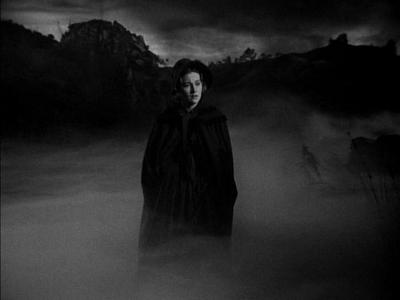
Each of the characters was brilliantly cast, drawn from the golden age of the Hollywood studio system at 20th Century Fox. Orson Welles’ intense, tormented Rochester brooded and boomed the requisite angst and emotion in the most eloquent of baritone tones. Rochester’s voice is so important, and that is where many of the later versions have failed. They whine and simper when they should not. My one puzzlement was with his dark makeup which almost made him look like the Moor of Othello, which he would later portray on film in 1952. You notice the stark contrast in his complexion in scenes with the fair, bewildered Jane Eyre played with delicate vulnerability and strident resolve by Joan Fontaine. This may be all for emotional affect – the dark and light – the bad and the good – contrasting their personalities as opposites, but found it one step over-the-top.


The secondary characters support the story beautifully. There are so many that I will only mention my three favorites: Agnes Moorehead as Mrs. Reed has a very minor role, but she just oozes indolence and arrogance like no other actress of this era. The young actresses in this movie really shine. Peggy Ann Garner as the young Jane is outstanding, relaying the spirit and puzzlement of her situation and Margaret O’Brien as Rochester’s French ward Adele steals every scene. Watch her eyes flash and facial expressions when Rochester returns home to Thornfield with gifts of the dancing dress and slippers. Amazing for one so young. I would be remiss if I did not mention the luminescent violet eyed Elizabeth Taylor as the doomed Helen, Jane’s only friend at Lowood School. It is one of her early roles and she just glows with early stardom.


The Production:

Jane Eyre is a gothic tale, yet few movies relay this fact as affectively as this black and white masterpiece. The use chiaroscuro, deep, long shadows and stark light, used to perfection by painters of the Renaissance, adds an eerie presence of mystery and tension to the scenes. The sweeping and dramatic music score by Bernard Herman, who also scored Citizen Kane and The Ghost and Mrs. Muir, enhances the drama at important moments. The startling garden scene where Rochester proposes to Jane with the wind howls and lightning striking a tree is all tingly terror and happiness all at once thanks to the music. The direction by the venerable Robert Stevenson was overshadowed by Orson Welles’ heavy hand and input behind the camera. Even though Stevenson is given full directing credit, so much of Welles’ unique filmatic style in imprinted in this movie that it must have been a difficult collaboration. The costuming is interesting. Jane wears only about two different demure frocks, and the gown for the elegant gold-digger Blanch Ingram (Hillary Brooke) who is trying to snag the rich Rochester, is as gaudy and flashy as her personality. Visually, this movie is all about contrasts of personalities, settings and emotions.


My Praise:

So why does the 1944 Jane Eyre remain my favorite movie version of Bronte’s classic story? Besides the amazing cast, superb art direction, sweeping music and the perceptive direction – the script adapted from Bronte’s novel by John Housman, Aldous Huxley and Robert Stevenson – though truncated and not strictly faithful to Bronte’s narrative, stands out as the most tragic, romantic and emotionally wrenching of any of the seven versions I have seen so far, including the new theatrical movie released in March staring Mia Wasikowska and Michael Fassbender. I am still strongly convinced that this tale can only be told as a Gothic one, filmed in black and white, and should supply us with two tormented characters who overcome social barriers, a tragic past and emotional upheaval to find the love that they were destined to deserve.


Jane Eyre (1944)
20th Century Fox
Directed by Robert Stevenson
Screenplay by John Housman, Aldous Huxley and Robert Stevenson
Cinematography by George Barnes
97 minutes

***

Laurel Ann, thank you again for your interest and generosity in contributing a guest post for All Things Jane. Thanks to your thoughtful commentary and wonderful screen captures, I'm inspired to revisit this film version of Jane Eyre - it's been FAR too long since I've seen it.

To those you have seen this film version, I'd love to hear your thoughts! And to anyone who hasn't, I dearly hope that this review has piqued your interest as it has mine. :)