Showing posts with label Orson Welles. Show all posts

Wednesday, April 27, 2011

Jane Eyre (1944) - Guest Review

Friends, I am absolutely thrilled to welcome Laurel Ann from Austenprose to the blog today with a guest film review as part of my All Things Jane celebration! Austenprose is one of the premiere destinations in the blogosphere for all things Jane Austen related. Laurel Ann features a plethora of Austen-related book reviews (new editions of her novels, as well as the sequels they've inspired), film and miniseries reviews, Masterpiece discussions!
 
This year, Austenprose is playing host to two fabulous reading challenges (which I'm woefully behind on - need to work on that!) - The Sense and Sensibility Bicentenary Challenge 2011 and the Being a Jane Austen Mystery Reading Challenge 2011.
 
On October 11th, Laurel Ann's first book, Jane Austen Made Me Do It, a collection of short stories edited by the Austenprose webmistress, will release - and you can count on seeing it featured here. :)
 
Please welcome Laurel Ann and her review of the classic 1944 film version of Charlotte Bronte's Jane Eyre!
 
Jane Eyre (1944) – A Review


Tagline: A Love Story Every Woman would Die a Thousand Deaths to Live!

There has been so much discussed and written about the 1944 movie adaptation of Charlotte Bronte’s classic novel, Jane Eyre. Masterpiece, monumental and engrossing are some of the generous praise thrown at its feet. I confess to being one of its loyal admirers having been charmed at a very young age. It remained my all-time favorite movie for many years. Now, looking back at it with a more critical eye, and with many new adaptations to compare it to, it still remains my favorite movie adaptation of the novel so far. I am not a professional film critic, but I can share my reasons why this film moves me to tears even after many viewings, and many years.


Jane Eyre is by far the most popular of Charlotte Bronte’s books, and quite possibly the most well-known of any Victorian novel. Only Charles Dickens' David Copperfield may rival her tale in popularity and readership. Set in the bleak, harsh moors of North England, the story is so familiar that I fear I will repeat myself here if elaborate on it too freely, so here is a very brief synopsis: Jane Eyre, a plain and outspoken young orphan girl is thrown over by her wealthy aunt and sent to a harsh and loveless girl’s institution where she barely survives and manages to eek out an education.


Leaving at age 18, Jane becomes a governess to the French ward of Mr. Rochester of Thornfield Hall in Yorkshire. It is also a cold, mysterious environment until Jane’s constancy and spunk warm the heart of its deeply troubled master Edward Rochester. There are dark secrets lurking in the Hall, including a strange woman named Grace Pool who lives in the attic. Jane and Rochester’s friendship earns her trust and respect and she falls in love with him. Rumors that he will marry a beautiful society debutant forces Jane to face the fact of their social differences are a barrier to his love. She cannot stay and witness him paying his attentions to his new wife and tells him she must leave. He reveals his love and proposes. She accepts. At their wedding ceremony a stranger declares an impediment. Rochester drags his bride and the party back to Thornfield and up into the attic to expose the dark secret which will tear Jane and Rochester apart.


The Cast:

Each of the characters was brilliantly cast, drawn from the golden age of the Hollywood studio system at 20th Century Fox. Orson Welles’ intense, tormented Rochester brooded and boomed the requisite angst and emotion in the most eloquent of baritone tones. Rochester’s voice is so important, and that is where many of the later versions have failed. They whine and simper when they should not. My one puzzlement was with his dark makeup which almost made him look like the Moor of Othello, which he would later portray on film in 1952. You notice the stark contrast in his complexion in scenes with the fair, bewildered Jane Eyre played with delicate vulnerability and strident resolve by Joan Fontaine. This may be all for emotional affect – the dark and light – the bad and the good – contrasting their personalities as opposites, but found it one step over-the-top.


The secondary characters support the story beautifully. There are so many that I will only mention my three favorites: Agnes Moorehead as Mrs. Reed has a very minor role, but she just oozes indolence and arrogance like no other actress of this era. The young actresses in this movie really shine. Peggy Ann Garner as the young Jane is outstanding, relaying the spirit and puzzlement of her situation and Margaret O’Brien as Rochester’s French ward Adele steals every scene. Watch her eyes flash and facial expressions when Rochester returns home to Thornfield with gifts of the dancing dress and slippers. Amazing for one so young. I would be remiss if I did not mention the luminescent violet eyed Elizabeth Taylor as the doomed Helen, Jane’s only friend at Lowood School. It is one of her early roles and she just glows with early stardom.


The Production:

Jane Eyre is a gothic tale, yet few movies relay this fact as affectively as this black and white masterpiece. The use chiaroscuro, deep, long shadows and stark light, used to perfection by painters of the Renaissance, adds an eerie presence of mystery and tension to the scenes. The sweeping and dramatic music score by Bernard Herman, who also scored Citizen Kane and The Ghost and Mrs. Muir, enhances the drama at important moments. The startling garden scene where Rochester proposes to Jane with the wind howls and lightning striking a tree is all tingly terror and happiness all at once thanks to the music. The direction by the venerable Robert Stevenson was overshadowed by Orson Welles’ heavy hand and input behind the camera. Even though Stevenson is given full directing credit, so much of Welles’ unique filmatic style in imprinted in this movie that it must have been a difficult collaboration. The costuming is interesting. Jane wears only about two different demure frocks, and the gown for the elegant gold-digger Blanch Ingram (Hillary Brooke) who is trying to snag the rich Rochester, is as gaudy and flashy as her personality. Visually, this movie is all about contrasts of personalities, settings and emotions.


My Praise:

So why does the 1944 Jane Eyre remain my favorite movie version of Bronte’s classic story? Besides the amazing cast, superb art direction, sweeping music and the perceptive direction – the script adapted from Bronte’s novel by John Housman, Aldous Huxley and Robert Stevenson – though truncated and not strictly faithful to Bronte’s narrative, stands out as the most tragic, romantic and emotionally wrenching of any of the seven versions I have seen so far, including the new theatrical movie released in March staring Mia Wasikowska and Michael Fassbender. I am still strongly convinced that this tale can only be told as a Gothic one, filmed in black and white, and should supply us with two tormented characters who overcome social barriers, a tragic past and emotional upheaval to find the love that they were destined to deserve.
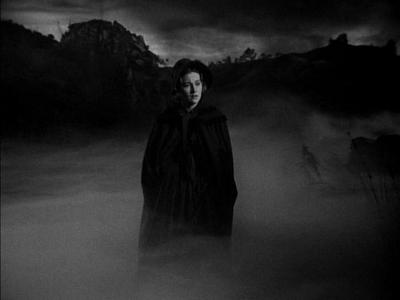


Jane Eyre (1944)
20th Century Fox
Directed by Robert Stevenson
Screenplay by John Housman, Aldous Huxley and Robert Stevenson
Cinematography by George Barnes
97 minutes

***

Laurel Ann, thank you again for your interest and generosity in contributing a guest post for All Things Jane. Thanks to your thoughtful commentary and wonderful screen captures, I'm inspired to revisit this film version of Jane Eyre - it's been FAR too long since I've seen it.

To those you have seen this film version, I'd love to hear your thoughts! And to anyone who hasn't, I dearly hope that this review has piqued your interest as it has mine. :)

Saturday, December 26, 2009

Me and Orson Welles


Me and Orson Welles opened in my area last Friday, and I went to see it Monday night with my friend Lori. It is SUCH a treat. I wrote a bit about the storyline a few weeks ago in my review of the novel on which the film is based (you can read my review of Robert Kaplow's novel here). Suffice it to say Me and Orson Welles is one of the best book-to-film adaptations I’ve ever seen. I haven’t verified this, but I’m pretty sure whole passages of dialogue were transferred to the script, practically verbatim. I loved everything about this movie. I’m a movie nut, as long time readers of this blog well know, but it’s a rare thing that a movie comes along that caters so perfectly to my tastes. This story is a love letter to the golden age of New York theater, when another world war probably seemed like an impossibility to anyone not deeply interested or involved in politics or foreign affairs. Nostalgic and funny, Me and Orson Welles is not only one of the best book-to-film adaptations I’ve ever seen, it’s also got to be one of the best theater movies ever made. All of the backstage drama makes the scenes showing the actual performance that much more powerful. You can’t help but stand in awe at the magic that’s possible on stage, and it’s such a treat to see it unfold.

The runaway star of the film is British actor Christian McKay as Orson Welles. The man deserves every single accolade and award thrown his way. His performance is absolutely spectacular. Now, remember that I’m not a Welles-ian scholar by any means, but having read the novel and seen several of Welles’s films multiple times, McKay doesn’t just play Orson Welles, he is Orson Welles. He manages to capture at the very least the public persona (and that is no small feat!), the essence of the man and the magnetic quality of his personality that comes through on screen. McKay’s performance is the center of the film, and deservedly so. McKay deserves every acting nomination possible IMO.

Zac Efron also rises above his High School Musical roots to deliver a surprisingly strong performance as the teenage Richard. While Richard’s role is of course prominent in the novel (it’s told from his point-of-view), you lose a little of that on screen. The movie is a little less heavy on Richard’s coming-of-age angst and school drama, choosing instead to focus on the backstage theatrics that ensue in the frantic days prior to the Mercury Theater’s first performance of Julius Caesar. He nails the role of Richard perfectly, balancing the character's bravado and uncertainty, a perfect foil for McKay's rather overwhelming Welles. Efron "fits" period roles really well - this and his turn in Hairspray being favorites of mine. Would love to see more of this type of work from him in the future.

The rest of the cast is chock-full of notable acting talent and strong performances - just want to mention a couple. Eddie Marsan, who was so wonderfully funny as Pancks in Little Dorrit earlier this year plays Welles's long-suffering business partner John Houseman. It was a real treat to see him on the big screen. :) Claire Danes was pretty good as Richard's crush, Sonja Jones. She fit the time period well, and delivered a good sense of Sonja's take no prisoners attitude towards achieving her goals that comes through in the novel. James Tupper really impressed me as Joseph Cotten, not only because he's cute (LOL) but because he's such a dead ringer for the real Joseph Cotten, in my opinion anyway. I must also mention Kelly Reilly as Muriel Brassler, one of the lead actresses in the Mercury Theater troupe. She's becoming something of a familiar face, since I've now seen her in Poirot, Mrs. Henderson Presents, Pride and Prejudice, and Sherlock Holmes (review of the latter forthcoming). I was also very impressed with Zoe Kazan's turn as Richard's more *ahem* age-appropriate love interest, Gretta. Kazan happens to be the granddaughter of Elia Kazan, which I thought was an interesting piece of trivia. She also had such a great "look" about her, not your typical Hollywood look which was rather refreshing to see. I could mention a laundry list of other enjoyable performances, but I'll leave it at that. Suffice it to say, the film is packed with top-notch work.

The success of the film rests in large part on director Richard Linklater's pacing and world-crafting, both of which are superb. This story covers just one short week in Richard's life, and due to that time constraint, the pace never lets up. The film practically hums with energy and life. And the movie's depiction of 1930s New York is just fantastic - I could've stayed in that world for ages. :) Also, the costumes and set pieces just scream authenticity - everything on-screen represents period drama at its finest. I also adored the music - both the original score pieces, and the use of period songs, the latter so important to Richard's character in the book. It's all very, very well done. Loved the movie, can't wait until it comes out on DVD. It's backstage drama at its finest. :)

Monday, November 23, 2009

Review: Me and Orson Welles by Robert Kaplow

Me and Orson Welles
By: Robert Kaplow
Publisher: Penguin
ISBN: 978-0-14-303522-0

About the book:

“This is the story of one week in my life. I was seventeen. It was the week I slept in Orson Welles’s pajamas. It was the week I fell in love. And it was the week I changed my middle name – twice.”

With this beginning, Robert Kaplow sweeps readers into a breakneck romantic farce that reads like a Who’s Who of the classic American theater. At center stage is the twenty-two year old Orson Welles, about to launch his debut production of Julius Caesar. Enter Richard Samuels, an achingly sincere teenager who literally walks into his first acting job. What he finds is a whirlwind of comedy and pathos, self-absorbed celebrities and their outsized egos, art and love. Me and Orson Welles is a joy.

Review:

When I saw the trailer for the upcoming film Me and Orson Welles, I knew I had to read the book on which the movie is based. The story looked tailor-made to cater to my tastes – the clothes, the music, the theater of the time period, I love it all. With the book, Robert Kaplow has crafted a witty and insightful coming-of-age story that doubles as one of the best love letters to a bygone age that you could wish for. (Just a heads up, there is some off-color language in this book – I would’ve preferred a less, but if you can get past that the story is that the story is terrific!) In the late 1930s, America was in a depression with no thought of the war to come, and master songsmiths like Irving Berlin and Cole Porter were making their contributions to what would become known as the Great American Songbook. It was a “golden age,” when American films featured stars like Gary Cooper and Cary Grant, and the theater was peopled by the likes of the Barrymores and young Orson Welles.

Into this glittering theatrical world, seventeen-year-old Richard Samuels literally stumbles upon his first acting job – a bit part in Welles’s fledgling Mercury Theatre production of Julius Caesar. Full of big dreams and hopelessly idealistic, Richard has no idea what he’s gotten into when he joins the production and finds himself in Orson Welles’s starry orbit. Welles is a star on the rise and he knows it. The man is a pompous jerk but the allure of his genius is irresistibly strong and undeniable. In one short week, Richard probably learns more about life, love, and his own purpose and self-worth than many people do in an entire lifetime.

Richard’s voice just shines and makes this novel a joy to read. He’s worldly-wise yet naïve, sarcastic yet sweet – in other words, a typical teenager made up of all the confusion and contradictions that accompany that time of one’s life. Kaplow also excels at building his setting – he absolutely nails NYC. The city itself is as much of a character as Richard or Welles, and reading the descriptive passages in the novel made the sights, sounds, and smells of the city come alive. This book is also one of the best mash-ups of fiction and historical fact that I’ve ever come across. I’m a huge classic film fan, so reading about Orson Welles’s theatrical beginnings, or learning that actor Joseph Cotten was a member of the Mercury Theatre troupe, were absolutely fascinating. While I could never claim to be a Wellesian scholar, based on my perception of Orson Welles’s character from his films that I’ve seen, Kaplow has done an excellent job of capturing the essence of the man. Every time Welles spoke on the page, it was his unmistakable voice that I heard in my head while reading.

If you’ve seen the television show Slings & Arrows, Me and Orson Welles comes as close as you could wish to capturing the humor, angst, and life found in the theater. Me and Orson Welles is a breezy, insightful, laugh-out-loud funny love letter to a golden age in American entertainment.

Here's the movie trailer:


I cannot WAIT to see this movie!! The last time I checked it opens in NY and LA over Thanksgiving, and then wide release December 11th. I just hope those dates don't change (unless they move the wide release opening up...I would totally go for that). ;-)