Tuesday, June 28, 2011

Poirot: The Clocks


Masterpiece Mystery continued last night with another thoroughly enjoyable Poirot mystery entitled The Clocks. I don't know if it's just because I haven't been familiar with this latest slate of Agatha Christie mysteries, or if there's been a genuine up-tick in episode quality (irregardless of faithfulness to the source material), but I'm enjoying the broadcast runs of these episodes much more than previous years of Poirot offerings. Is it just me? Anyways, here's the episode summary from the PBS website:

A lovely young stenographer, Sheila Webb, is greeted at a job not by her client but by an eerie assembly of clocks all frozen at the precise same moment in time and, behind the couch where she sits waiting, a corpse. Horrified, she scrambles screaming into the street, straight into the arms of Naval Lieutenant Colin Race. In Race, she finds a protector who takes her story to Hercule Poirot, and together they set about exonerating her, all the while trying to unearth a German mole who masterminded Race's botched spy mission at Dover Castle. But when a second murder is discovered, the mystery becomes more "dagger" than "cloak" and the evidence mounts against Sheila. Faced with enduring a pint of beer, the rubbing of cats against his legs, and being mistaken for a Frenchman, will Poirot prevail in revealing the killer and the mole? Joined by Tom Burke (Dracula), David Suchet stars as Hercule Poirot in this adaptation of the novel by Agatha Christie. (One episode; 90 minutes; TV-PG)
The Clocks opens with a bang, a suspensful set-up involving stolen intelligence documents that was reminscent of The 39 Steps. It's the end of the workday in a maze of tunnels beneath Dover Castle, and Fiona Hanbury (Anna Skellern) witnesses her co-worker, Annabel Larkin (Olivia Grant)
filch documents from a private office. Unable to rally her fiance, Lt. Colin Race (Tom Burke), engrossed in an after-hours poker game, Fiona nervously tails the thief. While jotting down the address, she's seen by her target, and in her attempt to flee the scene both women are struck dead by a passing car. That has to be one of the most action-packed openings to a Poirot episode of all time - *BAM* and you have two actresses vaporized. I'm unfamiliar with Skellern's work, but Grant may be familiar to fans of the show Lark Rise to Candleford, where she played the character Lady Adelaide Midwinter. Tom Burke may be recognizable to fans of the mystery series Jericho from a couple of years ago, when he appeared in the episode A Pair of Ragged Claws. I'd love to see more from Burke in the future, I think he's got a lot of period drama potential.


Race is - as he should be!! - guilt-ridden over dismissing Fiona's last frantic phone call. Within a few days, Race is seeking out his old friend (I can't help it, I find Poirot's never-ending supply of "old friends" hilarious) Hercule Poirot (David Suchet) for help with a curious mystery that literally ran him down in the street while he was attempting to decipher Fiona's hastily scrawled clue identifying the German spy. Sheila Webb (Jaime Winstone) runs into Race, screaming from a house where she found a dead body. Sheila, a typist, was sent to the location after a phone call to her agency specifically requested her services. Suspicion falls on Sheila when the owner of the home, the blind Miss Pebmarsh, claims she never made the phone call requesting the typist's services, and doesn't know Sheila or the victim. Race has a chivalrous streak, and is determined to clear Sheila's name. It's blindingly apparent that this is due to equal parts chivalry and the fact that he's quite taken with Sheila, nevermind that his fiance has been dead for less than a week. *rolls eyes*

Winstone does the period look extremely well. I've only ever seen her in one other film - Made in Dagenham, where she exhibited a great deal more spunk, and I've got to say I think the role of Sheila would've benefited from a dash of the sass she exhibited in that film. Miss Pebmarsh is played by the absolutely divine Anna Massey. Massey has appeared in everything from the Around the World in 80 Days miniseries, where she played Queen Victoria, to The Importance of Being Earnest, where she played Miss Laetitia Prism, as well as a memorable turn in Inspector Lewis.


This is where things start to get a little crazy plot-wise, and I'm sure that the novel streamlines the investigations (because Christie was a genius, and some of these reworked scripts...aren't *g*). However, jumps in logic and red herrings aside, what saves this adaptation for me is the period detail and engaging performances. Race's superior, Vice Admiral Hamling (Geoffrey Palmer), is convinced that the stolen government documents and the dead man are connected, and urges the investigation to proceed along those lines. Palmer is a long-time favorite of mine, and it was a real treat to see him in a Poirot film. If you've never checked out his work, I highly recommend the long-running series As Time Goes By, which Palmer headlined opposite Judi Dench. Sadly for this film, I felt like Palmer's presence was really under-utilized.

Accompanied by the long-suffering local Inspector Hardcastle (Phil Daniels), Race and Poirot interview the odd assortment of neighbors in the vicinity of the murder. While I enjoyed the appearances of actors like Guy Henry as the academic Matthew Waterhouse (Henry plays Pius Thicknesse in Harry Potter and the Deathly Hallows and Mr. Collins in Lost in Austen) and Jason Watkins as the deceptively-named Joe Bland (Bland is perhaps best-known for his role as Plornish in Little Dorrit and Herrick in the series Being Human), the number of unnecessary-to-the-plot neighbors the script throws at the viewer tends to muddy the waters of the investigation's on-screen flow. However, from the perspective of looking at a microcosm neighborhood life, the juicy gossip uncovered in the interviews provides the neighbors with a fun excuse to dish on each other.

Regarding the agency Sheila works for, I was thrilled to see Lesley Sharp appear in The Clocks as the agency's proprietress Miss Martindale. Sharp is a Masterpiece veteran, having appeared in The Diary of Anne Frank as Petronella van Daan and Cranford as Mrs. Bell, as well as a memorable appearance in the Doctor Who season four episode entitled Midnight. I really enjoyed Sinead Keean's appearance as Sheila's ill-fated co-worker Nora. Keenan played Addams in the Doctor Who special The End of Time, and currently is probably best-known as George's girlfriend Nina in the supernatural sci-fi drama Being Human. She was the perfect choice to play the bold and brassy Nora, and handled the period aspects of the role extremely well.

While this script throws red herrings at the viewer left and right, and the resolution of the two disparate cases is nice and convenient, overall I still really enjoyed this film and look forward to investigating Christie's orginal novel soon (hopefully...there's so many things I want to read "soon"!). Whether or not the Miss Pebmarsh storyline plays out in the novel in the manner it does on-screen is irrelevant to my appreciation of her spy-related plot twist in the film. I thought it was interesting and pretty effective to have Pebmarsh turn to spying following the deaths of her sons in the Great War - the same conflict that also led to her blindness.

I'm a total sucker for the romances in this mystery films, but there was a missed opportunity with the Colin and Sheila storyline. From what I've read about the novel's storyline, the Colin character doesn't have a fiancee, so any romantic interest doesn't have, oh, I don't know, RECENT TRAUMATIC DEATH hanging over its development. *sigh* The script gives Sheila a ton of emotional baggage, and since Colin very clearly has a hero complex in the world of The Clocks they are destined to be together. I like Colin as an emotionally sensitive hero, and I do think that's what Sheila needs, but I would've liked him - maybe respect is a better word - better if he hadn't been making out with needy Sheila a week after Fiona gets squashed by a car. That said, this little romance leads to one of the funniest moments in Poirot series history in my opinion - when Poirot basically asks Colin if he needs a kick in the pants to go after Sheila, Colin pauses, and then pats Poirot on the arm in a hilariously condescending, no-of-course-not-papa type moment. I was rolling. :)

Overall, I found The Clocks is another solidly entertaining entry in the Poirot portion of the Masterpiece Mystery season. I love the attention to period detail, the cast chock-full of familiar faces, and the briskly-paced, engaging storyline. I'd love to hear your thoughts! :)

Saturday, June 25, 2011

Poirot continues on Masterpiece

Tomorrow on Masterpiece Mystery, Poirot continues with a brand-new episode entitled The Clocks, based on the novel by Agatha Christie. Here's a bit about the story:
In Dover on the cusp of war, cloak meets dagger when Hercule Poirot is called on to uncover a German spy network and exonerate a beautiful stenographer accused of a grisly murder. David Suchet stars as Poirot in a new episode of an Agatha Christie whodunit, The Clocks, airing Sunday, June 26, 2011 on MASTERPIECE MYSTERY!
I'm really looking forward to this story, especially since it sounds vaguely reminscent of The 39 Steps!

Friday, June 24, 2011

"you transfix me quite"


We haven't talked about Jane Eyre in far too long, my friends. The above image is the recently released poster for the UK release of Jane Eyre - isn't it the most gorgeous thing you've ever seen? I love the juxtaposition of the warm pink hues in the Jane half of the poster, contrasted to the frosty shade of blue in the Rochester portion. Blue works for Michael Fassbender, no? *wink*

While UK Bronte fans are looking forward to the theatrical release of Jane Eyre (seriously, I don't know how they've survived this long - j/k), North American Jane Eyre fans will see the release of the film on DVD and Blu-Ray August 16th.

AUGUST 16TH.

That's less than two months from now, people! Happiness!! :)


Here's some info on the DVD extras (excuse me while I swoon, again, but isn't the DVD artwork LOVELY? *sigh*):
  • A Look Inside Jane Eyre
  • To Score Jane Eyre: Director Cary Fukunaga and Composer Dario Marianelli Team Up
  • The Mysterious Light of Jane Eyre
  • Director’s Commentary with Director Cary Fukunaga
  • Deleted scenes
I'm especially excited about the deleted scenes. More Rochester/Jane please? :)

Here's the trailer for the UK release of Jane - I highly approve of all the Rochester scenes, don't you?


And, because it's Friday, and because this blog has been a veritable Jane Eyre-wasteland for far too long, here are some clips of Michael Fassbender and Mia Wasikowska being brilliant and swoon-worthy as Rochester and Jane. (Thanks to Rachel for going on a Jane Eyre clip-posting spree on Facebook last night.)

"I would do anything"


I couldn't resist. :)

Thursday, June 23, 2011

Review: Petra by T. L. Higley


Petra: City in Stone
By: T. L. Higley
Publisher: B&H Books
ISBN: 978-1-14336-6856-2

About the book:

She believed the city hidden in rock would protect her from the past - until it threatened to destroy her future.

Cassia, a destitute young woman in need of hope, seeks refuge for her little boy in Petra, home of his dead father's estranged family and capital of the flourishing Arabian empire. Surely this rock-carved city, hidden away between towering sandstone cliffs, can protect them from their pasat and provide for their future.

But the boy's father was not the man she believed, and when a murderous queen plots to take Cassia's son, her hopes of security are ripped away.

As the plot against the young Alexander unfolds, Cassia finds unexpected allies in the mysteriesou followers of The Way, who sacrifice everything to help Cassia rescue her son from the queen and her pagan gods. But it will take more than these new friends to save her son.

It will take a power beyond any Cassia has known - and a faith that can save a city.

Review:

Julian, a privileged son of Rome, fled his home and family when he failed to stop a new wave of persecution against Christians, costing him his betrothed and leaving his confidence in his faith and calling deeply shaken. Cassia abandoned the security of her home in Damascus following the death of her young son Alexander’s brutish father. Desperate to provide for her son, she makes her way to Petra, the great trading city cut out of stone, seeking Alexander’s estranged grandparents and the hope of a brighter future for her son. Cassia’s hopes for a fresh start in Petra are crushed when she earns the enmity of Petra’s powerful, malevolent queen, and her son is stripped from her arms. Left frightened and alone, Cassia is shocked to discover aide from an unexpected quarter – followers of The Way, a faith that subscribes to only one God, a strange people she’d been taught to distrust. Julian longs for the comforting escape of anonymity, but his empathy for Cassia’s plight and the dark spiritual forces at work in the city call him to take a stand. In the fight to save Alexander, the untried and the tested alike will face forces that will threaten the very existence of Petra’s fledgling church and the future of the city itself.

Petra is my first T. L. Higley novel, and it certainly won’t be my last. I love the fact that she sets her fiction in periods that do not seem to receive a great deal of attention in the current market. The ancient time period and exotic setting lend Cassia and Julian’s story an appealing flair of high stakes adventure and romance. It’s refreshing to read a novel set in ancient times that isn’t biblical fiction. Instead, Higley makes good use of the post-resurrection time period to explore the establishment of the early church, and the push and pull of how it functioned in a largely polytheistic world increasingly dedicated the persecution of “upstart” Christian believers. I loved how through the church fellowships Higley illustrated the critical role letters from leaders of the faith (i.e., Paul’s letters to the Ephesians, etc.) played in growing the church and encouraging often-vulnerable or reviled Christians to stand firm in their faith and witness to their communities.

Higley’s first “lost cities” novel is a fast-paced tale, liberally laced with adventure and spiritual truths. I felt like the narrative got a bit bogged down in the final fourth of the novel with the main characters’ “spiritual awakening” moments. While certainly critical and important to their character arcs, I felt like it stalled the forward momentum of the plot a bit longer than I would’ve preferred. That said, Higley does a superb job with the story’s sense of place and time and in crafting characters that really feel authentic to their time period, and timeless and relatable in their struggles and experiences. Cassia is a fantastic example of Higley’s character-crafting abilities – it would be all too easy to present her as a single mother, with modern views on women’s roles and independence, but Higley doesn’t fall into that trap. Cassia’s desire to be loved wars with a desperate need for independence and security birthed from years of victimization – a struggle that is relatable today, but believable within the ancient timeframe of Petra.

The entire time I was reading Petra, I was reminded of the Indiana Jones films. This is in no small part, I’m sure, due to the fact that Petra makes an appearance in The Last Crusade. But more than that, the timeless spirit of adventure that Higley imbues in every page of her story is what reminded me of Indy’s adventures. Higley clearly appreciates and relishes the adventure of faith, and that, coupled with a strong sense of time and place and fast-paced action makes Petra an absorbing, thoroughly entertaining read.

Monday, June 20, 2011

Midnight in Paris


I love it when a movie surprises me, and succeeds in exceeding all of my expectations and completely and utterly capturing my imagination. Surprisingly, Midnight in Paris is such a film. I say "surprising" because historically Woody Allen and I have not been the best of friends. Prior to Paris there was a grand total of two, yes two Allen films I could say I liked - The Purple Rose of Cairo and Scoop. Midnight in Paris blows past its slim competition in Allen's filmography, and indeed shoots past most of its contemporary competition to achieve the elusive mark of ultimate favor from me - that of a modern-day classic. This is one of those rare films that I can best describe by saying it "gets" me. This is a film that engaged me on all fronts, emotionally and intellectually, best experienced in a packed theater full of like-minded patrons who feel the exact same way.

Woody Allen gets me on that deep a level? Yes. Apparently so. File that under things I never thought I'd type. :)

Gil is a romantic, who longs to escape his hum-drum existence as a scriptwriter in Hollywood to pen a novel like his literary heroes who inhabited Paris in the 1920s - Hemingway, Fitzgerald, Stein, etc. He's engaged to his complete opposite, Inez - a pretentious, nagging twit who has no understanding or sympathy for Gil's literary aspirations or romantic nature. In keeping with the theme of "firsts" for this movie, Gil is played by Owen Wilson, who is absolutely delightful, funny, and charming - and again, those are three adjectives I never thought I'd apply to that man. Wilson fills the requisite "Woody Allen" role with dash and endearing style, and if he would tap into this side of his acting personality more often I could be a huge fan. Rachel McAdams, as Inez, I can take or leave quite easily. I thought she was excellent in the Shakespearean-themed Slings and Arrows series, and later this year we'll get to see her take on Irene Adler in Sherlock Holmes: A Game of Shadows (which sounds more like a video game than a film, but whatevs). She plays the incredibly clueless, annoying Inez really, really well. (I'm ignoring the oh-so-unsurprising Republican stereotyping mercifully and briefly employed vis-a-vis Inez's parents.)

I was an English major in college, and this film actually succeeded in making me really and truly miss school, homework and deadlines and all. Midnight in Paris is a lit lover's dream come true. Whether or not you cherish the works of Fitzgerald and Hemingway, their own special brand of genius and impact on literature cannot be denied. Watching Gil geek out over meeting his writing heroes is like the ultimate in English major wish fulfillment, simply imagine yourself in his shoes, standing opposite a favorite author, and voila, the magic of Midnight in Paris is instantly personalized.

The soundtrack to this world is glorious. Allen had the good taste to liberally sprinkle the soundtrack with Cole Porter songs - the man is a absolute favorite of mine, so witty and urbane and intelligent. The song choices and instrumental pieces provide a glorious soundscape for Gil's time-tripping Parisian adventure.


One of the film's biggest charms is its characterization of literary and artistic giants like Fitzgerald, Hemingway, Salvador Dali, and Pablo Picasso. While Adrien Brody was absolutely hilarious with his over-the-top, energetic portrayal of Dali, Corey Stoll, I think, stole the show with his interpretation of Ernest Hemingway. Dry, hilariously monotone, and just positively seething with an over-the-top, excessive sense of hyper-masculinity, Stoll just owned the screen as Hemingway. Which was good for Hemingway, because I have never been a big Hemingway fan...

F. Scott Fitzgerald, however, is another story, my friends. And this isn't just a Great Gatsby thing, Gatsby is all well and good but it's his short stories that make my heart sing. I absolutely wore out my reprint edition copy of Flappers and Philosophers. Anyways, if you've been around the blog for a while, you know I'm a ridiculously excitable Tom Hiddleston fangirl, and when he came on-screen as Fitzgerald I nearly jumped out of my chair. One has to admire the man's acting range - he covers Masterpiece fans with his turns in Cranford and Wallander, and comic book movie fans with utterly memorable, completely beguiling, loved-every-second-of-it turn as Loki in Thor (my review). Hiddleston and Alison Pill as Zelda did a superb job bringing a little slice of the Fitzgeralds' stormy, passionate relationship to life.

On his "accidental sojourns" into the past Gil meets Adriana (Marion Cotillard), one of Picasso's on-again, off-again lovers. The two instantly click, in no small part due to the fact that they are both die-hard romantics by nature. Cotillard positively shines as Adriana. She looks as though she were made to inhabit 1920s Paris (just one way of saying she is class personified) - her turn in Public Enemies (my review) also proves her affinity for the period - and Allen plays up her etheral beauty to great effect, making it easy to see how she captivates Gil from the moment they meet.* I loved Cotillard's appearance in Inception (my review), and I'm really looking forward to seeing her in The Dark Knight Rises next year.

*The scene where Gil tries to hide the fact that he was going to give Adriana a pair of Inez's earrings was comedy GOLD. Also, while I'm on the subject of Gil and women, his scenes with Gertrude Stein (Kathy Bates) are wonderful. Blunt, forthright, and brassy, Bates was wonderful in the role.


Unlike Gil and to his ever-lasting shock, Adriana does not hold the belief that her time is a golden age. She longs to live in the Paris of the 1890s, when artists like Edgar Degas (Francois Rostain) and Henri de Toulouse-Lautrec (Vincent Menjou Cortes) frequented the Moulin Rouge and restaurants like Maxim's, a gathering place for the glittering social and artistic elite of the day. It was a real treat to see this film's recreation of Maxim's, as my first filmic introduction to that famous address was in the 1958 film Gigi.

It's only after Gil follow's Adriana into her dream world that he realizes living in the past isn't all its cracked up to be (i.e., a lack of vaccinations in 1890s Paris). Living with one's eyes completely on the past blinds one to the charms of the present, and strips the era in question of its uniqueness and beauties. Balance is the key, and it's a concept that Allen beautifully articulates on-screen. Midnight in Paris knows what makes nostalgia lovers like me tick. We can't recapture a golden age, but we can love it and appreciate it, and through that appreciation enrich our present.

As Gil discovers, it's best not to live in one's dreams, you might say, but to use those dreams to enrich one's present - and when one finds like-minded souls that share the same passions, so much the better, no? :) I was excited to see Gabrielle, a fellow Cole Porter aficionado, played by Lea Seydoux, last seen as Isabella in Robin Hood (my review) and later this year in Mission Impossible.

I adored every second of this movie. Midnight in Paris is a film for dreamers, a love letter to romantics, a rare movie-going experience for lit lovers to savor. Packed with glorious shots of Paris, past and present, to savor, gorgeous costumes and period detail, top-notch acting, and hilarious one-liners, get thee to a theater to see Midnight in Paris ASAP. If you need more convincing, read Rachel's fantastically articulate take on the film at a Fair Substitute for Heaven.

Poirot: Three Act Tragedy


Masterpiece Mystery (finally) kicked off its new season properly last night with a brand-new Hercule Poirot episode entitled Three Act Tragedy. I found this episode to be a thoroughly enjoyable, stylish entry into the Poirot film canon. Now, I have yet to read the original novel by Agatha Christie, but a cursory glance at the book's Wikipedia page reveals that - shockingly - this film seems to be a pretty faithful adaptation of Christie's story. Is this a new trend? (I'm not going to hold my breath. *wink*) Here's the episode summary from the PBS website:

When an elderly Cornish vicar suddenly drops dead at a party, everyone looks to fellow guest Hercule Poirot to solve the murder. But the Belgian super-sleuth sees no foul play, correctly predicting that analysis of the clergyman's glass will yield nothing more than the remains of an excellent dry martini.

Before long, however, Poirot is summoned back to England from his boredom among the palms and irksome children of Monte Carlo. Another death among the same revelers has occurred, this time, indisputably, murder.

With the help of two enthusiastic amateurs — his old friend, the retired stage actor Sir Charles Cartwright, and Charles's jaunty love interest, Miss "Egg" Lytton Gore, Poirot questions the dramatis personae, as Sir Charles calls the party guests. And as Sir Charles embraces his role, donning a pair of patent-leather spats, Poirot works to unravel a perplexing mystery, building a house of cards, tracking a missing butler, and even hosting his own sherry party — "That is a fashionable thing to do, n'est-ce pas?" David Suchet portrays the fastidious detective Hercule Poirot, with Martin Shaw as Sir Charles Cartwright and Art Malik (Upstairs Downstairs) as Sir Bartholomew Strange, in this adaptation of Agatha Christie's novel. (One episode; 90 minutes; TV-PG)

First of all, I just have to point out the hilarity in having Poirot conveniently be "best friends" with yet another random person who doesn't seem to know any of Poirot's other "best friends" from his previous stories (much like the penchant for having Miss Marple distantly related to everyone in England). The friend in question this time around is Sir Charles Cartwright, a famous stage actor on the brink of retirement, who has gathered Poirot and an assortment of other friends and acquaintances to his home for a cocktail party. Cartwright is played by Martin Shaw, who I love and adore because of his memorable portrayal of Chauvelin in The Scarlet Pimpernel television film series. Cartwright aspires to a May/December romance with young ingenue Miss Lytton Gore, known to her friends as Egg (I kid you not). Egg is played by Kimberley Nixon, who got her start on Masterpiece playing Sophy Hutton in Cranford, followed by a small role in the hilarious film Easy Virtue (my review). It is a testament to my love for Shaw that the forty year age difference between him & Nixon didn't seem *completely* unbelievable. The man has charisma. :)

Cartwright's other best friend is nerve specialist Dr. Bartholomew Strange, played by Art Malik - last seen in Upstairs Downstairs as Mr. Amanjit, and here is nearly unrecognizable without all that hair. Dr. Strange, Egg, and Poirot are the guests of honor at Cartwright's cocktail party, and the shocked witnesses to the sudden death of the kindly vicar Reverend Babbington (Nigel Pegram). The reverend was elderly and harmless - despite the suddenness of his passing, Poirot writes off his death as an unhappy coincidence - until Cartwright brings him the news that his friend Dr. Strange has dropped dead in the same manner at a similar party, held for almost the identical guest list as the first. A closer investigation reveals that a murderer is on the loose - but the disparities between the victims, and the broad assortment of potential motives among the partygoers raise more questions than answers. With the help of his friends and "the little grey cells" Poirot is in a race against the clock to discover the murderer before he can strike again.

As is the norm for this series, the cast is packed with a slew of familiar British acting talent, though in this case most of them serve as investigative red herrings. In addition to the main players I've already discussed, Kate Ashfield, a Masterpiece vet, appears as the ambitious playwright and astute observer of human nature Miss Wills. Ashfield played the role of Miep Gies in The Diary of Anne Frank (my review) and appeared opposite Douglas Henshall in Collision (my review). Anastasia Hille is a Mystery veteran, having appeared in memorable episodes of Inspector Lewis and Foyle's War. Here is plays high-end fashion designer Cynthia Dacres, which is really just an excuse to show case some AMAZING period fashions - seriously, the clothes in this episode were fabulous! Cynthia's husband is a wastrel gambler played by Ronan Vibert, who played a critical role in the Inspector Lewis universe, and is also a Scarlet Pimpernel veteran along with Shaw, where he played THE BEST ROBESPIERRE EVER.


My favorite random cast appearance is Tom Wisdom in the largely thankless role of Egg's rejected lover Oliver Manders. TOTAL EYE CANDY (at least he provides Egg with a nice back-up plan). Wisdom has appeared in modern classics like The Sisterhood of the Traveling Pants 2 (just so you know, I loved that movie) and in the category of so-bad-they're-awesome movies, The Dragon Chronicles: Fire & Ice. The latter is hilariously, wonderfully bad and I love every second of it. Wisdom also bears a more than passing resemblance to Ben Barnes, a.k.a. Prince Caspian. Thoughts?


 Barnes is on the left, and Wisdom is on the right. Amazing, no?

Three Act Tragedy is a stylish, well-constructed little film, and it ranks as one of my favorite Poirot episodes to be released in recent years. I loved the impression the film gave, that it was very intentionally filmed like a play - right down to Shaw's tendency to deliver his lines as though he's declaiming Shakespeare from the stage of the Globe Theatre. From the "scene change" moments featuring items like critical newspaper headlines, to the spotlights that stopped the action to shine on a murder victim, the whole film felt like a deliciously stylized 1930s-era play. And the "reveal" at the end of the investigation is perhaps one of my favorite Poirot moments ever. Suchet lets Poirot relish, just a bit, the detective's moment in the spotlight when he hijacks a play rehearsal. I've always gotten the feeling that Poirot thinks the world revolves around him, and for a few fantastic moments in Three Act Tragedy it does, and my favorite Belgian detective holds his audience captive.

If you caught this episode, I'd love to hear your thoughts! Especially if you've read the novel - based on the summary info online, I'm still rather shocked by how faithful the film seems to have remained to the book's essential elements. I thoroughly enjoyed this episode and look forward to revisiting it in the future!

Sunday, June 19, 2011

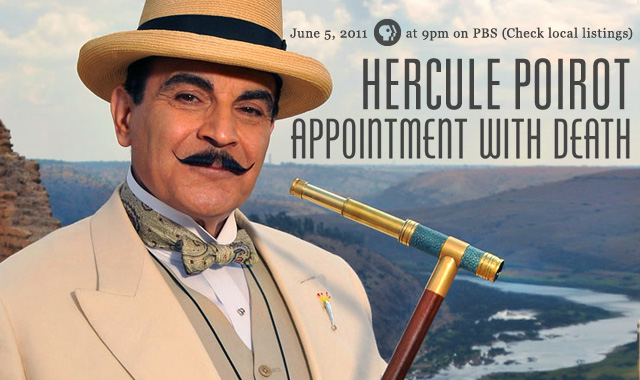
Poirot: Appointment with Death


Agatha Christie's Middle Eastern-set mysteries have always ranked among my favorites of her work. She had such a gift for bringing the land, people, and history, dripping with mysterious possibilities, to vibrant, colorful life in her books. I really looked forward to the latest adaptation of Appointment with Death on Masterpiece Mystery. Not only is it packed with a first-rate cast, but the novel is one of my favorites, and the setting is FABULOUS. Following the recent trend of completely rewriting - and in many cases butchering - Christie's original stories, Appointment deviates substantially from the original novel. However, in this case, I'm able to pretty much enjoy the film version "as is," despite the fact that I think Christie's story is much better than this reworked version. One can't beat the original. :) That said, here's the film summary from the PBS website:
Impassioned archaeologist Lord Greville Boynton, accompanied by his universally despised wealthy second wife Lady Boynton, is in zealous pursuit of a major artifact in Syria. A curious array of onlookers has also gathered in the unforgiving desert heat — among them the tormented Boynton children, a psychiatrist, a nun, a travel writer and a cerebral but not exactly rugged Belgian detective, Hercule Poirot. When most of the camp returns from an expedition, they find Lady Boynton has been stabbed to death. How can Poirot make sense of a murder when most of the suspects weren't even present at the time of death? Poirot's investigation exposes red herrings, broken personalities and a tragic back story buried deep. Will Poirot give up in frustration or will the voices of his little grey cells sing out and solve the case? David Suchet stars as Hercule Poirot in this adaptation of the novel by Agatha Christie, joined by Tim Curry (Return to Cranford). (One episode; 90 minutes; TV-PG).
Lord Greville Boynton's lifelong quest to discover the resting place of the head of John the Baptist is on it's latest stop in Syria, where his family and a host of interested onlookers converge on the dig site to witness Boynton's hoped-for archaeological triumph. Boynton is brough to life with energy and verve by the fabulous Tim Curry, last seen on Masterpiece in Return to Cranford. Boynton is rather likable if frustrating - completely absorbed by his work, he is also completely blind to the fact that his wife, Lady Boynton (Cheryl Campbell) is universally despised by family and acquaintances alike. Campbell may be familiar to fans of Inspector Lewis - the actress appeared in the episode Music to Die For. Campbell positively chews the scenery in every scene she appears in - one has to wonder if she relished, just a bit, the chance to play so wholly repulsive a character like Lady Boynton. Interestingly, the script chooses to make Lady B. a big player in the American financial markets - a wholly fictional construct when compared to the novel, but it opens the door to interesting motives for murder in the film.

Lady Boynton adopted three children prior to her marriage to Lord Boynton - three children trained to live in absolute terror of their "mother," scarred by years of mental and physical abuse at the hands of either her or her lackey, Nanny (Angela Pleasence). The now-adult children are the handsome Raymond (Tom Riley), Carol (Emma Cunniffe), and the emotionally volatile Jinny (Zoe Boyle). Riley has appeared in both Inspector Lewis and Marple episodes, as well as a memorable turn as Mr. Wickham in the hilariously wonderful Lost in Austen. With his movie-star good looks and already a backlist of memorable film appearances, I look forward to Riley's future career. He plays the edgy, tortured Raymond chillingly well. Boyle's turn as Jinny was her first film credit, and she's also an Inspector Lewis veteran - and will be appearing in season two of Downton Abbey next year as Miss Lavinia Swire.

Two members of the expedition take a particular interest in Jinny's welfare - Dr. Gerard, played by the always fabulous John Hannah, and Dame Celia Westholme, adventuress and author, played by the unbelievably classy Elizabeth McGovern. I just adore John Hannah - his accent and screen presence can just make me melt. :) Hannah is perhaps most familiar to movie-going audiences from the Mummy franchise, where he played Brendan Fraser's brother-in-law. One of my absolute favorite roles of Hannah's, though, is from his Masterpiece appearance in the Marple episode The 4:50 from Paddington (also known as What Mrs. McGillicuddy Saw). People, he is to die for adorable in that episode. McGovern just exudes class, and I can't wait to see her return to Masterpiece Classic as the Countess of Grantham in Downton Abbey. She's one of the few actress I can think of that could really sell the "adventuress" aspect of Westholme's character in this film.

Christina Cole makes a memorable appearance as Dr. Sarah King, who is attracted to Raymond in spite of the man's crippling mother issues. I just love Cole - she's appeared in so many Masterpiece Mystery presentations she really should be classified as a series regular. She first appeared in Foyle's War, followed by a Marple appearance, then Inspector Lewis later this year - and in between she's made memorable turns as Mrs Elton in Emma, Caroline Bingley in Lost in Austen, and Blanche Ingram in Jane Eyre. Sarah has the patience of a saint when it comes to Raymond. I've also got to mention Christian McKay's appearance as the American investor Cope. He does an extraordinarily good job playing Americans, especially the one and only Orson Welles in the filmic love letter to New York City, Me and Orson Welles (my review). Cope in this incarnation is an interesting character, since he only joined the expedition to witness the destruction of Lady Boynton's financial empire.

I almost forgot to mention Mark Gatiss's appearance as Lord Boynton's son Leonard. Gatiss is currently on my A-list as co-creator of the fabulous, mind-blowingly amazing Sherlock television show, where he also plays Holmes's brother Mycroft. He comes across as just so ickily proper he never fails to crack me up.


I've pretty much given up trying to figure out why scriptwriters feel the need to one-up Christie's genius, or make her timeless mysteries more "relevant" to contemporary audiences by the insertion of storylines I ffeel pretty sure Christie would never touch with a ten-foot pole. Lady Boynton is completely hateful in the novel, but she's not quite the sadistic child abuser as painted in the flashback scenes in this film. That said, since the filmmakers did go down this road, they handled the revenge plot against Lady B. concocted by Celia Westholme and Dr. Gerard fairly well. Of all the characters, the script does remain true to the novel's idea that Celia is the woman with the most to fear or hold against Lady Boynton's machinations.

On the other hand, the whole white slavery ring involving a Polish nun (yes, that is not a typo) feels completely ridiculous, almost laughably so. The nun in question is played by Beth Goddard, who most recently briefly appeared in X-Men: First Class as the young Charles Xavier's mother. In a ridiculously melodramatic twist, the nun shadows the vulnerable Jinny as a potential kidnap victim, and then gets hers when she drops dead in the desert from heatstroke. The horribly abused children angle does add a dark shading to the storyline, but at least it speaks to a compelling motive for Lady Boynton's murder. The slavery angle is just a ridiculously conceived, poorly executed, and completely unnecessary red herring.

Despite the film's departures from the source material, I really do enjoy this adaptation to the Poirot film series. I adore the archaeological setting, and the clothing and furniture just drip with period charm and detail. The film series proves once again that film versions of Christie's stories are excellent excuses to gather a whole slew of acting talent together in one place and deck them out in period costumes. The story is moody, atmospheric, and tense, and best of all, Poirot acts like the sleuth I know and love from both the novels and all of Suchet's previous appearances as Poirot (Murder on the Orient Express being a notable exception). Charming, witty, and insightful, Appointment with Death showcases the Poirot I know and love.

If you've read the book and/or seen this film version, I'd love to hear your thoughts!

Saturday, June 18, 2011

New Poirot episodes start tomorrow!

I am thrilled that brand-new episodes of Poirot start on Masterpiece Mystery tomorrow night with the premiere of Three Act Tragedy. Here's a bit about the story:
Join Hercule Poirot in a new whodunit with a cast of suspicious characters, a tray of dry but potentially deadly martinis, and murder on center stage. Three Act Tragedy airs Sunday, June 19, 2011 on MASTERPIECE MYSTERY! Art Malik (Upstairs Downstairs) and Kimberley Nixon (Cranford) join David Suchet as he reprises his signature role as Agatha Christie's suave Belgian sleuth.