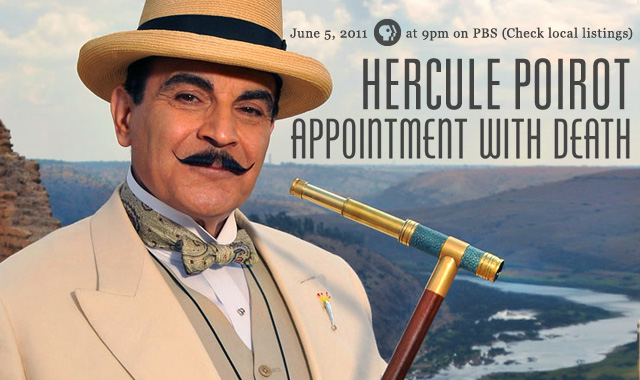
Agatha Christie's Middle Eastern-set mysteries have always ranked among my favorites of her work. She had such a gift for bringing the land, people, and history, dripping with mysterious possibilities, to vibrant, colorful life in her books. I really looked forward to the latest adaptation of Appointment with Death on Masterpiece Mystery. Not only is it packed with a first-rate cast, but the novel is one of my favorites, and the setting is FABULOUS. Following the recent trend of completely rewriting - and in many cases butchering - Christie's original stories, Appointment deviates substantially from the original novel. However, in this case, I'm able to pretty much enjoy the film version "as is," despite the fact that I think Christie's story is much better than this reworked version. One can't beat the original. :) That said, here's the film summary from the PBS website:
Impassioned archaeologist Lord Greville Boynton, accompanied by his universally despised wealthy second wife Lady Boynton, is in zealous pursuit of a major artifact in Syria. A curious array of onlookers has also gathered in the unforgiving desert heat — among them the tormented Boynton children, a psychiatrist, a nun, a travel writer and a cerebral but not exactly rugged Belgian detective, Hercule Poirot. When most of the camp returns from an expedition, they find Lady Boynton has been stabbed to death. How can Poirot make sense of a murder when most of the suspects weren't even present at the time of death? Poirot's investigation exposes red herrings, broken personalities and a tragic back story buried deep. Will Poirot give up in frustration or will the voices of his little grey cells sing out and solve the case? David Suchet stars as Hercule Poirot in this adaptation of the novel by Agatha Christie, joined by Tim Curry (Return to Cranford). (One episode; 90 minutes; TV-PG).Lord Greville Boynton's lifelong quest to discover the resting place of the head of John the Baptist is on it's latest stop in Syria, where his family and a host of interested onlookers converge on the dig site to witness Boynton's hoped-for archaeological triumph. Boynton is brough to life with energy and verve by the fabulous Tim Curry, last seen on Masterpiece in Return to Cranford. Boynton is rather likable if frustrating - completely absorbed by his work, he is also completely blind to the fact that his wife, Lady Boynton (Cheryl Campbell) is universally despised by family and acquaintances alike. Campbell may be familiar to fans of Inspector Lewis - the actress appeared in the episode Music to Die For. Campbell positively chews the scenery in every scene she appears in - one has to wonder if she relished, just a bit, the chance to play so wholly repulsive a character like Lady Boynton. Interestingly, the script chooses to make Lady B. a big player in the American financial markets - a wholly fictional construct when compared to the novel, but it opens the door to interesting motives for murder in the film.

Two members of the expedition take a particular interest in Jinny's welfare - Dr. Gerard, played by the always fabulous John Hannah, and Dame Celia Westholme, adventuress and author, played by the unbelievably classy Elizabeth McGovern. I just adore John Hannah - his accent and screen presence can just make me melt. :) Hannah is perhaps most familiar to movie-going audiences from the Mummy franchise, where he played Brendan Fraser's brother-in-law. One of my absolute favorite roles of Hannah's, though, is from his Masterpiece appearance in the Marple episode The 4:50 from Paddington (also known as What Mrs. McGillicuddy Saw). People, he is to die for adorable in that episode. McGovern just exudes class, and I can't wait to see her return to Masterpiece Classic as the Countess of Grantham in Downton Abbey. She's one of the few actress I can think of that could really sell the "adventuress" aspect of Westholme's character in this film.
Christina Cole makes a memorable appearance as Dr. Sarah King, who is attracted to Raymond in spite of the man's crippling mother issues. I just love Cole - she's appeared in so many Masterpiece Mystery presentations she really should be classified as a series regular. She first appeared in Foyle's War, followed by a Marple appearance, then Inspector Lewis later this year - and in between she's made memorable turns as Mrs Elton in Emma, Caroline Bingley in Lost in Austen, and Blanche Ingram in Jane Eyre. Sarah has the patience of a saint when it comes to Raymond. I've also got to mention Christian McKay's appearance as the American investor Cope. He does an extraordinarily good job playing Americans, especially the one and only Orson Welles in the filmic love letter to New York City, Me and Orson Welles (my review). Cope in this incarnation is an interesting character, since he only joined the expedition to witness the destruction of Lady Boynton's financial empire.
I almost forgot to mention Mark Gatiss's appearance as Lord Boynton's son Leonard. Gatiss is currently on my A-list as co-creator of the fabulous, mind-blowingly amazing Sherlock television show, where he also plays Holmes's brother Mycroft. He comes across as just so ickily proper he never fails to crack me up.

I've pretty much given up trying to figure out why scriptwriters feel the need to one-up Christie's genius, or make her timeless mysteries more "relevant" to contemporary audiences by the insertion of storylines I ffeel pretty sure Christie would never touch with a ten-foot pole. Lady Boynton is completely hateful in the novel, but she's not quite the sadistic child abuser as painted in the flashback scenes in this film. That said, since the filmmakers did go down this road, they handled the revenge plot against Lady B. concocted by Celia Westholme and Dr. Gerard fairly well. Of all the characters, the script does remain true to the novel's idea that Celia is the woman with the most to fear or hold against Lady Boynton's machinations.
On the other hand, the whole white slavery ring involving a Polish nun (yes, that is not a typo) feels completely ridiculous, almost laughably so. The nun in question is played by Beth Goddard, who most recently briefly appeared in X-Men: First Class as the young Charles Xavier's mother. In a ridiculously melodramatic twist, the nun shadows the vulnerable Jinny as a potential kidnap victim, and then gets hers when she drops dead in the desert from heatstroke. The horribly abused children angle does add a dark shading to the storyline, but at least it speaks to a compelling motive for Lady Boynton's murder. The slavery angle is just a ridiculously conceived, poorly executed, and completely unnecessary red herring.
Despite the film's departures from the source material, I really do enjoy this adaptation to the Poirot film series. I adore the archaeological setting, and the clothing and furniture just drip with period charm and detail. The film series proves once again that film versions of Christie's stories are excellent excuses to gather a whole slew of acting talent together in one place and deck them out in period costumes. The story is moody, atmospheric, and tense, and best of all, Poirot acts like the sleuth I know and love from both the novels and all of Suchet's previous appearances as Poirot (Murder on the Orient Express being a notable exception). Charming, witty, and insightful, Appointment with Death showcases the Poirot I know and love.
If you've read the book and/or seen this film version, I'd love to hear your thoughts!


 Posts
Posts