Showing posts with label David Suchet. Show all posts

Friday, July 25, 2014

Poirot's final bow

This Sunday, David Suchet returns in the first of his final run of mysteries as Agatha Christie's Hercule Poirot in "The Big Four." This is SO bittersweet for me, as Poirot was one of my first introductions to British film...and now to see Suchet in the final episodes? When they broadcast Curtain (which isn't yet scheduled on Masterpiece's website), I will BAWL MY EYES out.

Thursday, August 1, 2013

The Hollow Crown preview!

I feel like I've been waiting for this to air in the States for FOREVER.

The films – chronicling a bloody tale of family, politics and power — tell the rise and fall of three Kings and how their destiny shaped English history. Richard II (Ben Whishaw) is a vain, self-indulgent man who rules with little regard for his people’s welfare. He is ultimately overthrown by his cousin Bolingbroke (Rory Kinnear), who ascends the throne as Henry IV (Jeremy Irons). Henry IV’s reign is marred by his own guilt over Richard’s death, civil war, and the gnawing fear that his son Hal (Tom Hiddleston) is a total wastrel unworthy of the throne. When Hal comes to the throne as Henry V he is left to bury the ghosts of his father’s past while fighting both the French forces as well as his own inner demons.

Directed by Rupert Goold (Richard II), Richard Eyre (Henry IV, Part 1 and Henry IV, Part 2) and Thea Sharrock (Henry V)The Hollow Crown features some of the most pre-eminent Shakespearean actors of our time. The Kings are played by Ben Whishaw, Jeremy Irons and Tom Hiddleston respectively, supported by a phenomenal cast including Rory Kinnear, Patrick Stewart, David Suchet, David Morrissey in Richard II,Simon Russell Beale, Michelle Dockery, Julie Walters and Maxine Peake in Henry IV and John Hurt, Anton Lesser and Paterson Joseph in Henry V


The clip at about the 1:10 mark, where Tom Hiddleston as Henry V gives the Saint Crispin's Day speech...people, I GET CHILLS. And TEARS. If this preview is turning me into that much of a mess I may never survive watching the entire play.

The plays begin September 20th, also know as Ruth's Birthday EVE, so I will go ahead and thank PBS for basically the best birthday present of all time. :)

Friday, March 30, 2012

Great Expectations begins this weekend!


Wow, it's been a while since we've talked about Masterpiece Classic, hasn't it? After taking the month of March off for repeats and fundraising, Masterpiece Classic returns this weekend with a two-part, brand-new production of Great Expectations by Charles Dickens. Here's a bit about the production:
Pip, an orphan boy, meets an escaped convict, a mentally unhinged rich woman, and a bewitching girl, and is bestowed great expectations of wealth from a mysterious patron, in Charles Dickens's Great Expectations. Starring Gillian Anderson (The X-Files, Bleak House) as Miss Havisham, one of Dickens' most haunting and enduring creations, Great Expectations unites renowned actors David Suchet (Hercule Poirot) and Ray Winstone with emerging talents Douglas Booth and Vanessa Kirby. Adapted by Sarah Phelps (Oliver Twist), Great Expectations celebrates Charles Dickens in the year that marks the bicentenary of his birth. 
Now, hopefully this won't be *too* controversial, but here goes nothing -- I'm not entirely sure if I'm going to be reviewing this immediately after its broadcast. I just feel like I have SO MUCH GOING ON. *sigh* So please bear with me. :)

Oh! And here's a trailer (love the use of "Carol of the Bells") --

Sunday, July 17, 2011

Review: The Clocks by Agatha Christie


The Clocks
By: Agatha Christie
Publisher: Berkley Mystery
ISBN: 0-425-17391-7

About the book:

As she waits in her new employer's living room, typist-for-hire Sheila Webb stumbles upon a strange scene: a well-dressed corpse surrounded by six clocks - clocks set to the wrong time. Even more mysterious is the fact that no one claims to have requested Miss Webb's services. One thing's for certain - it's time for Hercule Poirot to piece together a baffling mystery.

Review:

When Sheila Webb, a typist-for-hire, is particularly requested for her latest assignment, she expects a routine hour of work, not the discovery of a recently murdered elderly man behind the sitting room sofa, surrounded by clocks set to the wrong time. Horrified, she flees from the scene and straight into the arms of intelligence agent Colin Lamb, pursuing his own line of investigation, on the tail of a nest of spies. The victim has no identification on him, and both Sheila and her would-be-employer, a Miss Pebmarsh, claim to have no knowledge of the victim's identity. Even stranger, Miss Pebmarsh claims to never requested a typist's services. Colin feels an immediate kinship with Sheila, and determines to see the investigation through and the lovely stenographer cleared of all suspicion. But as the investigation progresses, and lead after lead fails to reveal motive or the victim's identity, Colin turns to his old friend Hercule Poirot for help in unraveling the tangled web of murder, lies, and deceit that have taken up residence in the seemingly genteel neighborhood of Wilbraham Crescent...

The Clocks is one of Christie's later Poirot novels, and I feel like it shows. Most obviously, Poirot barely appears in the novel, and the need for his investigative acumen feels a little forced as opposed to an organic part of the storyline. I also found the narrative style a bit cumbersome. Christie alternates between third-person narration and first-person narration, from Colin's point-of-view, and with the exception of the prologue, I would've preferred to read the entire novel from Colin's perspective. In many respects Colin is a classic Christie hero, a bright young thing, burdened with questions about the nature of his profession. Whether from his viewpoint or third-person, experiencing the entire story in one narrative style would have, I believe, tightened the narrative flow and raised the suspense factor.

In this adventure Christie employs an interesting mix of international espionage and neighborhood dynamics. The latter is more effective than the former, as Christie was a master at misdirection and an adept at slyly suggesting danger or subterfuge in that most genteel of locations - the proper English village or neighborhood. I particularly enjoyed the scenes where Colin and Inspector Hardcastle attempted to glean clues about the murdered man from the odd assortment of neighbors surrounding Miss Pebmarsh's home. I wish Poirot had been given more "screentime," if you will, but I enjoyed the detective's lengthy discussion of contemporary crime fiction (including Christie creation Ariadne Oliver) and its reliance on coincidence and chance. In a novel perhaps over-populated with red herrings, Poirot's commentary is perhaps Christie's own sly comment on the conventions of a genre she largely helped define in the twentieth century. Ultimately while not one of my favorite Poirot novels, The Clocks benefits from a strong, unique opening while providing a showcase for Christie's trademark red herrings and carefully constructed, twisting plotlines.

Book vs. Film:

There are several substantial differences between the book and the recent Masterpiece Mystery film version of The Clocks, not the least of which is transferring the setting from the 1960s Cold War to pre-World War II. In many respects, including the time period change, I feel like the film improves a bit on the novel's storyline. While I felt that the film got a little crazy plot-wise, over-packed, if you will, with red herrings, it's not nothing on the book. *wink* I do wish that the script hadn't invented a previous love interest for Colin, and had instead let his burgeoning romance with typist Sheila Webb unfold as the investigation progressed. One of the reasons I loved Colin's interest in Sheila in the book is that almost from the first he recognizes Sheila as his girl, despite knowing nothing about her and her propensity for stretching the truth.

I am so thankful the script gave Poirot a greater role than he possesses in the novel. David Suchet gives one of his strongest performances in recent years as Poirot in The Clocks, brimming with the detective's trademark idiosyncrasises, warmth, understated wit, and intelligence. In the novel, Poirot is relegated to three or four scenes, while the film allows Poirot to develop a real rapport with Colin which is a lot of fun to watch. While both the novel and film have their merits, in this case I think I have to give the edge to the film adaptation for giving Poirot a greater role and tightening the narrative flow of the storyline.

Wednesday, July 6, 2011

Poirot: Hallowe'en Party


Poirot concluded what - in my opinion - has been its most entertaining run in years on Masterpiece Mystery with a rather out of season, but wildly entertaining, adaptation of Hallowe'en Party by Agatha Christie. Here's the story summary from the PBS website:

"I saw a murder once...I did! I did!" boasts a clumsy, disliked girl at a Halloween party. For this, she is ridiculed and dismissed. But before the party's end, she is dead, snuffed out in an apple-bobbing tub. Party guest Ariadne Oliver — never again to consume another apple — summons her old friend Hercule Poirot for help and the gallant sleuth is only too happy to oblige. With the dubious help of the grisly old village witch and the wildly speculative mystery writer Oliver, Poirot must investigate old sins and discover the connections between a years-old stabbing, a Russian au pair, and a forgery to unmask a dangerous killer, all before another corpse surfaces. Adapted by Mark Gatiss (Sherlock) and based on the novel by Agatha Christie, Hallowe'en Party stars David Suchet as Hercule Poirot, ZoĆ« Wanamaker as Ariadne Oliver, and Deborah Findlay (Cranford).
I never really paid that much attention to the name Mark Gatiss until Sherlock aired on Masterpiece last year, and I was smacked full upside the head with the realization that the man is, apparently, a genius. So I went into Hallowe'en Party with high expectations after learning that Gatiss penned the script, and I have to say I was not disappointed in the least. This episode was based on yet another Agatha Christie novel I have yet to read (shocking, I know), but I loved this presentation. The story and characters felt fully realized and the sense of drama and atmosphere was superb. I've never been one for "celebrating" Halloween, but I like I good spooky film (in the Christie vein, anyways), and this film did such an excellent job evoking fall, the fun of costumes, and spooky stories that I can see myself making an annual tradition of watching Hallowe'en Party.

This story once again features the mystery writer Ariadne Oliver. Fantastically played by Zoe Wanamaker, Oliver is really a delightful foil to the always proper and reserved Poirot. It seems a little odd to say that Poirot has "chemistry" with anyone, but Suchet and Wanamaker play off each other so well in their respective roles that their scenes together are a joy to watch. They bring a real sense of camraderie and history to Oliver and Poirot's friendship. Wanamaker has appeared three previous times as Oliver in a Poirot adaptation - the first time in Cards on the Table, back when A&E was airing Poirot films, and the second and third outings on Masterpiece in Mrs McGinty's Dead and Third Girl. When McGinty initially aired on Masterpiece two years ago (my review), I was not that impressed with the episode (though I will admit it improves on DVD). I am planning to review Third Girl soon (I promise! *wink*). As far as Ms. Oliver goes, the fourth time may be the charm, as I thoroughly enjoyed Wanamaker's sly humor and dry asides throughout the storyline.

Hallowe'en Party opens with a motley assortment of children and adults gathered at Rowena Drake's home for a party. The opening twenty minutes or so were fantastic simply on the basis of the sheer amount of period detail crammed into every frame of film. From the home and its decor to the costumes and games the children played, Mrs. Drake's party was like a little time capsule of 1930s Halloween festivities. Rowena Drake is played by Deborah Findlay, who should be a familiar face to fans of Masterpiece. Findlay played Miss Phoebe in Wives and Daughters, appeared in episodes of Foyle's War and Inspector Lewis, and plays Miss Tomkinson in Cranford. It's a credit to both the script and Findlay's acting talent that I totally bought into her character arc for this film (look at me, trying to avoid spoilers...). :P Rowena's children are basically filler (and largely unlikable) characters, but it's interesting to note that Edmund is played by Ian Hallard, who appeared in Marple: The Sittaford Mystery, while Frances is played by the much more familiar Georgia King, who has appeared in Jane Eyre, The Shadow in the North, and Little Dorrit.

When the universally maligned Joyce (Macy Nyman) is found dead, face-first in the apple-bobbing tub (how's that for drama?), Ariadne calls Poirot for assistance in the investigation, since she's laid up with a bad cold. Just prior to her death, Joyce claimed to have seen a murder once - an assertion that's universally dismissed as ridiculous until she's found murdered. I found this crime pretty shocking - perhaps some fellow Christie aficionadoes can help me out. I can't recall another story where a child's murder is central to the investigation. Surely I'm forgetting something - so please chime in!

En route to investigate, Poirot meets gardener extraordinaire Michael on the train, who suggests that he talk with the local gossip Mrs. Goodbody (Paola Dionisotti) to see if there could be any truth to Joyce's incredible claim. Michael is played by Julian Rhind-Tutt (isn't his name AWESOME?!), who I must confess to thinking is rather handsome here - and more's the pity since he seems to have a predisposition to playing less-than-heroic characters. *sigh* He's appeared in Marple, Stardust, The Shadow in the North, and Merlin, to name a few of his credits.

Mrs. Goodbody wastes no time in enlightening Poirot as to the town's dark secrets - and this, people, is one of the many reasons I love Agatha Christie's stories (and these films, even when they deviate from the source material). NO ONE could take a seemingly idyllic small-town setting such as we find in the beginning of Hallowe'en Party and slowly peel back layer by layer of subterfuge and secrets to reveal the dark and tangled motives for murder found beneath a cheerful veneer. *delicious shivers all around*

There are a couple of notable cast members that I simply cannot go without mentioning. First up, it was great to see the venerable Timothy West as the town's Reverend Cottrell. West appeared in the quiz show-themed episode Your Sudden Death Question of Inspector Lewis last year (my review) and played Sir Leicester Dedlock in the absolutely sublime Bleak House. It was also fantastic to see Sophie Thompson, Emma's sister, on-screen again, even if it was in a rather thankless and under-utilized role as the unfortunate Joyce's mother. Thompson should be a very familiar face to fans of period drama - she played Miss Bates in the 1996 Emma, and appeared in Gosford Park and Nicholas Nickleby.

As Poirot uncovers the roots of Joyce's murder, he discovers that the foolish words that doomed her were rooted in a history of affairs, forged documents, and murder - juicy stuff here people, these are the ingredients of Masterpiece Mystery melodrama at its best! *wink* I thoroughly enjoyed watching this episode unfold, and high praise to Gatiss for a sharp script and to the actors and production team for delivering such a delicous, atmospheric period piece. If you watched this episode, or you've read the novel, I'd love to hear your thoughts. This has to rank as a favorite Suchet-as-Poirot performance - he really seemed to be on fire this episode, and Poirot was by turns positively brimming with his trademark incisiveness, dry wit, warmth, and quirkiness. :)

This run of Poirot episodes has been simply outstanding. I will always find something to enjoy in even less-than-perfect Poirot films (can't really beat David Suchet in his element, eh?), but the three films aired on Masterpiece Mystery this season have really set the bar high as far as quality and sheer entertainment value. Here's the link round-up:

Tuesday, June 28, 2011

Poirot: The Clocks


Masterpiece Mystery continued last night with another thoroughly enjoyable Poirot mystery entitled The Clocks. I don't know if it's just because I haven't been familiar with this latest slate of Agatha Christie mysteries, or if there's been a genuine up-tick in episode quality (irregardless of faithfulness to the source material), but I'm enjoying the broadcast runs of these episodes much more than previous years of Poirot offerings. Is it just me? Anyways, here's the episode summary from the PBS website:

A lovely young stenographer, Sheila Webb, is greeted at a job not by her client but by an eerie assembly of clocks all frozen at the precise same moment in time and, behind the couch where she sits waiting, a corpse. Horrified, she scrambles screaming into the street, straight into the arms of Naval Lieutenant Colin Race. In Race, she finds a protector who takes her story to Hercule Poirot, and together they set about exonerating her, all the while trying to unearth a German mole who masterminded Race's botched spy mission at Dover Castle. But when a second murder is discovered, the mystery becomes more "dagger" than "cloak" and the evidence mounts against Sheila. Faced with enduring a pint of beer, the rubbing of cats against his legs, and being mistaken for a Frenchman, will Poirot prevail in revealing the killer and the mole? Joined by Tom Burke (Dracula), David Suchet stars as Hercule Poirot in this adaptation of the novel by Agatha Christie. (One episode; 90 minutes; TV-PG)
The Clocks opens with a bang, a suspensful set-up involving stolen intelligence documents that was reminscent of The 39 Steps. It's the end of the workday in a maze of tunnels beneath Dover Castle, and Fiona Hanbury (Anna Skellern) witnesses her co-worker, Annabel Larkin (Olivia Grant)
filch documents from a private office. Unable to rally her fiance, Lt. Colin Race (Tom Burke), engrossed in an after-hours poker game, Fiona nervously tails the thief. While jotting down the address, she's seen by her target, and in her attempt to flee the scene both women are struck dead by a passing car. That has to be one of the most action-packed openings to a Poirot episode of all time - *BAM* and you have two actresses vaporized. I'm unfamiliar with Skellern's work, but Grant may be familiar to fans of the show Lark Rise to Candleford, where she played the character Lady Adelaide Midwinter. Tom Burke may be recognizable to fans of the mystery series Jericho from a couple of years ago, when he appeared in the episode A Pair of Ragged Claws. I'd love to see more from Burke in the future, I think he's got a lot of period drama potential.


Race is - as he should be!! - guilt-ridden over dismissing Fiona's last frantic phone call. Within a few days, Race is seeking out his old friend (I can't help it, I find Poirot's never-ending supply of "old friends" hilarious) Hercule Poirot (David Suchet) for help with a curious mystery that literally ran him down in the street while he was attempting to decipher Fiona's hastily scrawled clue identifying the German spy. Sheila Webb (Jaime Winstone) runs into Race, screaming from a house where she found a dead body. Sheila, a typist, was sent to the location after a phone call to her agency specifically requested her services. Suspicion falls on Sheila when the owner of the home, the blind Miss Pebmarsh, claims she never made the phone call requesting the typist's services, and doesn't know Sheila or the victim. Race has a chivalrous streak, and is determined to clear Sheila's name. It's blindingly apparent that this is due to equal parts chivalry and the fact that he's quite taken with Sheila, nevermind that his fiance has been dead for less than a week. *rolls eyes*

Winstone does the period look extremely well. I've only ever seen her in one other film - Made in Dagenham, where she exhibited a great deal more spunk, and I've got to say I think the role of Sheila would've benefited from a dash of the sass she exhibited in that film. Miss Pebmarsh is played by the absolutely divine Anna Massey. Massey has appeared in everything from the Around the World in 80 Days miniseries, where she played Queen Victoria, to The Importance of Being Earnest, where she played Miss Laetitia Prism, as well as a memorable turn in Inspector Lewis.


This is where things start to get a little crazy plot-wise, and I'm sure that the novel streamlines the investigations (because Christie was a genius, and some of these reworked scripts...aren't *g*). However, jumps in logic and red herrings aside, what saves this adaptation for me is the period detail and engaging performances. Race's superior, Vice Admiral Hamling (Geoffrey Palmer), is convinced that the stolen government documents and the dead man are connected, and urges the investigation to proceed along those lines. Palmer is a long-time favorite of mine, and it was a real treat to see him in a Poirot film. If you've never checked out his work, I highly recommend the long-running series As Time Goes By, which Palmer headlined opposite Judi Dench. Sadly for this film, I felt like Palmer's presence was really under-utilized.

Accompanied by the long-suffering local Inspector Hardcastle (Phil Daniels), Race and Poirot interview the odd assortment of neighbors in the vicinity of the murder. While I enjoyed the appearances of actors like Guy Henry as the academic Matthew Waterhouse (Henry plays Pius Thicknesse in Harry Potter and the Deathly Hallows and Mr. Collins in Lost in Austen) and Jason Watkins as the deceptively-named Joe Bland (Bland is perhaps best-known for his role as Plornish in Little Dorrit and Herrick in the series Being Human), the number of unnecessary-to-the-plot neighbors the script throws at the viewer tends to muddy the waters of the investigation's on-screen flow. However, from the perspective of looking at a microcosm neighborhood life, the juicy gossip uncovered in the interviews provides the neighbors with a fun excuse to dish on each other.

Regarding the agency Sheila works for, I was thrilled to see Lesley Sharp appear in The Clocks as the agency's proprietress Miss Martindale. Sharp is a Masterpiece veteran, having appeared in The Diary of Anne Frank as Petronella van Daan and Cranford as Mrs. Bell, as well as a memorable appearance in the Doctor Who season four episode entitled Midnight. I really enjoyed Sinead Keean's appearance as Sheila's ill-fated co-worker Nora. Keenan played Addams in the Doctor Who special The End of Time, and currently is probably best-known as George's girlfriend Nina in the supernatural sci-fi drama Being Human. She was the perfect choice to play the bold and brassy Nora, and handled the period aspects of the role extremely well.

While this script throws red herrings at the viewer left and right, and the resolution of the two disparate cases is nice and convenient, overall I still really enjoyed this film and look forward to investigating Christie's orginal novel soon (hopefully...there's so many things I want to read "soon"!). Whether or not the Miss Pebmarsh storyline plays out in the novel in the manner it does on-screen is irrelevant to my appreciation of her spy-related plot twist in the film. I thought it was interesting and pretty effective to have Pebmarsh turn to spying following the deaths of her sons in the Great War - the same conflict that also led to her blindness.

I'm a total sucker for the romances in this mystery films, but there was a missed opportunity with the Colin and Sheila storyline. From what I've read about the novel's storyline, the Colin character doesn't have a fiancee, so any romantic interest doesn't have, oh, I don't know, RECENT TRAUMATIC DEATH hanging over its development. *sigh* The script gives Sheila a ton of emotional baggage, and since Colin very clearly has a hero complex in the world of The Clocks they are destined to be together. I like Colin as an emotionally sensitive hero, and I do think that's what Sheila needs, but I would've liked him - maybe respect is a better word - better if he hadn't been making out with needy Sheila a week after Fiona gets squashed by a car. That said, this little romance leads to one of the funniest moments in Poirot series history in my opinion - when Poirot basically asks Colin if he needs a kick in the pants to go after Sheila, Colin pauses, and then pats Poirot on the arm in a hilariously condescending, no-of-course-not-papa type moment. I was rolling. :)

Overall, I found The Clocks is another solidly entertaining entry in the Poirot portion of the Masterpiece Mystery season. I love the attention to period detail, the cast chock-full of familiar faces, and the briskly-paced, engaging storyline. I'd love to hear your thoughts! :)

Saturday, June 25, 2011

Poirot continues on Masterpiece

Tomorrow on Masterpiece Mystery, Poirot continues with a brand-new episode entitled The Clocks, based on the novel by Agatha Christie. Here's a bit about the story:
In Dover on the cusp of war, cloak meets dagger when Hercule Poirot is called on to uncover a German spy network and exonerate a beautiful stenographer accused of a grisly murder. David Suchet stars as Poirot in a new episode of an Agatha Christie whodunit, The Clocks, airing Sunday, June 26, 2011 on MASTERPIECE MYSTERY!
I'm really looking forward to this story, especially since it sounds vaguely reminscent of The 39 Steps!

Sunday, June 19, 2011

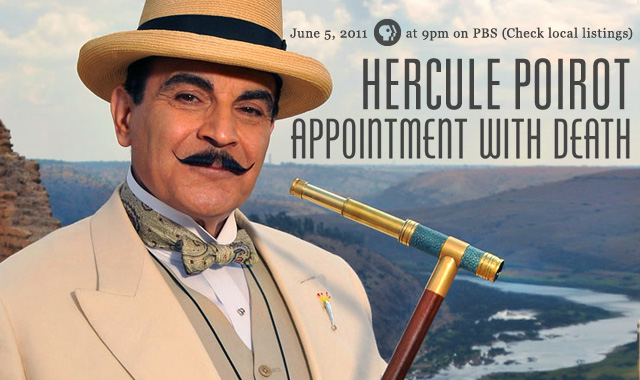
Poirot: Appointment with Death


Agatha Christie's Middle Eastern-set mysteries have always ranked among my favorites of her work. She had such a gift for bringing the land, people, and history, dripping with mysterious possibilities, to vibrant, colorful life in her books. I really looked forward to the latest adaptation of Appointment with Death on Masterpiece Mystery. Not only is it packed with a first-rate cast, but the novel is one of my favorites, and the setting is FABULOUS. Following the recent trend of completely rewriting - and in many cases butchering - Christie's original stories, Appointment deviates substantially from the original novel. However, in this case, I'm able to pretty much enjoy the film version "as is," despite the fact that I think Christie's story is much better than this reworked version. One can't beat the original. :) That said, here's the film summary from the PBS website:
Impassioned archaeologist Lord Greville Boynton, accompanied by his universally despised wealthy second wife Lady Boynton, is in zealous pursuit of a major artifact in Syria. A curious array of onlookers has also gathered in the unforgiving desert heat — among them the tormented Boynton children, a psychiatrist, a nun, a travel writer and a cerebral but not exactly rugged Belgian detective, Hercule Poirot. When most of the camp returns from an expedition, they find Lady Boynton has been stabbed to death. How can Poirot make sense of a murder when most of the suspects weren't even present at the time of death? Poirot's investigation exposes red herrings, broken personalities and a tragic back story buried deep. Will Poirot give up in frustration or will the voices of his little grey cells sing out and solve the case? David Suchet stars as Hercule Poirot in this adaptation of the novel by Agatha Christie, joined by Tim Curry (Return to Cranford). (One episode; 90 minutes; TV-PG).
Lord Greville Boynton's lifelong quest to discover the resting place of the head of John the Baptist is on it's latest stop in Syria, where his family and a host of interested onlookers converge on the dig site to witness Boynton's hoped-for archaeological triumph. Boynton is brough to life with energy and verve by the fabulous Tim Curry, last seen on Masterpiece in Return to Cranford. Boynton is rather likable if frustrating - completely absorbed by his work, he is also completely blind to the fact that his wife, Lady Boynton (Cheryl Campbell) is universally despised by family and acquaintances alike. Campbell may be familiar to fans of Inspector Lewis - the actress appeared in the episode Music to Die For. Campbell positively chews the scenery in every scene she appears in - one has to wonder if she relished, just a bit, the chance to play so wholly repulsive a character like Lady Boynton. Interestingly, the script chooses to make Lady B. a big player in the American financial markets - a wholly fictional construct when compared to the novel, but it opens the door to interesting motives for murder in the film.

Lady Boynton adopted three children prior to her marriage to Lord Boynton - three children trained to live in absolute terror of their "mother," scarred by years of mental and physical abuse at the hands of either her or her lackey, Nanny (Angela Pleasence). The now-adult children are the handsome Raymond (Tom Riley), Carol (Emma Cunniffe), and the emotionally volatile Jinny (Zoe Boyle). Riley has appeared in both Inspector Lewis and Marple episodes, as well as a memorable turn as Mr. Wickham in the hilariously wonderful Lost in Austen. With his movie-star good looks and already a backlist of memorable film appearances, I look forward to Riley's future career. He plays the edgy, tortured Raymond chillingly well. Boyle's turn as Jinny was her first film credit, and she's also an Inspector Lewis veteran - and will be appearing in season two of Downton Abbey next year as Miss Lavinia Swire.

Two members of the expedition take a particular interest in Jinny's welfare - Dr. Gerard, played by the always fabulous John Hannah, and Dame Celia Westholme, adventuress and author, played by the unbelievably classy Elizabeth McGovern. I just adore John Hannah - his accent and screen presence can just make me melt. :) Hannah is perhaps most familiar to movie-going audiences from the Mummy franchise, where he played Brendan Fraser's brother-in-law. One of my absolute favorite roles of Hannah's, though, is from his Masterpiece appearance in the Marple episode The 4:50 from Paddington (also known as What Mrs. McGillicuddy Saw). People, he is to die for adorable in that episode. McGovern just exudes class, and I can't wait to see her return to Masterpiece Classic as the Countess of Grantham in Downton Abbey. She's one of the few actress I can think of that could really sell the "adventuress" aspect of Westholme's character in this film.

Christina Cole makes a memorable appearance as Dr. Sarah King, who is attracted to Raymond in spite of the man's crippling mother issues. I just love Cole - she's appeared in so many Masterpiece Mystery presentations she really should be classified as a series regular. She first appeared in Foyle's War, followed by a Marple appearance, then Inspector Lewis later this year - and in between she's made memorable turns as Mrs Elton in Emma, Caroline Bingley in Lost in Austen, and Blanche Ingram in Jane Eyre. Sarah has the patience of a saint when it comes to Raymond. I've also got to mention Christian McKay's appearance as the American investor Cope. He does an extraordinarily good job playing Americans, especially the one and only Orson Welles in the filmic love letter to New York City, Me and Orson Welles (my review). Cope in this incarnation is an interesting character, since he only joined the expedition to witness the destruction of Lady Boynton's financial empire.

I almost forgot to mention Mark Gatiss's appearance as Lord Boynton's son Leonard. Gatiss is currently on my A-list as co-creator of the fabulous, mind-blowingly amazing Sherlock television show, where he also plays Holmes's brother Mycroft. He comes across as just so ickily proper he never fails to crack me up.


I've pretty much given up trying to figure out why scriptwriters feel the need to one-up Christie's genius, or make her timeless mysteries more "relevant" to contemporary audiences by the insertion of storylines I ffeel pretty sure Christie would never touch with a ten-foot pole. Lady Boynton is completely hateful in the novel, but she's not quite the sadistic child abuser as painted in the flashback scenes in this film. That said, since the filmmakers did go down this road, they handled the revenge plot against Lady B. concocted by Celia Westholme and Dr. Gerard fairly well. Of all the characters, the script does remain true to the novel's idea that Celia is the woman with the most to fear or hold against Lady Boynton's machinations.

On the other hand, the whole white slavery ring involving a Polish nun (yes, that is not a typo) feels completely ridiculous, almost laughably so. The nun in question is played by Beth Goddard, who most recently briefly appeared in X-Men: First Class as the young Charles Xavier's mother. In a ridiculously melodramatic twist, the nun shadows the vulnerable Jinny as a potential kidnap victim, and then gets hers when she drops dead in the desert from heatstroke. The horribly abused children angle does add a dark shading to the storyline, but at least it speaks to a compelling motive for Lady Boynton's murder. The slavery angle is just a ridiculously conceived, poorly executed, and completely unnecessary red herring.

Despite the film's departures from the source material, I really do enjoy this adaptation to the Poirot film series. I adore the archaeological setting, and the clothing and furniture just drip with period charm and detail. The film series proves once again that film versions of Christie's stories are excellent excuses to gather a whole slew of acting talent together in one place and deck them out in period costumes. The story is moody, atmospheric, and tense, and best of all, Poirot acts like the sleuth I know and love from both the novels and all of Suchet's previous appearances as Poirot (Murder on the Orient Express being a notable exception). Charming, witty, and insightful, Appointment with Death showcases the Poirot I know and love.

If you've read the book and/or seen this film version, I'd love to hear your thoughts!

Saturday, June 18, 2011

New Poirot episodes start tomorrow!

I am thrilled that brand-new episodes of Poirot start on Masterpiece Mystery tomorrow night with the premiere of Three Act Tragedy. Here's a bit about the story:
Join Hercule Poirot in a new whodunit with a cast of suspicious characters, a tray of dry but potentially deadly martinis, and murder on center stage. Three Act Tragedy airs Sunday, June 19, 2011 on MASTERPIECE MYSTERY! Art Malik (Upstairs Downstairs) and Kimberley Nixon (Cranford) join David Suchet as he reprises his signature role as Agatha Christie's suave Belgian sleuth.

Sunday, June 12, 2011

Another Poirot encore

Check your television listings if you're interested in another Hercule Poirot encore on Masterpiece Mystery this evening. If your local PBS station is opting not to re-air the episode, starting tomorrow it will be available online for a limited time. Here's a short teaser about the episode:

See an encore presentation of Hercule Poirot: Third Girl on Sunday, June 12; available for online viewing starting Monday, June 13, 2011. (Note: Limited TV airings; check local listings.) This thriller reunites Poirot and writer Ariadne Oliver as they try to free a mentally unstable heiress from her demons. Based on the novel by Agatha Christie, Third Girl stars David Suchet and Zoƫ Wanamaker. (One episode; 90 minutes; TV-PG).
I haven't forgotten my intention to review both this episode and last week's encore, Appointment with Death - but I need to get a book review or two finished first. :)

Monday, May 23, 2011

Poirot: Murder on the Orient Express


Masterpiece Mystery kicked off its 2011 season with an encore presentation of last year's Murder on the Orient Express, based on the novel by Agatha Christie. Orient Express is perhaps one of Christie's best-known novels, and with good reason. It's a terrific introduction to one of her most famous sleuths, the inimitable Hercule Poirot, and thanks to a sprawling cast it lends itself to colorful adaptations (it's been filmed two times prior to this). Since I did a terrible job keeping up with Mystery reviews last year, I'm hoping that PBS's decision to air encore presentations of Poirot and Marple episodes will afford me the chance (and the incentive) to bring my Masterpiece Mystery page up-to-date. Here's the story summary from the PBS website:

Hercule Poirot is visiting Istanbul, but is called back to London to work on a case. Poirot's old acquaintance Xavier Bouc, who is director of the Orient Express, secures him a last-minute ticket on the impressive train. The train is completely booked, carrying an eclectic group of passengers such as Princess Dragomiroff and her nervous maid, Hildegarde Schmidt, English governess Mary Debenham and Swedish missionary Greta Ohlsson.

During the journey, ruthless American businessman Samuel Ratchett approaches Poirot. Ratchett cryptically explains to Poirot that he needs to give something back before he can be forgiven, but fears he'll be murdered in the meantime. He asks Poirot for protection, offering a large sum of money, but Poirot refuses. The next morning, Poirot awakens to find the train stuck in a snowdrift and Ratchett dead.

Aided by Dr. Constantine, Poirot examines the murder scene and finds a variety of confusing clues. He interviews those who last saw Ratchett alive: his manservant Edward Masterman, personal assistant Hector MacQueen, and conductor Pierre Michel before making a striking realization about Ratchett. The evidence points towards a particular explanation for the murder, but Poirot also considers a darker, alternative theory. Isolated by the snow and potentially on the train with a killer, Poirot is embroiled in one of the most vexing cases of career, and will soon be forced to make one of the hardest decisions of his life.
Now, I've been a fan of David Suchet's portrayal of Poirot almost from the time he started bringing Christie's Belgian sleuth to life (in 1989, can you believe it?). I've also read the novel Murder on the Orient Express two or three times at least. So I feel like I have a fairly good handle on Poirot's character and the source material (although admittedly it's been a couple of years since I've re-read the book). That's why the tonal shift, established with the opening scenes of this film, is somewhat inexplicable to me. The script (penned by Stewart Harcourt, a veteran of the Marple series) adds two scenes not found in the novel that set a darker tone for the story and Poirot's character than is warranted, in my opinion. The first scene sees Poirot drive an army officer in Palestine to suicide when he is caught lying after Poirot's investigation. This tragedy is followed by another, when Poirot witnesses mob mentality take over the streets of Istanbul when a woman is stoned to death for committing adultery. The senselessness of both situations - and perhaps a niggling sense of guilt for failing to stop the tragedies - puts Poirot in an extremely foul, introspective mood and leads him to ruminate on the nature of justice. It is perhaps not as black and white as he would like to think.

Most of the time I really don't mind when scripts add scenes or rework Christie's novels if the essence of the main characters I love (i.e. Poirot or Miss Marple) remain essentially true to themselves (notable exceptions being the completely unnecessary incest subplot in Marple's Murder is Easy). The opening scenes of Orient Express are, in my estimation, completely unnecessary additions to the story and set a darker tone than I'd prefer for one of my favorite Christie mysteries, finally starring my favorite incarnation of Poirot. Poirot comes across as so depressed, moody, and angry by turns at various times throughout this adaptation that I felt as though my beloved sleuth had aged at least twenty years, completely unnecessarily to boot. That said, I didn't hate this adaptation - anything starring Suchet as Poirot is worth watching at least once in my opinion, and a stellar cast and glorious period detail make this production a feast for the eyes. However, when "ranking" film adaptations of Orient Express, this one sadly has to fall a tick below the 1974 Albert Finney-as-Poirot film version (believe it or not...).

Christie created one of her most memorable, colorful casts of characters when she penned Orient Express, and any film version is a prime opportunity to gather a slew of famous faces to take part in the famous whodunit. As the director of the line Xavier Bouc (Serge Hazanavicius), an old Poirot acquaintance, tells the detective, the Orient Express is one of the few places on Earth that serves as a "great equalizer," where commoners can mingle with royalty, all taking advantage of the line's cross-country transportation abilities. Where else would such unlikely companions find themselves sharing the same dining car - except, perhaps, in an open republic of  a society like America.

The linchpin of the piece is the abrasive American businessman Samuel Rachett (Toby Jones), who attempts to hire Poirot for protection since he's convinced he's the target of a murderous plot. Poirot takes an instant dislike to Rachett and refuses the man's proffered offer of an exorbitantly high fee. I'm hard-pressed to imagine a better choice than Jones to portray the slimy Ratchett. I'm sure he's a perfectly lovely individual in person, but to be blunt he looks so...odd, I guess you could say...that when he's playing the villain it's completely believable. The only positive role of Jones's that comes to mind is his turn as the voice of Dobby the elf in the Harry Potter films. The day after Poirot's refusal, the occupants of the coach wake up to find the train stuck in a snowdrift, and Ratchett brutally murdered in his cabin.

Ratchett's murder forces Poirot to take a closer look at his fellow passengers, since as the only remotely qualified investigator on board he's recruited to apply "his little grey cells" to the problem of who killed the businessman. The clues don't seem to add up - twelve knife wounds were inflicted, all at varying angles and with different degrees of force, a burnt paper fragment with the letters "AISY ARMS," a monogrammed woman's handkerchief, a button from a conductor's uniform, Ratchett's missing cash, and the confusing accounts of the night's activities from the passengers combine to make a puzzling snarl for Poirot to unravel. Poirot being Poirot, he quickly draws the conclusion that Ratchett was in fact none other than Cassetti, a notorious gangster responsible for the kidnap and murder of the American Daisy Armstrong. The shocking crime - and Cassetti's subsequent, and sickening, acquittal - destroyed the Armstrong family. And if you went into this film unfamiliar with the story, that mess of unlikely suspects and confusing clues is the genius of Christie's novel. In an enclosed, defined space, how can Poirot divine the killer when nothing adds up and everything seems unrelated?


Several beloved, familiar faces make up the cast of suspects, and I just want to spotlight some favorites. David Morrissey, most recently seen in South Riding, plays Colonel Arbuthnot, Daisy's father's best friend in the service. In a huge ensemble cast like this, Morrissey doesn't get a great deal of screentime, but it's refreshing to see him play a more noble, driven character - as opposed to the mess he plays in South Riding. I do adore his voice, and he looks quite dashing in the late 1930s-era suits. It was also a treat to see another Masterpiece vet, Hugh Bonneville, make an appearance as Edward Masterman, Ratchett's butler and previously Daisy's father's orderly in the army. Bonneville, of course, made a big splash on Masterpiece earlier this year anchoring Downton Abbey as Robert Crawley, Earl of Grantham.

I was thrilled to see this production cast an old favorite of mine, actor Samuel West, as Dr. Constantine, the Armstrong family doctor and the conspirators' first line of defense in attempting to divert Poirot's line of investigation. I developed a huge crush on West when he played the young Caspian in the old made-for-TV production of Prince Caspian and the Voyage of the Dawn Treader. Following that turn, he played the ill-fated Leonard Best in Howard's End, Mr. Elliot in some people's favorite version of Persuasion, St. John Rivers in the 1996 version of Jane Eyre, as well as appearances in Hornblower and Foyle's War. Sadly, the man has never achieved the kind of on-screen success and exposure that I think he deserves, so it's always a treat to spot him in a new role.

Eileen Atkins is another cast standout, playing Princess Dragomiroff, godmother to the ill-fated Daisy's mother. Atkins is one of a handful of grand British actresses who own the screen just by showing up. As Princess Dragomiroff, Atkins is mesmerizing - regal, cold, and calculating, she knows she's taken a calculated risk by traveling on the Orient Express and is prepared to accept the consequences of her actions. If anyone is going to carry off the whole Russian princess thing, it's Atkins. She most recently appeared on Masterpiece as Lady Maud in the highly enjoyable "re-boot" of Upstairs Downstairs, and is a veteran of Cranford and the Marple series, to name just a few of the credits in her illustrious career.

This may not be a favorite Poirot episode, but it is certainly one of the most visually stunning. Everything about this production is top-notch, from the clothing to the detail in the train compartments. This film truly brings a glittering, lost era to vibrant life, and makes me desperately wish I'd been around to travel the Orient Express in its heyday. While Christie's story, and Poirot's ultimate decision regarding the fate of the train passengers, raises some interesting questions about the nature of justice, I do feel like the ultimate tone of this film is "off" when compared to the book and Suchet's previous performances as Poirot. However, the concluding scene, with its stark, snowy-white backdrop, is stunningly well-filmed.

Whether you're an old-time Christie fan or a newbie, I'd love to hear your thoughts on this film if you caught its rebroadcast last night!

Saturday, May 21, 2011

Masterpiece Mystery starts tomorrow!

Masterpiece Mystery begins tomorrow night with an encore presentation of Agatha Christie's Murder On the Orient Express, starring the inimitable David Suchet as Poirot and a slew of other familiar faces in the all-star cast. Here's a bit about the story:
Hercule Poirot solves the greatest case of his career aboard the world's most glamorous train in an encore presentation of Agatha Christie's Murder on the Orient Express, Sunday, May 22, 2011 on MASTERPIECE MYSTERY! Star David Suchet is joined by a first-class rail car full of great actors, including Eileen Atkins (Upstairs Downstairs), Barbara Hershey and Hugh Bonneville (Downton Abbey). Watch the full episode online starting Monday, May 23.

Friday, May 20, 2011

Masterpiece Mystery 2011 Schedule

Masterpiece Mystery has finally announced its summer schedule! Here's a look at what's in store for us in the coming weeks:


AGATHA CHRISTIE MYSTERIES

Agatha Christie’s beloved characters return to this season’s MASTERPIECE MYSTERY! lineup, featuring the suave Belgian detective Hercule Poirot (David Suchet) and the charming spinster sleuth Miss Marple (Julia McKenzie). (All episodes 90 minutes unless otherwise noted. National broadcast dates in bold; online viewing dates in parentheses.)
  • May 22 (May 23 – Jun 5) Poirot: “Murder on the Orient Express” (Encore)*
  • (May 23 – Jun 21) “David Suchet on the Orient Express: A Masterpiece Special” 60 min. (Encore)*
  • May 29 (May 30 – Jun 12) Marple: “The Secret of Chimneys” (Encore)*
  • Jun 5 (Jun 6 – Jun 19) Poirot: “Appointment with Death” (Encore)*
  • Jun 12 (Jun 13 – Jun 26) Poirot: “The Third Girl” (Encore)*
  • Jun 19 (Jun 20 – Jul 19) Poirot: “Three Act Tragedy”
  • Jun 26 (Jun 27 – Jul 26) Poirot: “The Clocks”
  • Jul 3 (Jul 4 – Aug 2) Poirot: “The Hallowe’en Party”
  • Jul 10 (Jul 11 – Aug 9) Marple: “The Pale Horse”
ZEN

What does an honest cop do when his bosses are on the side of the lawbreakers? Detective Aurelio Zen brings justice to modern-day Italy—whether the authorities want it or not. This trio of spellbinding cases, based on the bestselling novels by Michael Dibdin, stars Rufus Sewell (Middlemarch). (All episodes 90 minutes. National broadcast dates in bold; online viewing dates in parentheses.)
  • Jul 17 (Jul 18 – Aug 30) “Vendetta”
  • Jul 24 (Jul 25 – Aug 30) “Cabal”
  • Jul 31 (Aug 1 – Aug 30) “Ratking” 
*Limited local airings; please check local listings.

All episodes can be viewed online for a limited time at pbs.org/masterpiece

More titles to be announced.

***
I am not thrilled about four Christie encores, and only one new Marple episode, but I'll take it. And I am SUPER excited about the Zen mysteries with my darling Rufus Sewell!

You can download a printable copy of the Mystery schedule here.

Saturday, July 24, 2010

Hercule Poirot concludes tomorrow...

Tomorrow on Masterpiece Mystery, this season of Hercule Poirot concludes with an adaptation of the Agatha Christie novel, Appointment with Death. Here's a bit about the story:

Don't miss this season's final new episode of Hercule Poirot, Sunday, July 25, 2010, on MASTERPIECE MYSTERY. In Appointment with Death, an archaeological dig is the scene of a murder in the Middle East, leading Poirot to unearth a tragic tale of twisted family secrets. The cast of suspects includes co-stars Tim Curry and Elizabeth McGovern.
In addition to the presence of David Suchet, Tim Curry, and Elizabeth McGovern (loved her in The Scarlet Pimpernel opposite Richard E. Grant!), this production also features Christina Cole, Tom Riley, Christian McKay, and JOHN HANNAH! I love JH. :)

Saturday, July 10, 2010

Tomorrow on Masterpiece Mystery...

Tomorrow on Masterpiece Mystery we get the premiere of Murder on the Orient Express. While this story may feel overly familiar since it's one of Agatha Christie's most famous (and often adapted tales), this is the first time David Suchet has played Hercule Poirot in this story. And since in my view Suchet IS Poirot, well, this is long overdue. Here's some info about the broadcast:
Hercule Poirot solves the greatest case of his career aboard the world's most glamorous train in Agatha Christie's Murder on the Orient Express, premiering Sunday, July 11, 2010, on MASTERPIECE MYSTERY! Star David Suchet is joined by a first-class rail car full of great actors, including Eileen Atkins, Barbara Hershey and Hugh Bonneville.
This is truly an all-star adaptation. In addition to Atkins, Hershey, and Bonneville, this version also features performances from Toby Jones, David Morrissey, and SAMUEL WEST! Excuse the excitement on the latter, but I've loved Sam West for years. :)

Wednesday, July 7, 2010

David Suchet on the Orient Express


I know this is really late notice, but if you're interested check your local PBS listings for a Masterpiece special airing this evening - David Suchet on the Orient Express. Here's a bit about the show:
Celebrated actor David Suchet sets aside his alter ego Hercule Poirot to step aboard one of the world's most iconic trains in the documentary David Suchet on the Orient Express: A Masterpiece Special. From London, Suchet travels to Calais in northern France to board the Venice Simplon Orient Express, and begins his 2,000-mile journey through six countries, with a breathtaking stop in Venice on the way to Prague. The delightful Suchet revels in the artistry and beauty of the train, and explores its attraction for Agatha Christie, who used it as the setting for one of her most recognized novels. With the incisive inquisitiveness of Poirot, Suchet also traces the history of the Orient Express from its elegant beginnings to its tumultuous final days, and how its legacy has lived on. Come aboard for a charming and insightful view of the timeless Orient Express.

Tuesday, April 6, 2010

Murder on the Orient Express trailer

This new adaptation of Agatha Christie's Murder on the Orient Express, starring David Suchet, will air on Masterpiece Mystery later this year. Thanks to Charleybrown at the Enchanted Serenity of Period Films for bringing the trailer to light!

Saturday, July 4, 2009

Poirot: Mrs. McGinty's Dead

The final Poirot episode slated to air on this season of Masterpiece Mystery was Mrs. McGinty's Dead. Here's a bit about the story from the PBS website:

There's no denying that Mrs. McGinty, a cleaning woman, is dead — killed with a blunt object in her home. And, there seems to be no doubt about who did it — James Bentley, her tenant. No doubt, that is, except to the arresting officer, Superintendent Spence, who calls on the analytic Hercule Poirot to reconsider an open-and-shut case. The village of Broadhinny is home to eclectic and seemingly charming residents. Yet, as Poirot politely and insistently digs below the surface, he finds a cadre of characters with unexpected secrets, and unearths two cases from the past with surprisingly contemporary connections to Broadhinny. David Suchet reprises his signature role as the Belgian detective Poirot and ZoĆ« Wanamaker returns as crime novelist Ariadne Oliver in this adaptation of Agatha Christie's novel, Mrs. McGinty's Dead.

I've got to be honest, not a huge fan of this episode. I found it extremely hard to follow. It'd be easy to blame the lack of coherency on too many players, but Christie could handle large ensemble casts. So I've got to think that in this case the script and direction left much to be desired in the areas of story flow and coherency. However, I will say that like all Poirot episodes, visually the show was a stunner, a feast for the eyes full of wonderful period detail.

Far & away the highlight of this episode was the presence of Zoe Wanamaker as Ariadne Oliver, mystery novelist and Poirot's friend and acquaintance. It was not only fun to watch her banter with David Suchet, but the scenes where she voiced her exasperation with her characters were hilarious!!

That's about all I've got to say about this episode...it just felt rather poorly executed, all things considered. Am I completely insane or was it a total muddle?

Poirot: Cat Among the Pigeons


Possible spoilers...

I've been watching David Suchet play Hercule Poirot for almost as long as he's "owned" the role (twenty years, to be exact!). Masterpiece Mystery offered up two new-to-the-States mysteries this season, the first to air in about three years. The first of these two films was Cat Among the Pigeons (yes, I know it's been about two weeks since it aired...chronically late with the blogging, LOL!). Here's a bit about the story from the PBS website:

At the esteemed Meabowbank school for girls, Hercule Poirot is helping friend and headmistress Miss Bulstrode pick her successor. With his flawless sense of human nature, Poirot learns that the teachers have more on their mind than mentoring young girls. When a sadistic gym teacher is found dead with a javelin through her heart, the girls get a shocking education in murder, and Poirot is drawn deep into a compelling case involving international espionage, a revolution in a foreign land and a missing princess. As the girls become increasingly hysterical and the teachers more guarded, can Poirot uncover a ruthless killer, the cat among the pigeons? David Suchet reprises his role as the Belgian super sleuth in this adaptation of Agatha Christie's Cat Among the Pigeons.

Overall I have to say I was quite pleased with this episode. When I see David Suchet playing Poirot, the man amazes me with his agelessness. I missed the presence of Poirot's stalwart compatriots Inspector Japp, Captain Hastings, and Miss Lemon - however, I can only assume they don't appear in the original novel on which this story is based. But I'm such fans I wouldn't mind it one bit if they were written in. ;-) Oh well, c'est la vie!

This film is paced extremely well, and is rich in atmosphere and period detail. I absolutely loved the elite girls school setting - on the surface, Meadowbank is the best girls school in England, but seething just beneath the surface is a whole other world of backstabbing, jealousies, and resentments. Poirot describes the school as "the world in miniature," and the description is of course more than apt. Everyone - from the teachers to the students - have their little secrets that they might *kill* to keep.

A couple of casting shout-outs:

Miss Bulstrode, the headmistress of Meadowbank, is played by Harriet Walter. Walter has appeared in everything from Sense and Sensibility (1995) playing Fanny Dashwood to Little Dorrit, seen earlier this year on Masterpiece Classic, playing Mrs. Gowan. I'm used to seeing her play really snarky, generally unlikable characters, so it was a nice change to see her playing a sympathetic individual.

Inspector Kelsey, the obligatory representative of the local police who must, of course, butt heads with our genius detective (*wink*), is played by none other than Anton Lesser. Lesser is also a Little Dorrit alum, where he played the corrupt banker Mr. Merdle. Playing one of the "good guys," even if he's a bit dense (HA!), was a most welcome change in this case.

The eye candy for this ep was provided by Adam Croasdell, playing the undercover agent/gardener also named Adam at the school. Poor Adam is unlucky in work and in love...the character may be a bit hopeless but I'll look forward to seeing the actor in future projects. :-)


Isn't he a doll? :) Anyways, I thoroughly enjoyed this episode. The way the international espionage storyline intersects with the school drama was superbly handled IMO. Very, very well done - the final reveal was even a bit unexpected, and surprise reveals are always welcome - just means, of coruse, that the story's been very well directed.. Poirot's in fine form here, and this was a welcome return to the airwaves for my favorite quirky Belgian sleuth.

Sunday, June 21, 2009

Masterpiece Mystery returns!

After a brief hiatus earlier this month, Masterpiece Mystery returns tonight with the first of two new (new to the U.S., at any rate) mysteries starring David Suchet as Agatha Christie's incomparable detective, Hercule Poirot.

From the Masterpiece website:

With his signature walking stick and gloves, Belgian super sleuth Hercule Poirot (David Suchet) is back exercising his "little grey cells" in two new cases.

Episodes of Hercule Poirot: Series IX

June 21, 2009
Cat Among the Pigeons
Something is amiss at Meadowbank School for Girls, where hidden rubies, kidnapping, and murder disrupt the term.

June 28, 2009
Mrs. McGinty's Dead
A man is about to hang for a brutal murder. But did he do it? After learning about 30-year-old homicides, Poirot concludes a ghost from the past has returned.