The premiere of
Downton Abbey on Masterpiece Classic this past Sunday was an absolute joy to watch from start to finish. The show, with its sprawling cast and attention to historical detail, is completely enthralling. It is drama at its finest, the kind that makes my period film loving heart sing with joy. Here is the summary of episode one from the Masterpiece website:
It's 1912, and life in the Edwardian country house of Downton Abbey is idyllic and bustling for the Crawley family, aided by their cadre of servants. Robert, Earl of Grantham, his American heiress wife Cora, and their three daughters, along with Robert's mother Violet, have lived largely uncomplicated lives. But the sinking of the Titanic hits home in an unexpected and dramatic way — Lord Grantham's heir, James Crawley, and his son Patrick have perished. It's personally agonizing (momentarily) for daughter Mary who was supposed to marry Patrick. On a grander scale, suddenly all the predictable succession plans have gone terribly awry, and unheard of questions now loom large — Who will be the new heir to the earldom? And what will happen to this distinguished estate, now in jeopardy? Mary's grief is short lived as she sets her sights on another suitor, the Duke of Crowborough.
As the drama unfolds among the aristocrats of Downton Abbey, changes are happening amidst the servants as well. John Bates has arrived as a new valet for Robert, but he has a pronounced limp, potentially making him unfit to perform his duties. Also, Bates seems to have some previous link to Robert, and a murky past. And, someone else in the servant's quarters is darkly entangled with the fortunes of the family he serves.
Despite much angling and consternation, the course of action emerges — a new heir presumptive will soon arrive at Downton. As Matthew Crawley, the heir presumptive, and his mother Isobel arrive, the emotions of the onlookers range from anxiety to outright antagonism. But in crisis there may be opportunity, and Matthew is considered as a suitor for Mary. Yet, nothing is quite as it seems in the changing landscape and shifting fortunes of Downton Abbey.
 |
| Robert Crawley |
I have never seen the original
Upstairs Downstairs, but that remains one of my mother’s favorite shows. And her description of that classic drama is the closest thing I can think to liken
Downton to – with the
Upstairs Downstairs reboot coming in April, comparisons will be unavoidable in the coming months, I’m sure. With the sharp class distinctions between Downton’s aristocrats and the resident servants, I feel like this type of show almost delivers two films in one. The differing perspectives and lifestyles represented in the two classes that call Downton home are absolutely fascinating, there’s no other word for it.
The show opens with the arrival of the news of the
Titanic’s sinking, and with the “death” of that great ship the Earl of Grantham, Robert Crawley (
Hugh Bonneville) sees his hopes of smooth succession plans for Downton Abbey destroyed as well. Since the estate is entailed, and the Earl has only three daughters, Downton must go to the nearest male relative. Prior to the Titanic tragedy, the heir presumptive was the Earl’s cousin, whose son Patrick was slated to wed the Earl’s eldest daughter Mary (
Michelle Dockery). Two choices remain for the family – attempt to break the entail and declare Mary the heiress, something the Earl is loathe to do and could likely fail, or accept the new heir, a distant third cousin, and through him attempt to salvage Downton’s future.
 |
| Cora Crawley |
The Crawley family patriarch is played by a long-time favorite of mine – Hugh Bonneville, a Masterpiece veteran. He’s appeared in everything from an Inspector in
Miss Marple to a villainous aristocrat in
Daniel Deronda to a kindly Mr. Bennet in
Lost in Austen. Bonneville brings a real kindness to his turn as the Earl of Grantham, principally evident in his character’s relationship with his new valet and former army comrade, John Bates (
Brendan Coyle). Every inch the aristocrat, Robert bears the burden of responsibility for Downton and its history heavily following the death of his close heir. It would be easy to view the Earl as a perfect, Edwardian “ideal,” but the script and Bonneville’s wonderfully nuanced performance turns Robert into an unforgettable, sympathetic character who has allowed not only the circumstances of his birth but also his regrets to refine his character. One of the most touching aspects of Robert’s personality is his relationship with his wife, Cora, played by
Elizabeth McGovern. McGovern became one of my favorite actresses following her performance as Lady Marguerite Blakeney in the three part
The Scarlet Pimpernel miniseries. She just screams “class” in my mind, and since she’s American she’s the perfect choice to play Cora, daughter of an American millionaire whose dowry saved Downton from financial ruin. Robert openly admits to marrying Cora for her money, and didn’t fall in love with his wife until after their marriage. I just loved witnessing the mutual warmth and affection in their relationship in spite of their different perspectives on societal position and the entail (and for the record, if I was Cora I would be ticked that all of my money would go to a virtual stranger instead of my own children!).
 |
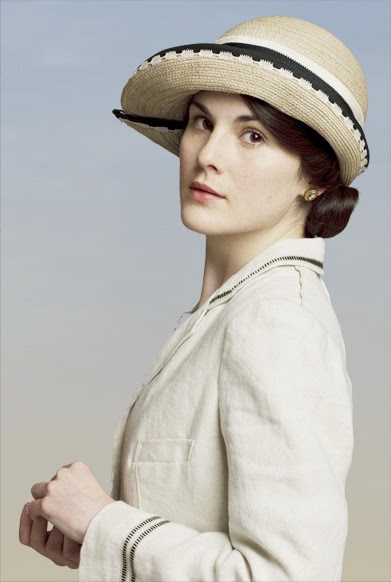
| Lady Mary |
The Crawley daughters are Mary (Michelle Dockery), the eldest, Edith (
Laura Carmichael), and Sybil (
Jessica Brown-Findlay). As the eldest and the heiress, should the entail be broken, Mary gets the bulk of screentime and character development in this episode. Dockery appeared in
Return to Cranford on Masterpiece last year, as Erminia, cousin of William, the series’ romantic lead. I'm afraid I took an almost instant dislike to Mary - from the moment her father breaks the news to her that her presumptive fiance is dead, her lack of feeling was almost chilling. But as the episode progresses, it becomes gradually clearer that Mary is much more than a "snooty" aristocrat - as a woman during this time she was privileged and blessed, certainly, but she was still a pawn to be bartered on the marriage market for the benefit of family and estate. The weight of bearing the burden that one's choices in the end are not entirely your own must be crushing, and Mary's public demeanor is clearly in part a defense mechanism designed to protect and keep her hopes in check. With the exception of Edith, whose frustration with the deference given to her older sister is abundantly clear, the character and motivations of the younger Crawley daughters remain to be revealed.
 |
| Violet, Dowager Countess |
The dowager countess, Violet, is played by the inimitable
Maggie Smith, and her character is an absolute delight. Violet would have been a fearsome woman to cross. She has a formidable will and a passionate devotion to Downton Abbey and the illustrious legacy she fears is in jeopardy following the
Titanic sinking. I found Smith's scenes opposite on-screen daughter-in-law McGovern to be absolutely priceless. When it comes to saving Downton, she's clear that her untitled daughter-in-law isn't her "friend," but an ally out of necessity. Violet has clear ideas about the way things should be done - it's basically her way or the highway, as the saying goes. When she first meets the new heir Matthew (Dan Stevens) and his mother (Penelope Wilton), their rather middle class sensibilities - especially Matthew's, since he's a lawyer - rock her carefully ordered world. That her beloved Downton should be inherited by a man who speaks of things like "jobs" and "weekends" is utterly insupportable! *wink* As always Maggie Smith's performance is a scene-stealer, and I look forward to Violet's future appearances in the balance of this series.
 |
| Matthew Crawley |
The new heir, Matthew, should be a familiar face to fans of Masterpiece Classic.
Dan Stevens's break-out role was as Edward Ferrars in the 2008 version of
Sense and Sensibility. Matthew is a character whose personality and values are in many respects completely alien to his aristocratic relations. He is determined to continue practicing law, and has little patience or understanding for the traditions that govern Downton Abbey. I think Dan Stevens is going to be the perfect actor to play Matthew with his fierce independent streak, determined
not to allow his new status as heir to change him. I think it will be interesting, though, to possibly see Matthew grow in understanding and empathy towards the Crawleys and the people who make serving that family their pride and livelihood. Resented as an interloper, Matthew's world is going to be rocked when Cora and Violet unite in their efforts to make the best of an untenable situation by determining that the best course of action for Downton's future is to secure a marriage between Matthew and Mary - and a more unlikely pair you're never likely to see.
 |
| Isobel Crawley |
Matthew's mother, Isobel, is played by the wonderful
Penelope Wilton. Wilton is another familiar face to fans of British drama. She's appeared in
Wives and Daughters, the 2005 version of
Pride and Prejudice, and
Doctor Who, to just name a few of the film credits in her illustrious career. The push-and-pull between Isobel, her son Matthew, and the Crawleys is fascinating to witness. The daughter and widow of doctors, she is highly intelligent and possesses a worldview that is perhaps best described as broader in scope than that of her female counterparts resident at the Abbey. She's also quite proud of Matthew, and while I think it's apparent he inherited his independent streak from her, she also knows how to play the game better than her son. A once in a lifetime opportunity has been set before him, and she would not see it squandered out of foolish pride. I look forward to seeing more social sparring between Isobel and Violet in future episodes.
Now, I'm going to do something I've never done with a Masterpiece production - I'm dividing my review of Part One of Downton Abbey in two. Not only is this post probably long enough (LOL), but intricacies and machinations that occur below stairs in Downton are every bit as worthy of their own post and examination as that of the servants' upper-class counterparts.
I realize we still have three weeks of
Downton Abbey episodes to look forward to on Masterpiece Classic, but I'm going to go ahead and go out on a limb here and state that at this pace,
Downton is likely to be my favorite Masterpiece production since
Bleak House. With the sprawl and scope of Dickens and the intimate understanding of social mores found in Austen,
Downton Abbey is an absolute jewel of television drama. And while I would be among the first to argue for the benefits of adapting classic novels to the screen, I
love the fact that
Downton Abbey is a original - there's no book to compare it to. Created and scripted by
Julian Fellowes (who may begin to rival Andrew Davies as my favorite screenwriter),
Downton delivers drama in spades. Fellowes is responsible for scripting several movies I love, including
The Young Victoria and most recently
The Tourist, as well as
Gosford Park (and with the benefit of hindsight, one must consider
Gosford a dry run for
Downton).
The costumes and sets for this miniseries are absolutely scrumptious! When watching
Downton, I couldn't help but liken the Crawleys to the Vanderbilts - and my desire to visit the Biltmore Estate again has grown tenfold. The direction and editing of this miniseries is superb, the cuts between the drama of the Crawleys and that of their servants seamlessly done. I also adored the score, supplied by
John Lunn. Lunn worked on
Little Dorrit and
Bleak House, so while the music here had a vaguely familiar "sound," it was completely and utterly captivating in its own right.
Look for my post on the servants of Downton Abbey soon! But in the meantime, please chime in with your thoughts on Part One and the Crawleys. There's little I like better than discussing British drama. :)




 Posts