Showing posts with label John Carter of Mars. Show all posts

Monday, August 20, 2012

100 years of John Carter...

Because apparently I will never get tired of talking about John Carter, here's a video produced for the Edgar Rice Burroughs Centennial Celebration this year that details John Carter's 100-year journey to the silver screen:

Wednesday, August 1, 2012

Femnista: Sci-Fi & Fantasy


Click to launch the full edition in a new window
Self Publishing with YUDU

The latest issue of Femnista is here and I could not be more thrilled! With a sci-fi & fantasy theme, this issue covers everything from Doctor Who to Merlin to The Avengers and everything in between! I wrote about a new passion of mine -- the John Carter film and the novel that inspired it, A Princess of Mars by Edgar Rice Burroughs! If my recent and extensive gushing on the subject of John Carter hasn't yet convinced you to give the books or film a try, perhaps this article will. :) Enjoy!

Friday, July 27, 2012

Review: The Warlord of Mars by Edgar Rice Burroughs


The Warlord of Mars (John Carter of Mars #3)
By: Edgar Rice Burroughs
Publisher: Fall River Press
ISBN:978-1-4351-3446-1

About the book:

For glory, power, and love...

In this thrilling adventure, John Carter risks everything to rescue his beloved wife, the Martian princess Dejah Thoris, from the seemingly impregnable Temple of the Sun, where she has been imprisoned by the evil false goddess Issus. Carter will not only brave extreme conditions and horrifying creatures, but he'll also wage bloody battles against Martian combatants long divided over theology, race, and politics. Can Carter overcome these incredible odds to become the mighty Warlord of Mars?

The Warlord of Mars is the third book in the classic best-selling John Carter of Mars science-fantasy series. Written during the heyday of the pulp fiction era, these epic, swashbuckling Red Planet tales of derring-do and dazzling romance permanently remapped the terrain of fantasy and science fiction.

Review:

Edgar Rice Burroughs concluded John Carter's first cycle of adventures on Mars -- sometimes referred to as the Martian Trilogy -- with the serialized publication of The Warlord of Mars in 1913-1914. At the conclusion of the previous installment, The Gods of Mars, the future of John Carter's beloved princess Dejah Thoris was in grave doubt. Having proven that the centuries-old Martian worship of Issus was falsehood perpetuated by power-hungry members of the Holy Therns and the First Born races, Carter set about destroying the religious infrastructure in order to free Barsoom from the false promises of the Issus-worshippers, where devotion is repaid with slavery and violent death. But Carter's quest to spread the truth is not without a price, as in repayment for his actions Carter's enemies lock the one he holds most dear in the vault at the center of the Temple of the Sun -- a room that can only be accessed once per Martian year. Seconds before the door closed, Carter saw Dejah Thoris nearly stabbed by Phaidor, the daughter of the head of the Therns and his avowed enemy since he spurned her romantic overtures. Living with the torment of not knowing whether his beloved wife is alive or dead, Carter has worked furiously to discover a way to free Dejah from her prison -- but his enemies will do anything to get to her first and claim her as their own. Fighting men who have nothing to lose, Carter chases news of Dejah across Barsoom, confronting countless new enemies, challenges, and even climates in his single-minded quest to save his imprisoned wife.

The Warlord of Mars is the slimmest of the first three volumes in Burroughs's John Carter of Mars series, but it is every bit as action-packed as its predecessors. Unlike the first two Carter novels, there is no prologue from Edgar Rice Burroughs, no preface to the following action from Carter to his "nephew" and guardian. The action opens a few months after Carter deposed the fake goddess Issus , with our hero deep in the throes of his search for a way to rescue the imprisoned Dejah and Thuvia, the latter a former Thern slave instrumental in aiding Carter when he returned to Mars in hostile territory at the beginning of the second novel. Whereas the previous novel saw Carter dealing essentially a death blow to the age-old Martian religion, exposing it as a cult, this follow-up adventure is largely concerned with the fall-out of that successful assault and sets up endless possibilities for future battle with the false religion's deposed leaders. Is there ever any question of Carter's ultimate success? No -- but that is part of the fun and magic of these books. Burroughs was a master craftig non-stop action sequences and building tension and suspense in his novels. Just when you think that surely Burroughs's imagination must be tapped out, he introduces new people, places, and customs to challenge Carter's seeming invincibility. Predictable? Sure, such is perhaps the nature of pulp fiction. But in the hands of a master like Burroughs, he proves that the journey is always a worthwhile and entertaining ride.

John Carter's third Martian adventure is just as fast-paced a rollicking adventure ride as its predecessors, and serves as a fitting capstone to the first "trilogy" within the overall series. When he was first introduced in A Princess of Mars, Carter was a man without a country or purpose, forced to make his way in a wholly alien world. In The Gods of Mars, Carter returns to Barsoom after an absence of ten years, and has to fight to reclaim the life he built with Dejah Thoris's people. The Warlord of Mars brings Carter full circle, forcing him to fight for the life he wants on his new home, culminating in a rather touching recognition of Carter's place and the esteem in which he's held by his adopted countrymen and friends. Having never explored pulp fiction of this ilk until recently, I remain thorougly impressed by Burroughs's work and in no little awe of his standing as a trailblazer in the science-fiction world. Barsoom is peopled with colorful peoples of wildly varied cultures, fascinating landscapes, and never-ending posibilities for adventure and death-defying escapades.

These novels are sheer fun from start to finish. I adore John Carter's completely over-the-top, unbelievable invincibility and his old-fashioned heroic charm. I love how much he adores Dejah Thoris -- it could be argued that he's the anti-James Bond, since Carter is just as ridiculously perfect and appealing to women, but he's very much a one-woman man, and his love story appeals to the old-fashioned romantic in me. :) Snappily plotted, well-written, imaginative, and endlessly adventurous, The Warlord of Mars confirms me as an avid John Carter fan, and happily there is no end in sight when it comes to exploring Burroughs's backlist. Barsoom and its people are a world I love getting lost in -- escapist entertainment of the highest order.

******

Continuing my look at classic John Carter covers, here's the Frank E. Schoonover cover for the 1919 hardback release -- isn't it a beauty?

Sunday, July 22, 2012

Review: The Gods of Mars by Edgar Rice Burroughs


The Gods of Mars (John Carter of Mars #2)
By: Edgar Rice Burroughs
Publisher: Fall River Press
ISBN: 978-1-4351-3445-4

About the book:

Battling against incredible odds...

At the thrilling conclusion of A Princess of Mars, Captain John Carter of Virginia was racing against time to bring vitalizing air back to the dying planet of mars and save its inhabitants, including his betrothed, the beautiful Dejah Thoris, Princess of Helium, only to be returned to Earth against his will. Now, ten years later, Carter is finally back on Mars, searching for the princess he'll do anything to reunite with. First, Carter must team up with his Martian ally Tars Tarkas to battle fearsome enemies, including the terrifying Plant Men and the deadly Pirates of Barsoom. Embroiled anew in death-defying battles and intrigue, Carter learns more about the ancient theological, racial, and political divisions that have kept Mars in a state of war for centuries. But will he survive long enough to find himself back in the arms of the divine Dejah?

The Gods of Mars is the second book in the classic best-selling John Carter of Mars science-fantasy series. Written during the heyday of the pulp fiction era, these epic, swashbuckling Red Planet tales of derring-do and dazzling romance permanently remapped the terrain of fantasy and science fiction.

Review:

At the conclusion of A Princess of Mars, Edgar Rice Burroughs's first chronicle of John Carter's Martian adventures, readers were left in the thrall of an irresistable cliffhanger. With the future of all life on Barsoom at stake, John Carter risked everything to help repair the planet's failing atmosphere plant -- and in doing so found himself unceremoniously sent back to Earth. With the future of his wife, Dejah Thoris, and their unborn child far from secure, Carter spends the next decade waiting and hoping for a way back to his new homeland to learn their fate. When Carter's fondest wish is finally granted and he is returned to Barsoom, his simple desire to be reunited with his lost love is easier sad than done. Upon his return to Mars, Carter finds himself in the Valley Dor, the final destination of the voluntary pilgrimage all Martians take down the River Iss, from which they can never return, in order to fulfill the tenets of their faith. But the renowned valley is anything but a peaceful spiritual haven. And Carter discovers that in order rejoin his family he must overcome centuries of belief and a false religious power determined to maintain its stranglehold on the Red Planet.

When Burroughs first introduced his vision of Mars to readers, the landscape and peoples Carter encountered were a fairly straightforward translation of the tenets of the American western placed within the parameters of a new frontier. There are the nomadic Tharks and the various tribes of warlike red men populating the desolate Martian landscape. But when Burroughs returned Carter to Mars for a second set of adventures (first serialized in 1913), he took the opportunity to gloriously expand on the world he'd created, introducing new landscapes and peoples for Carter to encounter. En route to the Martian "paradise" Carter battles fearsome Plant Men who are joined by an old foe -- the vicious white apes. Those creatures are controlled by the Holy Therns, the pasty-skinned, bald gatekeepers of Issus worship, a cult of cannibals drunk on power, willing to do anything to maintain their faithful following. And finally there are the fearsome Black Pirates of Barsoom, the self-proclaimed First Born tribe whose hidden seat of power Carter vows to destroy in order to free Mars from the power-mad perpetuation of a false faith.

I find Burroughs's treatment of organized religion particularly fascinating here. I did some cursory online reading and it doesn't seem as as though Burroughs was anti-faith. Rather, that he was highly concerned with the potential for exploitation of the faithful stemming from any organized religion. As such, Carter's single-minded assault on centuries of faith is extraordinarily thorough, and sets up nicely endless possibilities for conflict to come in subsequent volumes of the series. Carter as a fighting man is the epitome of straightforward action and belief, and as such is perhaps the embodiment of Burroughs's ideal argument in favor of the virtues of the "everyman."

Unfortunately much of the old-fashioned romance found within A Princess of Mars is distinctly one-sided here as Dejah is off-screen for most of the novel. But the charm of Carter's inherent nobility and chivalry are perhaps only magnified by Dejah's absence as thoughts of her are never far from his heart (seriously, he could make me swoon). Thuvia, a Martian prisoner Carter frees from the Therns is the principle female presence in this story. And while she falls in love with Carter (as expected), even though he doesn't give her a second look (could he be more perfect?), she is as honorable and moral as Dejah in the previous book and refreshingly capable of assisting in her escape from the Thern captors. Burroughs's women may be idealized, but he gives readers a bit more than "just" a fainting damsel in distress than one might expect from classic pulp fiction.

Much like its predecessor, The Gods of Mars is a rollicking, fast-paced, old-fashioned adventure novel that is every bit as fun and entertaining -- perhaps even morseo -- than Carter's first Martian outing. This book is a page-turner of the first order that has deepened my appreciation of Burroughs's work as a science fiction pioneer and made me even more of a John Carter fangirl. Filled with characters I've grown to love, this is a world that I adore getting lost in, leaving me eager to dive into the next installment.

******

I couldn't resist sharing some classic cover options once again. This gem is by Frank E. Schoonover and is from the 1918 hardcover edition of The Gods of Mars:


And this is a 1960s-era paperback cover (not sure about the artist?):

Monday, July 9, 2012

Review: A Princess of Mars by Edgar Rice Burroughs


A Princess of Mars (John Carter of Mars #1)
By: Edgar Rice Burroughs
Publisher: Fall River Press
ISBN: 978-1-4351-3448-5

About the book:

Marooned on a war-torn alien planet...

When Civil War veteran Captain John Carter is incredibly transported from Earth to a strange landscape on Mars, he finds that the weak gravity exponentially increases his speed and strength. Taken prisoner by Martian warriors, Carter impresses them with his remarkable fighting skills, and is quickly made a high-ranking chieftain. Before long, the captain finds himself embroiled in the deadly warfare and dark intrigues that have been polarizing the Martian races. The heroic Carter also finds dangerous romance with the divine princess Dejah Thoris, who wins Carter's love the first moment his eyes meet hers.

A Princess of Mars is the first book in the classic best-selling John Carter of Mars science-fantasy series. Written during the heyday of the pulp fiction era, these epic, swashbuckling Red Planet tales of derring-do and dazzling romance permanently remapped the terrain of fantasy and science fiction.

Review:

At the close of the Civil War, Confederate cavalryman John Carter found himself to be a man without a country -- and so he bid farewell to his native Virginia and headed west in search of gold. While attempting to save his prospecting partner from an Apache attack, Carter seeks refuge in a cave -- a cave with mystical properties as he soon finds himself transported to Mars, otherwise known as Barsoom. The variances in the Martian atmosphere gift Carter with a preternatural speed and strength. Carter's newly-discovered gifts allow him to survive among the Tharks, a nomadic, six-limbed tribe of fierce Martian warriors, winning him the hard-won respect of Tars Tarkas, one of the tribe's premiere chieftains. Carter gives little thought to his long-term future on Mars until the Tharks capture Dejah Thoris, the beloved Princess of Helium, one of the Red -- or humanoid -- Martians centers of power. In a life or death struggle to safeguard Dejah from the warlike Tharks and restore her to her people, Carter falls in love -- and in losing his heart finds a reason to fight for a future on this planet so different from his own.

I cannot remember the last time I indulged in the luxury of re-reading a book, so to read A Princess of Mars twice in four months? That's something special indeed. A Princess of Mars is my first experience with early 20th-century classic pulp fiction, and it has proven to be a memorable one indeed. Burroughs's first drafted John Carter's first adventure after a series of failed business ventures. The behind-the-scenes featurette on the recently released film, "100 Years in the Making," posits that John Carter was birthed out of an existential crisis in the author's life -- and taken as such it is fascinating to watch Carter's journey from outsider to Martian hero unfold. A Princess of Mars is in many respects the first space western, with the arid Martian climate standing in for the American west. If Mars is the western frontier, the various tribes of warlike Tharks are stereotyped Native Americans -- but what is fascinating is that Burroughs does not rest on stereotypical divisiveness. Carter moves from an attitude of superiority and frustration with his Thark captors to respect and admiration from their battle prowess and code of honor exhibited by warriors such as Tars Tarkas. This eventually helps birth an unprecedented alliance between the once sworn Green and Red Martian enemies, perhaps pointing to Burroughs' own belief in the inherent possibility of new beginnings symbolized by wild frontiers.

First published in 1912 in serial form, Princess is told wholly from John Carter's point-of-view. The first time I read the novel I was a bit put-off by the sheer amount of information "dumping," exacerbated by the fact that all of the action is related as Carter's reminiscences of his Martian adventures. For a good part of his time on Mars Carter is observing and learning, concealing the fact that he's learning the language and customs of the Tharks. This narrative style made the first third or so of the novel a bit of a slow-go on my first read-through -- but on my second, knowing what to expect, I couldn't put the book down. I relished Burroughs's imaginative world-building and richly-drawn characters. This is an intelligent adventure, articulately-told, with a cracking pace and a finely-honed sense of adventure and heart.

While the non-stop action and breath-taking fight sequences make this a page-turning read, by far my favorite aspect of the novel is romance -- perhaps something I relish all the more because, in a novel of this ilk, a romance this passionate seems unexpected. I'm a complete and total sucker for an old-fashioned romance, and Carter's character possesses an inherent nobility and chivalry that I just adored. And while Dejah isn't quite the warrior the film version introduces (at least not yet), her nobility, self-sacrificing spirit, and intelligence mark her as a ground-breaking character -- every inch the lady, strong-willed, and willing to fight for what she believes. I loved the way Burroughs's develops their relationship. He seems to relish in their cross-cultural misunderstandings, but doesn't shy away from ages-old male/female archetypal behavior that lends their budding romance humor and spark.

Princess is an old-fashioned adventure novel that becomes an increasing page-turner the more Burroughs lets us see Carter adapt to his new environment, gradually opening himself up to friendships and relationships with people whose appearance and customs are so different from his own at first blush. John Carter's first adventure on Mars is the rare type of novel that improves when revisited, giving me a deeper appreciation for Burroughs's work as a pioneer in the realm of science fiction and fantasy. A Princess of Mars is a ground-breaking, thoroughly entertaining adventure that holds up to this day -- a sterling example of Burroughs's imaginative prowess, a classic from the pen of a pulp fiction master. I adore this book. Bring on the sequels!

******

The cover of this edition of A Princess of Mars was painted by Kekai Kotaki, and while I love it I have to share the cover to the 1917 hardback edition by Frank E. Schoonover:


I love it. Here's another cover option, this time from the 1963 edition, by Bob Abbett:


Love it too. :)

Tuesday, April 17, 2012

Review: John Carter: The Movie Novelization by Stuart Moore


John Carter: The Movie Novelization (Also includes A Princess of Mars)
By: Stuart Moore, Edgar Rice Burroughs
Publisher: Disney Editions
ISBN: 978-1423165583

About the book:

This adaptation will not only give readers an amazing novelization of the upcoming John Carter film, but also the original text of A Princess of Mars, by Edgar Rice Burroughs. A Princess of Mars was the first book to feature John Carter, led to an eleven-book series featuring his adventures, and was also the basis for the 2012 movie!

The movie John Carter tells the story of a war-weary former military captain during the Civil War, who is inexplicably transported to Mars. He quickly (and reluctantly) becomes embroiled in a conflict of epic proportions amongst the inhabitants of the planet. The adaptation, written by Stuart Moore, wonderfully brings the movie's otherworldly action and adventure to the page, while keeping the themes of family, planetary survival, and loyalty at heart.

Review:

Although unfamiliar with Edgar Rice Burroughs' John Carter adventures, I thoroughly enjoyed the recent film -- so much so that I wanted to seek out the source material on which it was based. Many, if not all, of Burroughs' Carter novels are in the public domain (and as such are available as free or bargain-priced e-books), but I opted to purchase this novelization of the film for two reasons. One, I am a sucker for a decent script novelization, particularly if it expands on the movie's action to some degree (the novelizations of the original Star Wars films are extremely effective in this respect), and two, this novelization is packaged with A Princess of Mars, the original and first novel to feature John Carter's adventures on Mars, and the story on which the film is principally based.

The movie novelization is written by Stuart Moore, and as written realization of the film it falls a bit short. Let me put it this way -- if I'd read the novelization first there's a good chance I would've opted not to see John Carter on the big screen, and that would've been a crying shame. Moore's novelization is a decent adaptation of the script, but it fails to flesh out the fascinating world the film introduced me to. I wanted more of Carter's backstory, more insight into the development of his romance with Dejah Thoris, more insight into his efforts to adapt to the brave new and dangerous world he finds himself unexpectedly thrust into when he encounters the Thern being in the Arizona cave. Moore's prose is relatively flat, and given the imaginative canvas Burroughs created that's a shame. But having seen the film first, the novelization does a decent job translating the storyline from screen to the page -- I would simply encourage anyone who picks it up to not stop there when investigating the written origins of Carter's Mars adventures.

Reading A Princess of Mars was a first for me -- I have no experience reading early 20th-century classic pulp fiction, so stylistically I had no idea what to expect. I was of course familiar with Burroughs as the creator of Tarzan, and that character principally through its silver screen adaptations from the 1930s and 40s. First published in 1912 in serial form, Princess is told wholly from John Carter's point-of-view. This means there is a lot -- and I mean A LOT -- of information "dumping," exacerbated by the fact that all of the action is related as Carter's reminiscences, and for a good part of his time on Mars he's observing and learning, concealing the fact that he's learning the Martian language. This narrative style made the first third or so of Princess a bit of a slow go --  but with the images from the film firmly ingrained in my imagination, I was nonetheless eager to learn Carter's origin story as originally envisioned by his creator.

Roughly halfway through Burroughs' first Barsoom (Mars) novel, the action begins to pick up the pace, and what the movie novelization lacked in developing the Carter/Dejah relationship, Burroughs made up for in this novel. While the original Dejah isn't quite the warrior (at least not yet) that we see in the movie, her nobility and sacrificing spirit translated from Burroughs' text to the screen relatively intact. And I'm a complete sucker for an old-fashioned romance, and Carter's character has an inherent nobility that I just adored. Princess is an old-fashioned adventure novel that becomes an increasing page-turner the more Burroughs lets us see Carter adapt to his new environment, gradually opening himself up to friendships and relationships with people whose appearance and customs are so different from his own at first blush. Surprisingly, since it seems so out of my reading norm, I'm more interested than I ever expected in investigating Burroughs' subsequent John Carter novels. Happily the film (though not the novelization exactly) is a decent and fairly faithful adaptation of its ground-breaking source material -- I'm happy to have finally discovered this classic from the pen of a pulp fiction master.

Monday, March 26, 2012

John Carter


Yesterday afternoon I went to see John Carter. I'm a sucker for big sci-fi epics, and was quite curious as to what this film was about, exactly, because I thought Disney did such a crap job marketing it. Seriously, the studio trailers told you nothing of substance which is a real shame because not only was the movie pretty good, but apparently this property is arguably the grandfather of modern science fiction (the Edgar Rice Burroughs series of Mars novels first appeared in 1912) -- and I can't be the only massive Star Wars fan that had never heard of this, right? The shoddy marketing campaign for this film -- inexplicably refusing to capitalize on the story's place in the canon of classic science fiction -- makes absolutely no sense. And I have to think that is where a large portion, if not most, of the blame lies for the movie's poor performance at the box office. Because John Carter was a pretty entertaining flick, which surprised me after the ho-hum promotional push.

All of that said, I'm not going to be able to resist making this review a little tongue-in-cheek, as I found some of the spectacle rather humorous. But I don't view that as a detraction -- it reinforced by overal favorable impression of the film as being fun...because after all I don't watch as many films as I do to think (all of the time, anyways, ha!).


As the movie opens it introduces us to a Mars that is apparently a wasteland, with only two proper cities on the entire planet. The first is led by some guy named Sab Than who looks remarkably like Dominic West (ha!), which led to my first "what the heck is doing in this movie?!" moment. Now for some inexplicable reason West has always rather creeped me out, which served him well in this role as Sab Than is CRAZY and power-mad. So Sab Than is picked to possess the magic blue electric energy weapon (seriously I have no clue what it was called) by the lead bald guy in a fluffy silver-blue robe called Matai Shang (Mark Strong). And this is the point where I start to bemoan Strong's career choices yet again, since this is a new version of the same villain he's played in at least seven films since 2007. Mark, you ARE BETTER THAN THIS! *sigh* Apparently Matai's character is something called a "Thern," which is some sort of legendary group that likes to go around facilitating the destruction of worlds (boo on them!).

So there you have the Mars (I just can't call Mars "Barsoom," sorry Burroughs) set-up, now cut to America where we meet John Carter (Taylor Kitsch), who is being followed by vacant-eyed men in suits and then ends up DEAD (or DOES HE??) after summoning his favorite nephew, Edgar Burroughs (Daryl Sabara, Spy Kids!), who turns out to be his heir. Edgar or Ned, as his uncle likes to call him, is given John's SUPER SECRET DIARY and this is where things start to get interesting. Carter was a Civil War veteran, very much a man without a country or cause because DANG IT, he's been burned by the world and his wife & kid are dead and WHY SHOULD HE CARE ABOUT PEOPLE ANYMORE?! (Side note: the Ned scenes in New York have something of a steam punk vibe to them after seeing the Martian technology...nice contrast.) Anyways, to make a long story short, John ends up in a cave full of gold which turns out to be some sort of alien way-station, because he kills one of those Thern peeps and then accidentally uses the pretty medallion the bald guy was carrying to transport himself to Mars.


Now I'm going to cut John a little bit of slack here, because when he is transported to Mars (only it takes him quite a while to realize he's on another friggin' PLANET...the four-armed green people weren't a big enough clue), he acquires the awesome super power of being able to LEAP TALL BUILDINGS IN A SINGLE BOUND. Wait...there are only two cities...scratch the tall buildings part. *wink* (In 1912 fantastic leaping may have been cutting edge, who am I to judge?) So he hooks up with Tharks (the aforementioned four-armed green aliens), whose king Tars Tarkas (voiced by Willem Defoe) takes a liking to him, sort of as in the vein of a royal pet (that doesn't go over well). Now there is all sorts of clan in-fighting as Tars is faced with insurrection, and that's on top of family issues as his unacknowledged daughter Sola (voiced by Samantha Morton) is a clan outcast for holding radical views like NICENESS.

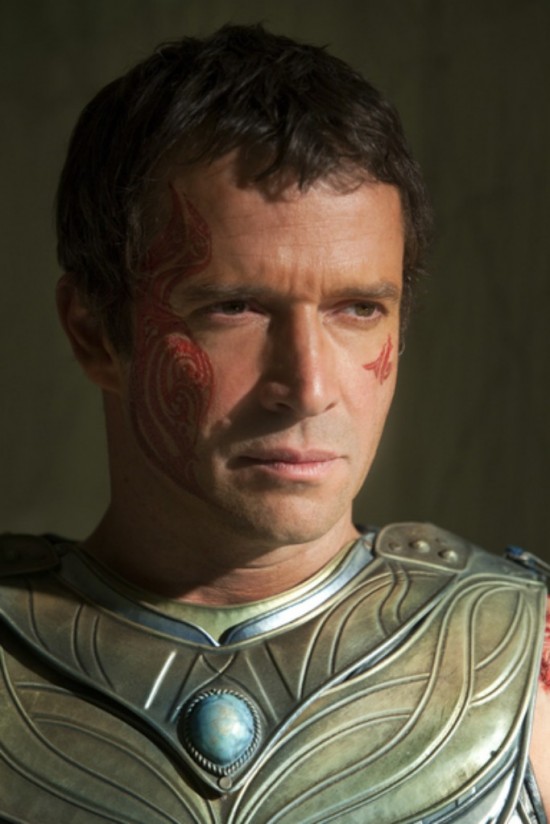
So John jumps around a lot, makes friends with with the giant bobble-headed dog-like creature (who is hilarious, and surprisingly useful), and then he meets Dejah (Lynn Collins), the warrior/professor-type princess of Helium, the "other" city that has been trying to holdout against Sab-Dominic-West-Than, and SPARKS FLY! But before I can talk about SPARKS, I should probably mention that Dejah's father Tardos Mor (Ciaran Hinds -- really! it's hilarious!) wants to marry her off to Sabs, because he is dopey enough to buy into the idea that an arranged marriage will buy lasting peace. Tardos is followed around by Kantos Kan, who is none other than James Purefoy! My reaction: 1) James what the HECK are you doing in this movie? 2) Why isn't this movie ABOUT you? 3) Thank goodness he gets one scene where he can be adorably snarky as ONLY PUREFOY CAN.

Look! It's a Purefoy!
Back to SPARKS. I really liked Kitsch and Collins on-screen. Kitsch was an interesting factor...there's something about him that holds me back from being completely over-the-moon for him, but his voice -- gah!!! There are moments when it takes on this wonderful gravelly quality and I MELTED. And I liked this touch of gentleman-like charm Kitsch actually manages to convey occasionally...helped keep Carter somewhat grounded as a 19th-century hero. He even goes for the angst factor, which comes up during his transformation into a Martian hero, and while it isn't the best on-screen angst I've seen it certainly isn't the worst. One has to give Kitsh credit, he really seemed to throw himself whole-heartedly into this project. As for Dejah -- while I can't speak to how Collins's interpretation compares to the source material, she is very much in the vein of Princess Leia -- smart, sassy, and capable (and occasionally sporting a completely ridiculous wardrobe!).

Dejah is of course the impetus for Carter to START CARING ABOUT PEOPLE AGAIN...I mean MARTIANS...and DO something with his life, all in the best heroic journey/science fiction/adventure story tradition. I really liked the world-building here -- Mars is appropriately bleak and desolate, with pops of color in its cities and the inhabitants' clothing. I even rather liked the green Thark aliens. :) The costumes were this interesting hybrid of minimalist futuristic and ancient Roman soldier garb, which was rather interesting because because it was unexpected (Purefoy as an alien/Roman soldier? Yes, I'll take it.). Two of the three writers have Pixar work in their history, which perhaps explains the well-paced action and the overall feeling of energy that pervades the film. Yes, it has its cheesy moments, but at least it has fun with them. :) And I loved Michael Giacchino's score -- big, sweeping, at times romantic -- it was grand.


John Carter clocks in at a little over two hours, but director Andrew Stanton keeps the action moving at a brisk pace so there were no apparent lags in the forward momentum, for me at any rate. Knowing next to nothing about the specifics of the storyline, I was pleasantly surprised and entertained. It is unfortunate that those with no knowledge of the film's antecedents are probably going to feel like it is derivative (no thanks to the WORTHLESS MARKETING), but just knowing that this series of stories inspired countless writers and films made me appreciate Burroughs's influence in a way I'd never bothered to think of before. And the end of the film was absolute PERFECTION for a romantic sap like me. :) SPOILERS: Knowing that Carter spent over ten years desperately search for a way to return to Mars and his ONE TRUE LOVE just killed me. Kitsch sold me on Carter's single-minded quest. Gotta love a man who doesn't let a little thing like love separated by time and space hold him bac. *wink* All told, a lot more fun than I ever expected. :)